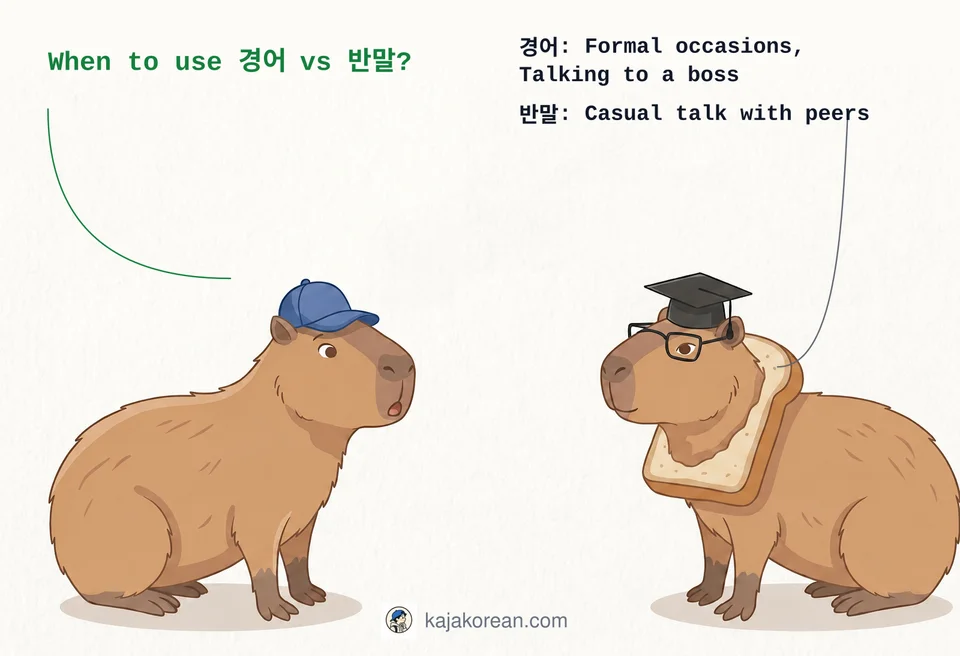
경어 vs 반말: The Boundary Between Respect and Familiarity

경어 (gyeong-eo, gyeongeo) · 반말 (ban-mal, banmal)

경어 is formal language expressing respect, while 반말 is informal language used for close or younger people.

Comparison between Korean honorific speech (경어) and informal speech (반말)

Word-by-word breakdown

One lane per word — no nested boxes, just the gist.

경어(gyeong-eo, gyeongeo)

Formal and polite speech expressing respect or courtesy toward the listener

When to use

Talking to a boss, Meeting someone for the first time, Formal occasions, Speaking to older people

The nuance

Use 경어 with people older than you, higher status, strangers, or in formal situations.

반말(ban-mal, banmal)

Informal and casual speech used with close friends or people younger or same age

When to use

Talking with close friends, Casual talk with peers, Casual family conversation, Speaking to younger people

The nuance

Use 반말 with close friends, peers, or younger people in casual settings. Avoid in respectful or formal contexts.

Real-world examples

  • 선생님, 안녕하세요. 오늘 수업 준비하셨나요?

    seon-saeng-nim, an-nyeong-ha-se-yo. o-neul su-eop jun-bi-ha-syeoss-na-yo?, seon saeng nim, an nyeong ha se yo. o neul su eop jun bi ha syeoss na yo?

    Correct use of 경어 to show respect to a teacher.

  • 선생님, 안녕. 오늘 수업 준비했어?

    seon-saeng-nim, an-nyeong. o-neul su-eop jun-bi-haess-eo?, seon saeng nim, an nyeong. o neul su eop jun bi haess eo?

    Using 반말 with a teacher is rude; 경어 should be used.

  • 친구야, 오늘 같이 영화 보러 갈래?

    chin-gu-ya, o-neul gat-i yeong-hwa bo-reo gal-rae?, chin gu ya, o neul gat i yeong hwa bo reo gal rae?

    Natural use of 반말 for close friends.

  • 친구야, 오늘 같이 영화 보러 갈까요?

    chin-gu-ya, o-neul gat-i yeong-hwa bo-reo gal-kka-yo?, chin gu ya, o neul gat i yeong hwa bo reo gal kka yo?

    Using 경어 with a close friend sounds overly formal and awkward.

  • 할머니, 안녕하세요. 건강하세요?

    hal-meo-ni, an-nyeong-ha-se-yo. geon-gang-ha-se-yo?, hal meo ni, an nyeong ha se yo. geon gang ha se yo?

    Correct use of 경어 to show respect to an elderly person.

  • 할머니, 안녕. 건강해?

    hal-meo-ni, an-nyeong. geon-gang-hae?, hal meo ni, an nyeong. geon gang hae?

    Using 반말 with an elderly person is disrespectful.

  • 동생아, 숙제 했어?

    dong-saeng-a, suk-je haess-eo?, dong saeng a, suk je haess eo?

    Natural use of 반말 with a younger sibling.

  • 동생아, 숙제 하셨나요?

    dong-saeng-a, suk-je ha-syeoss-na-yo?, dong saeng a, suk je ha syeoss na yo?

    Using 경어 with a younger sibling sounds unnatural.

Quick quiz

  1. Which speech style should you use when talking to your boss?

    상사와 대화할 때 어떤 말을 써야 하나요?(sang-sa-wadae-hwa-halttaeeo-tteonmal-eulsseo-yaha-na-yo?, sangsawadaehwahalttaeeotteonmaleulsseoyahanayo?)
  2. How do you naturally speak to a close friend?

    친한 친구에게 어떻게 말하는 것이 자연스러운가요?(chin-hanchin-gu-e-geeo-tteoh-gemal-ha-neungeos-ija-yeon-seu-reo-un-ga-yo?, chinhanchinguegeeotteohgemalhaneungeosijayeonseureoungayo?)
  3. What is the appropriate speech style for someone you meet for the first time?

    처음 만난 사람에게 적절한 말투는?(cheo-eumman-nansa-ram-e-gejeok-jeol-hanmal-tu-neun?, cheoeummannansaramegejeokjeolhanmaltuneun?)
  4. Which speech style is appropriate when speaking to a younger sibling?

    나이가 어린 동생에게 말할 때 어떤 말투가 적절한가요?(na-i-gaeo-rindong-saeng-e-gemal-halttaeeo-tteonmal-tu-gajeok-jeol-han-ga-yo?, naigaeorindongsaengegemalhalttaeeotteonmaltugajeokjeolhangayo?)

More comparisons to explore

View all word comparisons →