존댓말 vs 높임말 vs 경어: When to Use Each?

존댓말 (jon-daes-mal, jondaesmal) · 높임말 (nop-im-mal, nopimmal) · 경어 (gyeong-eo, gyeongeo)

존댓말, 높임말, and 경어 all involve respectful language, but 존댓말 refers to polite speech style, 높임말 to honorific vocabulary, and 경어 to the entire system of honorifics.

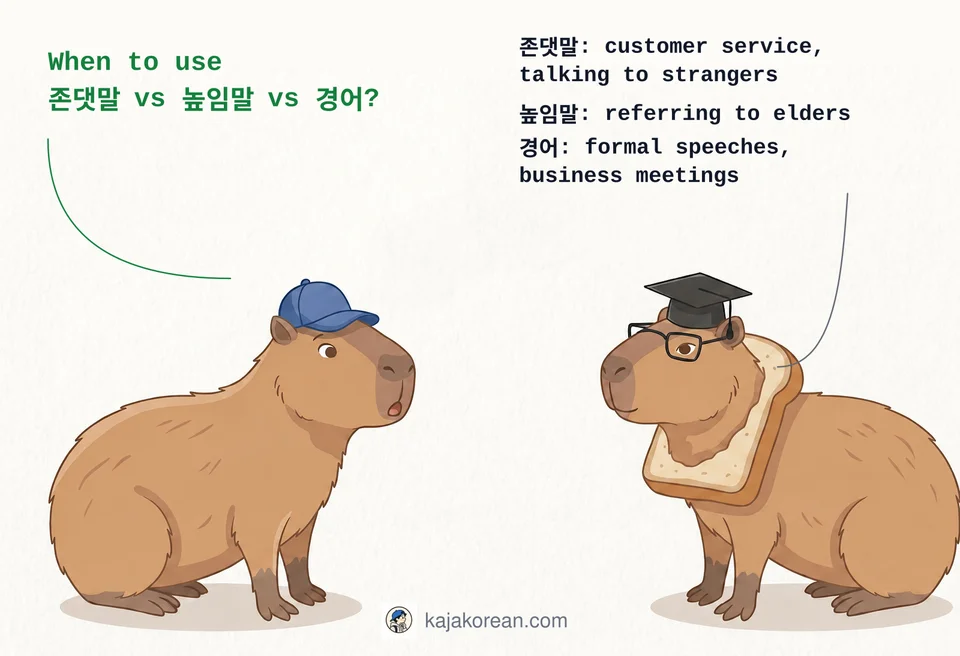
Comparison of Korean 존댓말, 높임말, and 경어 honorific language

Word-by-word breakdown

One lane per word — no nested boxes, just the gist.

존댓말(jon-daes-mal, jondaesmal)

A polite speech style used to show respect to the listener.

When to use

everyday conversation, customer service, talking to strangers

The nuance

A polite speech style with respectful sentence endings, mainly used directly toward the listener.

높임말(nop-im-mal, nopimmal)

Honorific vocabulary or expressions that elevate the subject or object.

When to use

referring to elders, mentioning listener's family, talking about superiors at work

The nuance

Using honorific suffixes or special vocabulary to elevate the subject or object.

경어(gyeong-eo, gyeongeo)

The entire system of honorific language, including 존댓말 and 높임말.

When to use

official documents, business meetings, formal speeches

The nuance

Includes all rules and expressions that show respect to the listener and third parties, covering both 존댓말 and 높임말.

Real-world examples

  • 할아버지께 존댓말을 써야 해요.

    hal-a-beo-ji-kke jon-daes-mal-eul sseo-ya hae-yo., hal a beo ji kke jon daes mal eul sseo ya hae yo.

    존댓말 is a polite speech style used toward the listener, so it is correct to use it with grandfather.

  • 할아버지께 높임말을 써야 해요.

    hal-a-beo-ji-kke nop-im-mal-eul sseo-ya hae-yo., hal a beo ji kke nop im mal eul sseo ya hae yo.

    높임말 elevates the subject or object through vocabulary, so it is correct to use it for grandfather.

  • 할아버지께 경어를 써야 해요.

    hal-a-beo-ji-kke gyeong-eo-reul sseo-ya hae-yo., hal a beo ji kke gyeong eo reul sseo ya hae yo.

    경어 includes both 존댓말 and 높임말, so using 경어 with grandfather is correct.

  • 친구에게 존댓말을 써야 해요.

    chin-gu-e-ge jon-daes-mal-eul sseo-ya hae-yo., chin gu e ge jon daes mal eul sseo ya hae yo.

    Typically, 반말 is used with friends, so 존댓말 is not required.

  • 친구에게 높임말을 써야 해요.

    chin-gu-e-ge nop-im-mal-eul sseo-ya hae-yo., chin gu e ge nop im mal eul sseo ya hae yo.

    높임말 is used for elders or superiors, so it is inappropriate for friends.

  • 친구에게 경어를 써야 해요.

    chin-gu-e-ge gyeong-eo-reul sseo-ya hae-yo., chin gu e ge gyeong eo reul sseo ya hae yo.

    경어 is for polite and formal contexts, not usually used among friends.

  • 직장 상사에게 존댓말을 사용해야 합니다.

    jik-jang sang-sa-e-ge jon-daes-mal-eul sa-yong-hae-ya hap-ni-da., jik jang sang sa e ge jon daes mal eul sa yong hae ya hap ni da.

    You should use 존댓말, a polite speech style, with your boss.

  • 직장 상사에게 높임말을 사용해야 합니다.

    jik-jang sang-sa-e-ge nop-im-mal-eul sa-yong-hae-ya hap-ni-da., jik jang sang sa e ge nop im mal eul sa yong hae ya hap ni da.

    You should use 높임말 vocabulary to show respect to your boss.

Quick quiz

  1. What do you mainly use when talking with friends?

    친구와 대화할 때 주로 사용하는 것은?(chin-gu-wadae-hwa-halttaeju-rosa-yong-ha-neungeos-eun?, chinguwadaehwahalttaejurosayonghaneungeoseun?)
  2. What do you mainly use to respectfully speak about elders?

    어른을 높여 말할 때 주로 사용하는 것은?(eo-reun-eulnop-yeomal-halttaeju-rosa-yong-ha-neungeos-eun?, eoreuneulnopyeomalhalttaejurosayonghaneungeoseun?)
  3. Which term includes both 존댓말 and 높임말?

    존댓말과 높임말을 모두 포함하는 말은?(jon-daes-mal-gwanop-im-mal-eulmo-dupo-ham-ha-neunmal-eun?, jondaesmalgwanopimmaleulmodupohamhaneunmaleun?)

More comparisons to explore

View all word comparisons →