
주격(ju-gyeok, jugyeok)
Case particle indicating the subject in a sentence
When to use
subject marking, subject emphasis, verb agent role
The nuance
주격 marks the subject, usually with '이/가', indicating the doer or topic of the action.
주격 (ju-gyeok, jugyeok) · 목적격 (mok-jeok-gyeok, mokjeokgyeok) · 보격 (bo-gyeok, bogyeok)
주격, 목적격, and 보격 each mark the subject, object, and complement roles in a sentence, and must be distinguished accurately based on sentence structure and meaning.
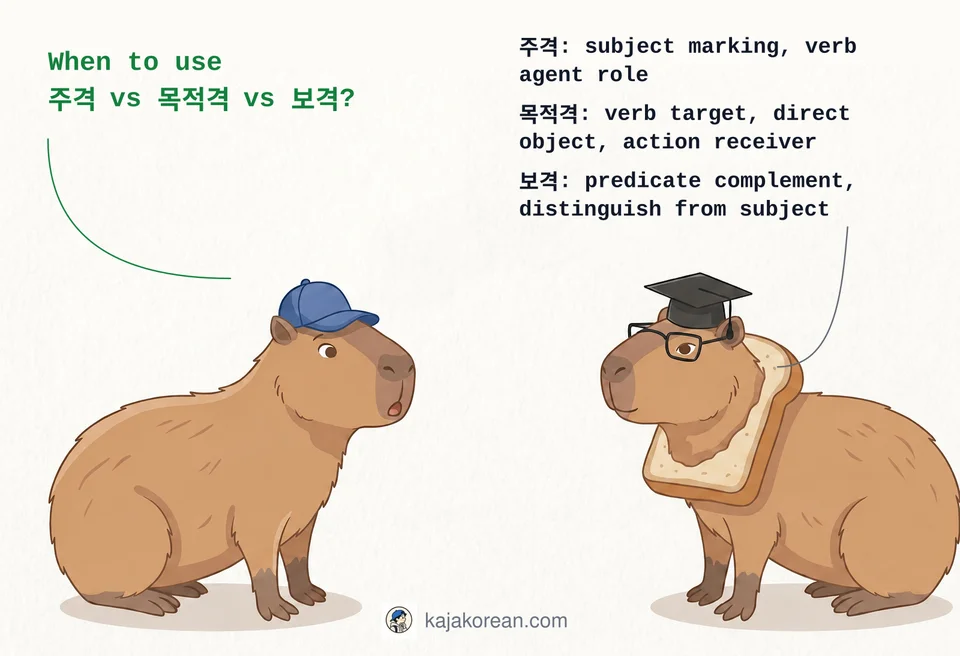
One lane per word — no nested boxes, just the gist.
Case particle indicating the subject in a sentence
When to use
subject marking, subject emphasis, verb agent role
The nuance
주격 marks the subject, usually with '이/가', indicating the doer or topic of the action.
Case particle indicating the direct object in a sentence
When to use
direct object, verb target, action receiver
The nuance
목적격 marks the direct object, usually with '을/를', indicating the receiver of the action.
Case particle indicating the complement of the predicate
When to use
predicate complement, subject state description, distinguish from subject
The nuance
보격 connects the subject and predicate, usually with '이/가', indicating the subject's state or identity as a complement.
철수가 사과를 먹는다.
cheol-su-ga sa-gwa-reul meok-neun-da., cheol su ga sa gwa reul meok neun da.
'철수' is the subject, so the subject marker '가' is appropriate.
철수를 사과가 먹는다.
cheol-su-reul sa-gwa-ga meok-neun-da., cheol su reul sa gwa ga meok neun da.
'철수' is the subject but marked with object particle '를', which is incorrect.
철수가 사과를 먹는다.
cheol-su-ga sa-gwa-reul meok-neun-da., cheol su ga sa gwa reul meok neun da.
'사과' is the direct object of the verb, so the object marker '를' is correct.
철수가 사과가 먹는다.
cheol-su-ga sa-gwa-ga meok-neun-da., cheol su ga sa gwa ga meok neun da.
'사과' is the object but marked with subject particle '가', which is wrong.
철수가 선생님이다.
cheol-su-ga seon-saeng-nim-i-da., cheol su ga seon saeng nim i da.
'선생님' is the complement, linking to subject '철수' with complement particle '이' appropriately.
철수가 선생님을이다.
cheol-su-ga seon-saeng-nim-eul-i-da., cheol su ga seon saeng nim eul i da.
Using object particle '을' with a complement is incorrect.
나는 학생이다.
na-neun hak-saeng-i-da., na neun hak saeng i da.
'학생' is the complement, connected to subject '나' with complement marker '이다'.
나는 학생을이다.
na-neun hak-saeng-eul-i-da., na neun hak saeng eul i da.
Attaching object particle '을' to a complement is incorrect.
Which particle is used to mark the subject?
Which particle marks the direct object of a verb?
Which particle functions as the predicate complement?