
려고(ryeo-go, ryeogo)
Expresses intention or purpose to do something
When to use
future intention, expressing purpose, formal contexts
The nuance
Attach to verb stem to indicate future intention or purpose; mainly used in written or formal contexts.
려고 (ryeo-go, ryeogo) · 러 (reo) · 고 싶어서 (gosip-eo-seo, gosipeoseo)
려고, 러, and 고 싶어서 all express intention or reason, but differ in usage and grammatical connection.
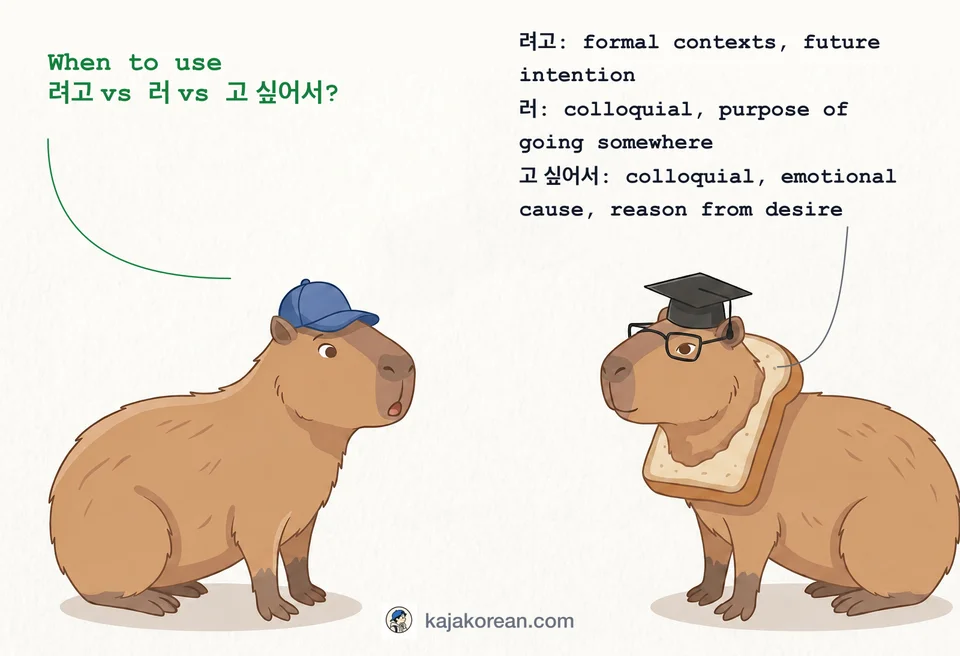
One lane per word — no nested boxes, just the gist.
Expresses intention or purpose to do something
When to use
future intention, expressing purpose, formal contexts
The nuance
Attach to verb stem to indicate future intention or purpose; mainly used in written or formal contexts.
Indicates going somewhere with the purpose to perform an action
When to use
purpose of going somewhere, combined with movement verbs, colloquial
The nuance
Attach to verb stem to indicate purpose of going/coming somewhere; used with movement verbs like ‘가다’, ‘오다’.
Expresses reason based on desire or wish to do something
When to use
reason from desire, emotional cause, colloquial
The nuance
Attach to verb stem with ‘-고 싶다’ plus ‘-어서/아서’ to express reason based on desire; used when emotion or wish is cause.
시험 공부하려고 도서관에 갔어요.
si-heom gong-bu-ha-ryeo-go do-seo-gwan-e gass-eo-yo., si heom gong bu ha ryeo go do seo gwan e gass eo yo.
‘려고’ properly expresses future intention or purpose.
시험 공부러 도서관에 갔어요.
si-heom gong-bu-reo do-seo-gwan-e gass-eo-yo., si heom gong bu reo do seo gwan e gass eo yo.
‘러’ must follow verb stem and be used with movement verbs; ‘공부러’ is incorrect, correct form is ‘공부하러’.
친구를 만나고 싶어서 전화를 했어요.
chin-gu-reul man-na-go sip-eo-seo jeon-hwa-reul haess-eo-yo., chin gu reul man na go sip eo seo jeon hwa reul haess eo yo.
‘고 싶어서’ correctly expresses reason based on desire.
친구를 만나려고 전화를 했어요.
chin-gu-reul man-na-ryeo-go jeon-hwa-reul haess-eo-yo., chin gu reul man na ryeo go jeon hwa reul haess eo yo.
‘려고’ properly indicates intention or purpose.
영화를 보러 집에 갔어요.
yeong-hwa-reul bo-reo jip-e gass-eo-yo., yeong hwa reul bo reo jip e gass eo yo.
‘러’ correctly indicates purpose of going somewhere.
영화를 보려고 집에 갔어요.
yeong-hwa-reul bo-ryeo-go jip-e gass-eo-yo., yeong hwa reul bo ryeo go jip e gass eo yo.
‘려고’ expresses purpose but does not imply movement.
영화를 보고 싶어서 집에 갔어요.
yeong-hwa-reul bo-go sip-eo-seo jip-e gass-eo-yo., yeong hwa reul bo go sip eo seo jip e gass eo yo.
‘고 싶어서’ expresses reason based on desire.
영화를 보고 싶으려고 집에 갔어요.
yeong-hwa-reul bo-go sip-eu-ryeo-go jip-e gass-eo-yo., yeong hwa reul bo go sip eu ryeo go jip e gass eo yo.
‘고 싶으려고’ is ungrammatical; correct form is ‘고 싶어서’.
Which expression is appropriate to indicate purpose of going somewhere?
What kind of reason does ‘~고 싶어서’ mainly express?
Which expression is best for expressing future intention or purpose?