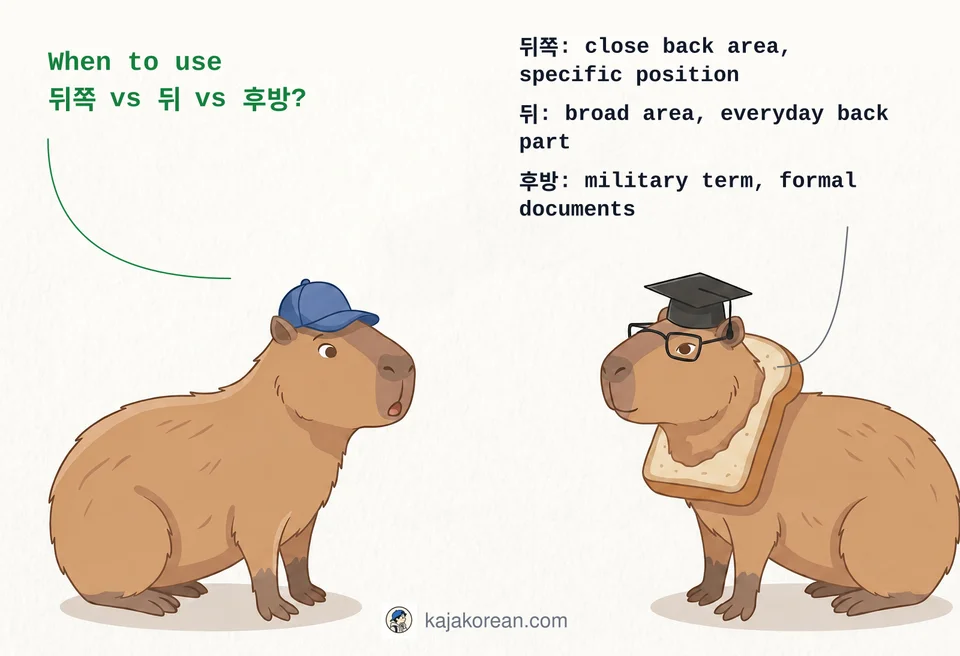
Refers to a specific and relatively close back part of an object or place.
When to use
close back area, specific position, everyday conversation
The nuance
Use 뒤쪽 to indicate a specific, relatively close position in everyday conversation.
뒤쪽 (dwi-jjok, dwijjok) · 뒤 (dwi) · 후방 (hu-bang, hubang)
뒤쪽 refers to a specific, relatively close position; 뒤 is a general, everyday term for the back area; 후방 is a formal or military term for a distant rear area.

One lane per word — no nested boxes, just the gist.
Refers to a specific and relatively close back part of an object or place.
When to use
close back area, specific position, everyday conversation
The nuance
Use 뒤쪽 to indicate a specific, relatively close position in everyday conversation.
The most basic and broad term for 'back,' meaning the entire rear part of something.
When to use
everyday back part, broad area, non-specific position
The nuance
뒤 is used for general, everyday references to the back part, without needing specificity.
Used in military, security, or formal contexts to mean a distant rear area or rear zone.
When to use
military term, formal documents, distant rear area
The nuance
Use 후방 in formal or professional contexts, especially military, to indicate a distant rear area.
학교 건물 뒤쪽에 놀이터가 있어요.
hak-gyo geon-mul dwi-jjok-e nol-i-teo-ga iss-eo-yo., hak gyo geon mul dwi jjok e nol i teo ga iss eo yo.
뒤쪽 correctly indicates a specific, close back area.
학교 건물 뒤에 놀이터가 있어요.
hak-gyo geon-mul dwi-e nol-i-teo-ga iss-eo-yo., hak gyo geon mul dwi e nol i teo ga iss eo yo.
뒤 appropriately refers to a general back area.
학교 건물 후방에 놀이터가 있어요.
hak-gyo geon-mul hu-bang-e nol-i-teo-ga iss-eo-yo., hak gyo geon mul hu bang e nol i teo ga iss eo yo.
후방 is inappropriate for everyday places as it implies a distant, formal rear area.
자동차 뒤쪽에 자전거를 놓았어요.
ja-dong-cha dwi-jjok-e ja-jeon-geo-reul noh-ass-eo-yo., ja dong cha dwi jjok e ja jeon geo reul noh ass eo yo.
뒤쪽 fits when specifying a close back part of a car.
자동차 뒤에 자전거를 놓았어요.
ja-dong-cha dwi-e ja-jeon-geo-reul noh-ass-eo-yo., ja dong cha dwi e ja jeon geo reul noh ass eo yo.
뒤 is suitable for a broad reference to the car's back.
자동차 후방에 자전거를 놓았어요.
ja-dong-cha hu-bang-e ja-jeon-geo-reul noh-ass-eo-yo., ja dong cha hu bang e ja jeon geo reul noh ass eo yo.
후방 sounds odd and inappropriate for everyday objects like cars.
군대는 후방 지역을 강화했다.
gun-dae-neun hu-bang ji-yeok-eul gang-hwa-haess-da., gun dae neun hu bang ji yeok eul gang hwa haess da.
후방 is appropriate in military contexts to mean a distant rear area.
군대는 뒤쪽 지역을 강화했다.
gun-dae-neun dwi-jjok ji-yeok-eul gang-hwa-haess-da., gun dae neun dwi jjok ji yeok eul gang hwa haess da.
뒤쪽 is unsuitable for military terms; 후방 should be used instead.
Which word indicates a distant rear area in a military context?
Which word is appropriate to specify a close back part of a friend's house?
Which word fits everyday conversation for a broad back area?