
추측(chu-cheuk, chucheuk)
To guess or infer based on uncertain information
When to use
Future prediction, Situation judgment, Guessing with insufficient info
The nuance
Use when making a judgment or guess about uncertain facts or situations.
추측 (chu-cheuk, chucheuk) · 회상 (hoe-sang, hoesang)
추측 involves guessing based on uncertain information, while 회상 is recalling actual experiences or memories.
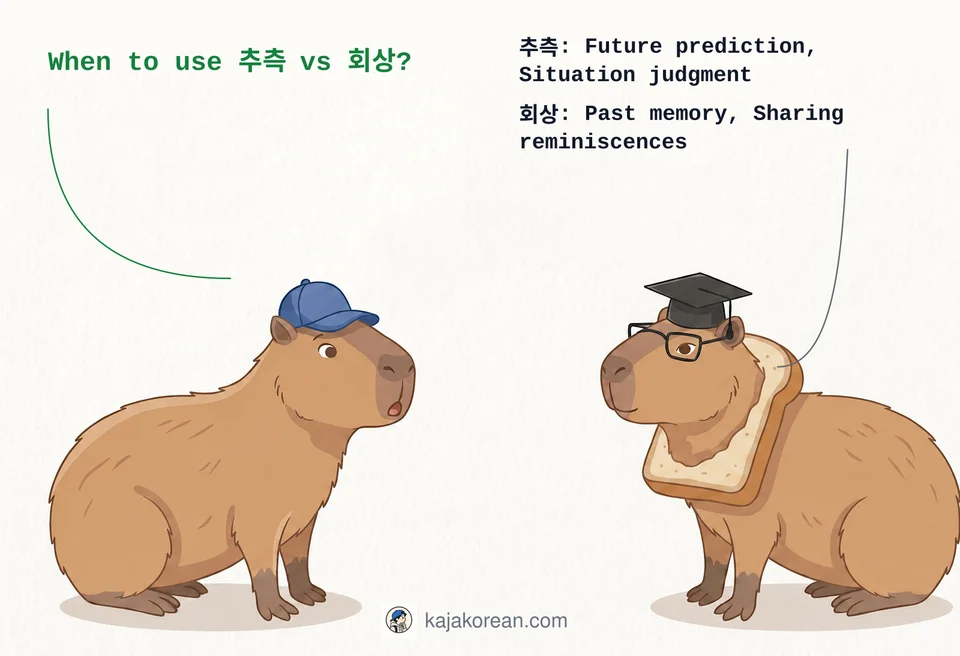
One lane per word — no nested boxes, just the gist.
To guess or infer based on uncertain information
When to use
Future prediction, Situation judgment, Guessing with insufficient info
The nuance
Use when making a judgment or guess about uncertain facts or situations.
To recall or reminisce about past experiences or memories
When to use
Past memory, Sharing reminiscences, Recalling experiences
The nuance
Use when recalling or reminiscing about actual past events or memories.
그의 마음속 생각을 추측해 봤다.
geu-ui ma-eum-sok saeng-gak-eul chu-cheuk-hae bwass-da., geu ui ma eum sok saeng gak eul chu cheuk hae bwass da.
Appropriate because guessing uncertain thoughts inside someone's mind.
그는 어렸을 때의 일을 회상했다.
geu-neun eo-ryeoss-eul ttae-ui il-eul hoe-sang-haess-da., geu neun eo ryeoss eul ttae ui il eul hoe sang haess da.
Correct because it involves recalling an actual past experience.
내일 날씨를 회상할 수 없다.
nae-il nal-ssi-reul hoe-sang-hal su eop-da., nae il nal ssi reul hoe sang hal su eop da.
'회상' is only for past memories; use '추측' for future predictions.
그가 왜 화났는지 회상해 보았다.
geu-ga wae hwa-nass-neun-ji hoe-sang-hae bo-ass-da., geu ga wae hwa nass neun ji hoe sang hae bo ass da.
Because it's guessing the reason for current anger, '추측' is suitable.
어제 본 영화를 회상하면서 웃었다.
eo-je bon yeong-hwa-reul hoe-sang-ha-myeon-seo us-eoss-da., eo je bon yeong hwa reul hoe sang ha myeon seo us eoss da.
Recalling a past experience (movie) and feeling emotions fits '회상'.
그의 의도를 회상해 보았다.
geu-ui ui-do-reul hoe-sang-hae bo-ass-da., geu ui ui do reul hoe sang hae bo ass da.
Intentions usually require guessing about present/future, so use '추측'.
나는 친구와의 추억을 회상했다.
na-neun chin-gu-wa-ui chu-eok-eul hoe-sang-haess-da., na neun chin gu wa ui chu eok eul hoe sang haess da.
Recalling past memories with a friend fits the use of '회상'.
그의 계획을 회상해 보았다.
geu-ui gye-hoek-eul hoe-sang-hae bo-ass-da., geu ui gye hoek eul hoe sang hae bo ass da.
Plans are future-oriented; thus, '추측' should be used.
Which word is appropriate when recalling past experiences?
Which word is correct for predicting future situations?
Fill in the blank: 'I tried to ______ his mind.'