Refers to the year following the current year, i.e., 'next year'.
When to use
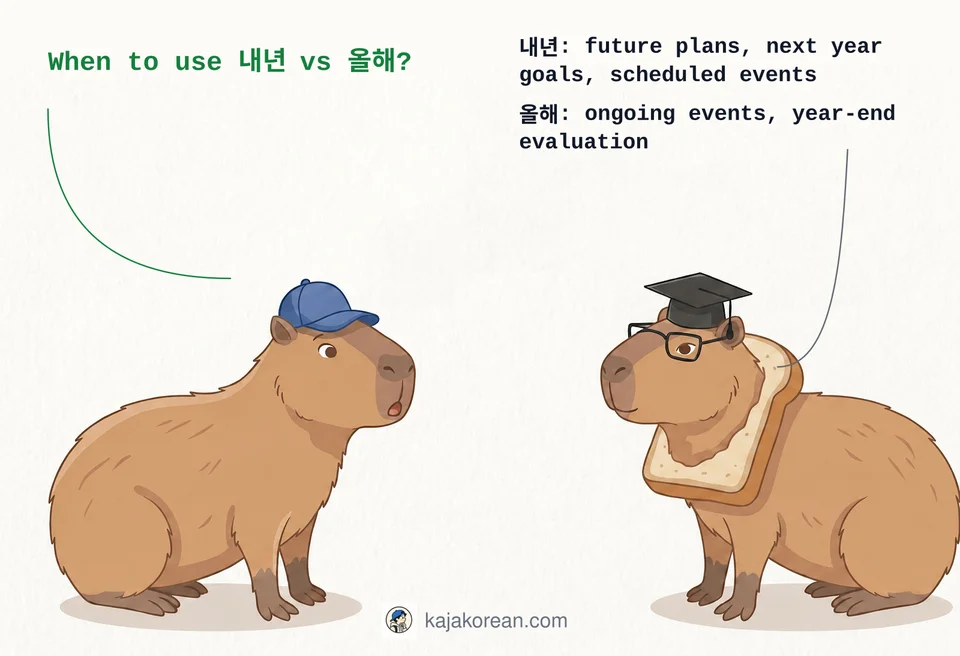
future plans, scheduled events, next year goals
The nuance
Use 내년 to indicate the year after the current year has ended. For example, if it is 2024 now, 내년 means 2025.
내년 (nae-nyeon, naenyeon) · 올해 (ol-hae, olhae)
Both 내년 and 올해 refer to years, but 내년 means the next year after the current one, while 올해 means the current year.

One lane per word — no nested boxes, just the gist.
Refers to the year following the current year, i.e., 'next year'.
When to use
future plans, scheduled events, next year goals
The nuance
Use 내년 to indicate the year after the current year has ended. For example, if it is 2024 now, 내년 means 2025.
Refers to the current year we are living in, i.e., 'this year'.
When to use
ongoing events, this year's achievements, year-end evaluation
The nuance
Use 올해 to talk about events or plans happening within the current year. For example, if it is 2024 now, 올해 means 2024.
내년에 해외여행을 갈 거예요.
nae-nyeon-e hae-oe-yeo-haeng-eul gal geo-ye-yo., nae nyeon e hae oe yeo haeng eul gal geo ye yo.
내년 refers to next year, so it's correct for expressing future plans.
올해 해외여행을 갈 거예요.
ol-hae hae-oe-yeo-haeng-eul gal geo-ye-yo., ol hae hae oe yeo haeng eul gal geo ye yo.
올해 means this year, so it's correct for plans within the current year.
내년에 이미 일어난 사건을 이야기했어요.
nae-nyeon-e i-mi il-eo-nan sa-geon-eul i-ya-gi-haess-eo-yo., nae nyeon e i mi il eo nan sa geon eul i ya gi haess eo yo.
내년 refers to the future, so it cannot describe past events; use 'last year' instead.
올해는 작년에 비해 날씨가 따뜻했다.
ol-hae-neun jak-nyeon-e bi-hae nal-ssi-ga tta-tteus-haess-da., ol hae neun jak nyeon e bi hae nal ssi ga tta tteus haess da.
올해 is the current year and naturally compares with last year.
내년은 올해보다 날씨가 더 따뜻했다.
nae-nyeon-eun ol-hae-bo-da nal-ssi-ga deo tta-tteus-haess-da., nae nyeon eun ol hae bo da nal ssi ga deo tta tteus haess da.
내년 refers to the future, so it cannot be used with past tense.
올해 졸업할 예정이에요.
ol-hae jol-eop-hal ye-jeong-i-e-yo., ol hae jol eop hal ye jeong i e yo.
올해 is appropriate when referring to graduation planned within the current year.
내년 졸업할 예정이에요.
nae-nyeon jol-eop-hal ye-jeong-i-e-yo., nae nyeon jol eop hal ye jeong i e yo.
내년 correctly indicates graduation planned for next year.
내년에 지금 일어나고 있는 일을 끝낼 거예요.
nae-nyeon-e ji-geum il-eo-na-go iss-neun il-eul kkeut-nael geo-ye-yo., nae nyeon e ji geum il eo na go iss neun il eul kkeut nael geo ye yo.
내년 means next year, so it cannot describe ongoing current events.
Which sentence should use '내년'?
Which sentence correctly uses '올해'?