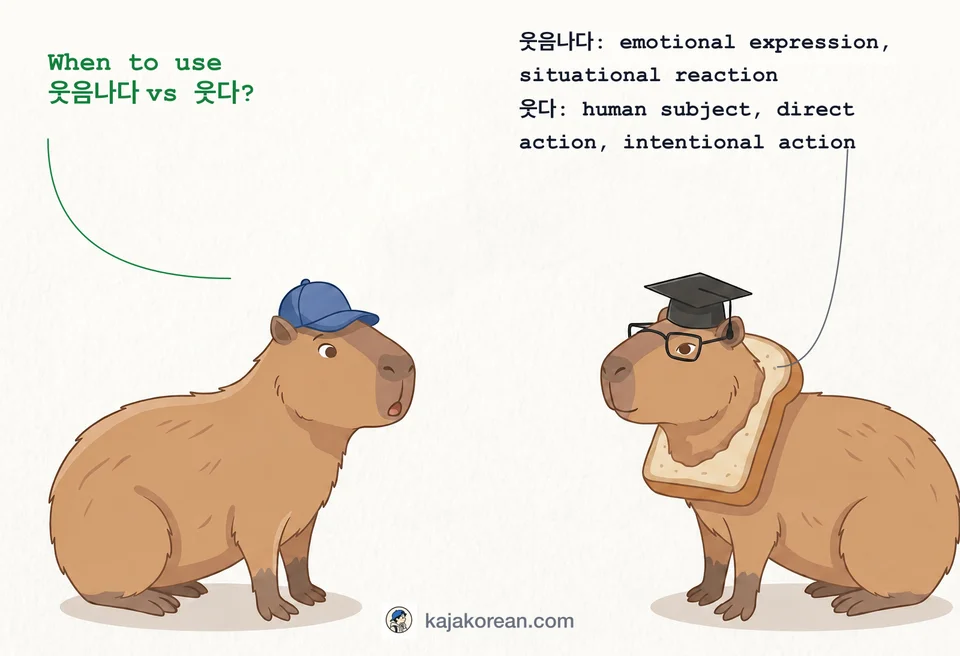
웃음나다 vs 웃다: Natural Ways to Express Laughter

웃음나다 (us-eum-na-da, useumnada) · 웃다 (us-da, usda)

웃음나다 (useum-nada) expresses spontaneous laughter from emotions, while 웃다 (utda) refers to intentional laughing actions.

Comparison of Korean words 웃음나다 and 웃다 with examples

Word-by-word breakdown

One lane per word — no nested boxes, just the gist.

웃음나다(us-eum-na-da, useumnada)

Means laughter that naturally comes out due to emotions or situations.

When to use

emotional expression, situational reaction, spontaneous laughter

The nuance

웃음나다 is used when laughter naturally emerges from emotions; the subject can be a person or a situation. Usually appears as '웃음이 나다'.

웃다(us-da, usda)

Refers to the conscious and direct act of laughing.

When to use

intentional action, human subject, direct action

The nuance

웃다 is used for deliberate laughing actions by a person; the subject must be a person. Used as a standalone verb.

Real-world examples

  • 그의 농담에 웃음이 났다.

    geu-ui nong-dam-e us-eum-i nass-da., geu ui nong dam e us eum i nass da.

    Because laughter naturally emerged from emotion, '웃음이 났다' is appropriate.

  • 그는 농담에 웃었다.

    geu-neun nong-dam-e us-eoss-da., geu neun nong dam e us eoss da.

    Since he intentionally laughed, '웃었다' is correct.

  • 그는 웃음이 났다.

    geu-neun us-eum-i nass-da., geu neun us eum i nass da.

    '웃음이 났다' is awkward with a human subject like '그는'; use '그는 웃었다' instead.

  • 상황이 너무 웃었다.

    sang-hwang-i neo-mu us-eoss-da., sang hwang i neo mu us eoss da.

    Situations cannot laugh, so '웃었다' is incorrect; use '웃음이 났다' for situations.

  • 그 상황에 웃음이 났다.

    geu sang-hwang-e us-eum-i nass-da., geu sang hwang e us eum i nass da.

    It's natural to say a situation caused laughter.

  • 나는 웃음이 났다.

    na-neun us-eum-i nass-da., na neun us eum i nass da.

    With a human subject, use '웃었다'; '웃음이 났다' suits emotions or situations.

  • 그녀는 웃었다.

    geu-nyeo-neun us-eoss-da., geu nyeo neun us eoss da.

    Correct for intentional, direct laughter.

  • 그녀는 웃음이 났다.

    geu-nyeo-neun us-eum-i nass-da., geu nyeo neun us eum i nass da.

    '웃음이 났다' sounds unnatural with a human subject.

Quick quiz

  1. Which sentence expresses natural laughter?

    다음 중 자연스러운 웃음을 표현하는 문장은?(da-eumjungja-yeon-seu-reo-unus-eum-eulpyo-hyeon-ha-neunmun-jang-eun?, daeumjungjayeonseureounuseumeulpyohyeonhaneunmunjangeun?)
  2. Fill in the blank: '나는 농담에 ___.'

    '나는 농담에 ___.' 빈칸에 알맞은 단어는?('na-neunnong-dam-e___.'bin-kan-eal-maj-eundan-eo-neun?, 'naneunnongdame___.'binkanealmajeundaneoneun?)
  3. Which expression is used when a situation causes laughter?

    상황이 웃음을 유발할 때 쓰는 표현은?(sang-hwang-ius-eum-eulyu-bal-halttaesseu-neunpyo-hyeon-eun?, sanghwangiuseumeulyubalhalttaesseuneunpyohyeoneun?)

More comparisons to explore

View all word comparisons →