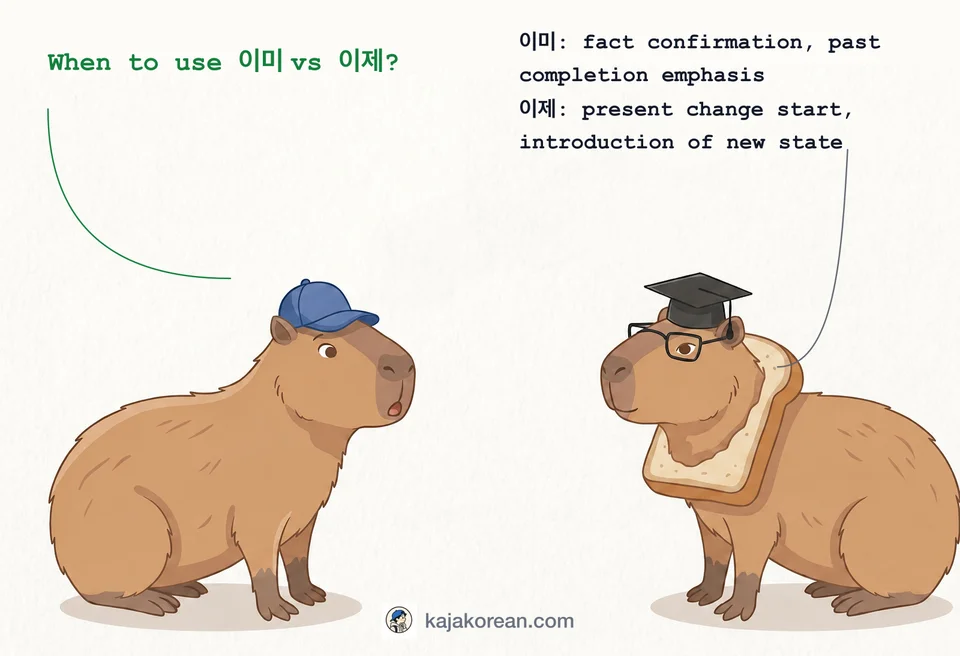
이미 vs 이제: Subtle Time Differences

이미 (i-mi, imi) · 이제 (i-je, ije)

이미 emphasizes that something was completed in the past, while 이제 indicates a change starting from the present moment.

Comparison of Korean words 이미 and 이제 indicating past completion vs present change

Word-by-word breakdown

One lane per word — no nested boxes, just the gist.

이미(i-mi, imi)

Used to emphasize that something was already completed or is a fact in the past.

When to use

past completion emphasis, fact confirmation, prior state before change

The nuance

이미 is used to indicate that something was finished or definitely happened in the past; it does not express changes starting now or in the future.

이제(i-je, ije)

Indicates that a change or new state has begun from the present moment.

When to use

present change start, introduction of new state, future direction indication

The nuance

이제 is used to express that a situation has changed or will change starting now; it does not indicate a completed past fact.

Real-world examples

  • 이미 숙제를 다 했어요.

    i-mi suk-je-reul da haess-eo-yo., i mi suk je reul da haess eo yo.

    Emphasizes the homework was completed in the past, so '이미' is appropriate.

  • 이제 숙제를 다 했어요.

    i-je suk-je-reul da haess-eo-yo., i je suk je reul da haess eo yo.

    '이제' indicates a change starting now, so it doesn't fit a completed past fact; use '이미' instead.

  • 이제 출발할 시간이에요.

    i-je chul-bal-hal si-gan-i-e-yo., i je chul bal hal si gan i e yo.

    Indicates a change starting now, so '이제' is appropriate.

  • 이미 출발할 시간이에요.

    i-mi chul-bal-hal si-gan-i-e-yo., i mi chul bal hal si gan i e yo.

    '이미' emphasizes past completion, so it's inappropriate for sentences about present or future change.

  • 이미 그 영화 봤어요.

    i-mi geu yeong-hwa bwass-eo-yo., i mi geu yeong hwa bwass eo yo.

    Confirms the movie was watched in the past, so '이미' is correct.

  • 이제 그 영화 봤어요.

    i-je geu yeong-hwa bwass-eo-yo., i je geu yeong hwa bwass eo yo.

    '이제' means change starting now, so it doesn't fit a past completed action.

  • 이제부터 열심히 공부할 거예요.

    i-je-bu-teo yeol-sim-hi gong-bu-hal geo-ye-yo., i je bu teo yeol sim hi gong bu hal geo ye yo.

    Indicates a new action starting from now, so '이제' is appropriate.

  • 이미부터 열심히 공부할 거예요.

    i-mi-bu-teo yeol-sim-hi gong-bu-hal geo-ye-yo., i mi bu teo yeol sim hi gong bu hal geo ye yo.

    '이미부터' is ungrammatical, and '이미' is only for past completion emphasis.

Quick quiz

  1. Which word is appropriate to emphasize a completed past action?

    과거에 어떤 일이 완료되었음을 강조할 때 적절한 단어는?(gwa-geo-eeo-tteonil-iwan-ryo-doe-eoss-eum-eulgang-jo-halttaejeok-jeol-handan-eo-neun?, gwageoeeotteoniliwanryodoeeosseumeulgangjohalttaejeokjeolhandaneoneun?)
  2. Which word indicates a change starting at the present moment?

    현재 시점에서 변화가 시작되었음을 나타내는 단어는?(hyeon-jaesi-jeom-e-seobyeon-hwa-gasi-jak-doe-eoss-eum-eulna-ta-nae-neundan-eo-neun?, hyeonjaesijeomeseobyeonhwagasijakdoeeosseumeulnatanaeneundaneoneun?)
  3. "___ finished the homework." (past completion emphasis)

    "___ 숙제를 다 했어요." (과거 완료 강조)("___suk-je-reuldahaess-eo-yo."(gwa-geowan-ryogang-jo), "___sukjereuldahaesseoyo."(gwageowanryogangjo))
  4. "___ It's time to leave." (present change start)

    "___ 출발할 시간이에요." (현재 변화 시작)("___chul-bal-halsi-gan-i-e-yo."(hyeon-jaebyeon-hwasi-jak), "___chulbalhalsiganieyo."(hyeonjaebyeonhwasijak))

More comparisons to explore

View all word comparisons →