Haoche vs Haeyoche: Comparing Old-fashioned and Modern Polite Speech

하오체 (ha-o-che, haoche) · 해요체 (hae-yo-che, haeyoche)

Haoche (하오체) is a classical, literary polite speech style, while Haeyoche (해요체) is the most common modern polite speech used daily.

Comparison of Korean polite speech styles: 하오체 vs 해요체

Word-by-word breakdown

One lane per word — no nested boxes, just the gist.

하오체(ha-o-che, haoche)

An old-fashioned, literary polite speech style mainly used in late 19th to early 20th century

When to use

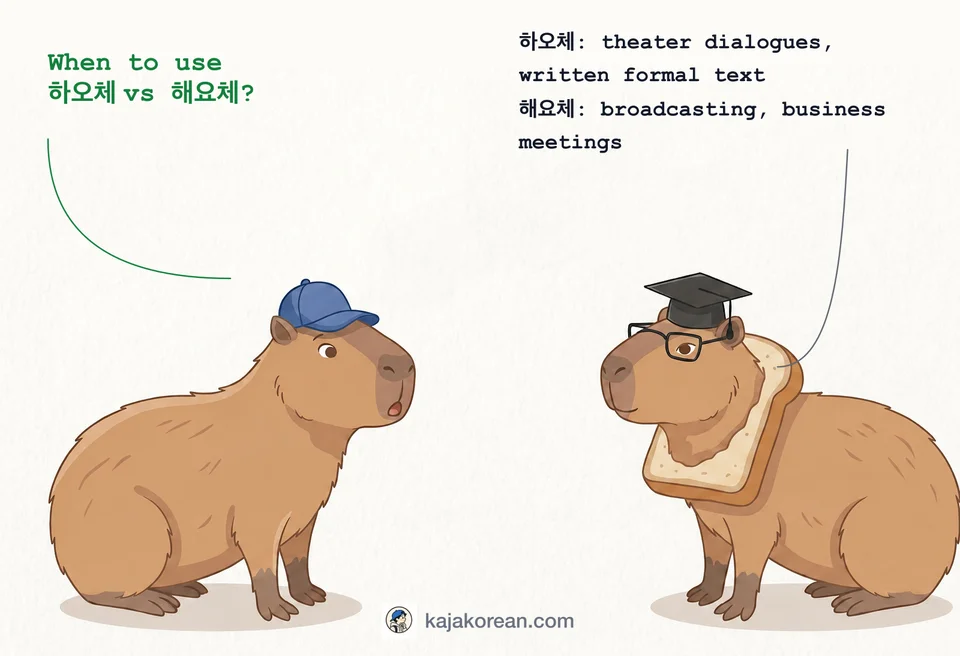
historical documents, classical literature, theater dialogues, written formal text

The nuance

Haoche is mainly used in written language, historical contexts, classical literature, or theater; it sounds awkward or inappropriate in modern daily conversations.

해요체(hae-yo-che, haeyoche)

The most widely used polite speech style in modern Korean, soft and respectful

When to use

daily conversation, business meetings, broadcasting, educational settings

The nuance

Haeyoche is widely used in daily conversations, business, broadcasting, education, and is friendly yet formal.

Real-world examples

  • 하오체: 오늘 날씨가 참 좋소.

    ha-o-che: o-neul nal-ssi-ga cham joh-so., ha o che: o neul nal ssi ga cham joh so.

    Correct use of haoche grammar and vocabulary creates a proper classical tone.

  • 하오체: 밥 먹었소?

    ha-o-che: bap meok-eoss-so?, ha o che: bap meok eoss so?

    Short and concise haoche sentence is natural.

  • 하오체: 오늘은 무엇을 하오?

    ha-o-che: o-neul-eun mu-eos-eul ha-o?, ha o che: o neul eun mu eos eul ha o?

    Proper use of haoche ending '-오'.

  • 하오체: 내일 회의는 몇 시에 하오?

    ha-o-che: nae-il hoe-ui-neun myeoch si-e ha-o?, ha o che: nae il hoe ui neun myeoch si e ha o?

    Haoche is inappropriate and awkward in modern business settings; use haeyoche instead.

  • 해요체: 오늘 날씨가 참 좋네요.

    hae-yo-che: o-neul nal-ssi-ga cham joh-ne-yo., hae yo che: o neul nal ssi ga cham joh ne yo.

    Natural modern Korean sentence with soft, polite haeyoche.

  • 해요체: 밥 먹었어요?

    hae-yo-che: bap meok-eoss-eo-yo?, hae yo che: bap meok eoss eo yo?

    Commonly used haeyoche question in daily life.

  • 해요체: 내일 회의는 몇 시에 해요?

    hae-yo-che: nae-il hoe-ui-neun myeoch si-e hae-yo?, hae yo che: nae il hoe ui neun myeoch si e hae yo?

    Appropriate haeyoche use in business context.

  • 해요체: 오늘은 무엇을 하오?

    hae-yo-che: o-neul-eun mu-eos-eul ha-o?, hae yo che: o neul eun mu eos eul ha o?

    Mixing haoche ending '-오' in haeyoche sentence causes grammatical error.

Quick quiz

  1. Which is most suitable for modern daily conversation?

    다음 중 현대 일상 대화에 가장 적합한 존댓말은?(da-eumjunghyeon-daeil-sangdae-hwa-ega-jangjeok-hap-hanjon-daes-mal-eun?, daeumjunghyeondaeilsangdaehwaegajangjeokhaphanjondaesmaleun?)
  2. Which style is used to create a classical atmosphere in theater?

    연극에서 고전적인 분위기를 내고 싶을 때 사용하는 말투는?(yeon-geuk-e-seogo-jeon-jeok-inbun-wi-gi-reulnae-gosip-eulttaesa-yong-ha-neunmal-tu-neun?, yeongeukeseogojeonjeokinbunwigireulnaegosipeulttaesayonghaneunmaltuneun?)
  3. Which is appropriate for polite speech in business meetings?

    비즈니스 미팅에서 상대방에게 공손하게 말할 때 적절한 표현은?(bi-jeu-ni-seumi-ting-e-seosang-dae-bang-e-gegong-son-ha-gemal-halttaejeok-jeol-hanpyo-hyeon-eun?, bijeuniseumitingeseosangdaebangegegongsonhagemalhalttaejeokjeolhanpyohyeoneun?)

More comparisons to explore

View all word comparisons →