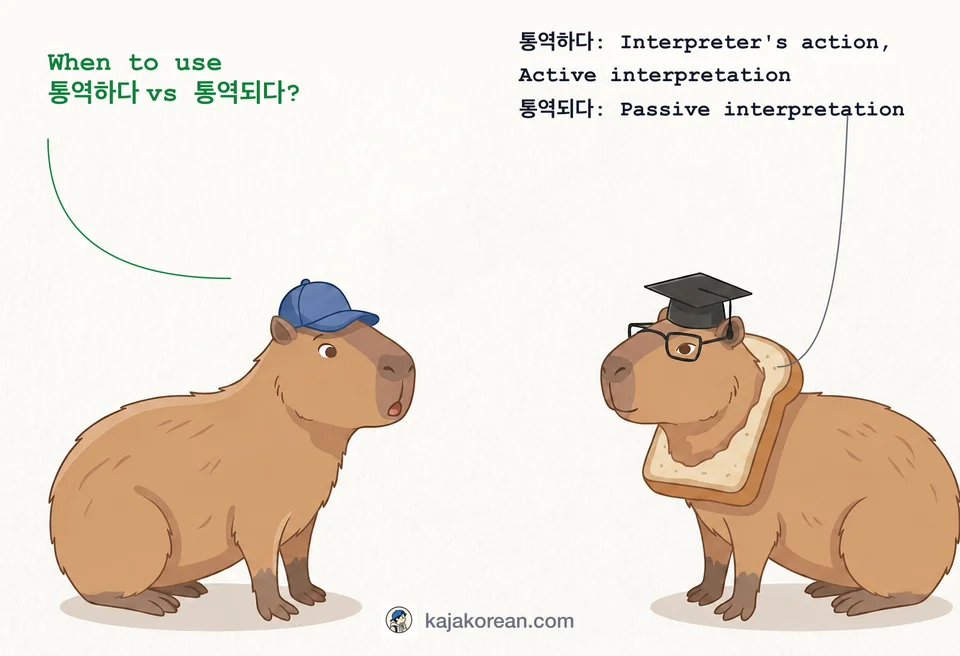
통역하다 vs 통역되다: Active vs Passive Interpretation

통역하다 (tong-yeok-ha-da, tongyeokhada) · 통역되다 (tong-yeok-doe-da, tongyeokdoeda)

통역하다 (tong-yeokhada) means actively interpreting speech, while 통역되다 (tong-yeokdoeda) expresses that interpretation happened passively or was done by someone else.

Comparison of Korean verbs 통역하다 and 통역되다 for active vs passive interpretation

Word-by-word breakdown

One lane per word — no nested boxes, just the gist.

통역하다(tong-yeok-ha-da, tongyeokhada)

Active act of a person interpreting speech into another language

When to use

Active interpretation, Direct interpreting by subject, Interpreter's action

The nuance

Use when the subject actively interprets speech. It is an active verb.

통역되다(tong-yeok-doe-da, tongyeokdoeda)

Indicates that interpretation was done passively or by someone else

When to use

Passive interpretation, State of being interpreted, Emphasis on interpretation result

The nuance

Use when the subject receives the interpretation action, i.e., passive voice.

Real-world examples

  • 그는 영어를 한국어로 통역한다.

    geu-neun yeong-eo-reul han-guk-eo-ro tong-yeok-han-da., geu neun yeong eo reul han guk eo ro tong yeok han da.

    The subject actively interprets, so use 통역하다.

  • 회의에서 통역되었다.

    hoe-ui-e-seo tong-yeok-doe-eoss-da., hoe ui e seo tong yeok doe eoss da.

    Expresses passive interpretation, so 통역되다 is correct.

  • 그녀는 통역되었다.

    geu-nyeo-neun tong-yeok-doe-eoss-da., geu nyeo neun tong yeok doe eoss da.

    People don't get 'interpreted'; they interpret. Use 통역하다.

  • 통역사가 회의를 통역되었다.

    tong-yeok-sa-ga hoe-ui-reul tong-yeok-doe-eoss-da., tong yeok sa ga hoe ui reul tong yeok doe eoss da.

    Subject actively interprets, so use 통역하다, not 통역되다.

  • 그는 통역을 잘 한다.

    geu-neun tong-yeok-eul jal han-da., geu neun tong yeok eul jal han da.

    He actively interprets well, so 통역하다 fits.

  • 그의 말은 통역되었다.

    geu-ui mal-eun tong-yeok-doe-eoss-da., geu ui mal eun tong yeok doe eoss da.

    His words are the object of interpretation, so passive 통역되다 is correct.

  • 나는 통역되었다.

    na-neun tong-yeok-doe-eoss-da., na neun tong yeok doe eoss da.

    People don't get 'interpreted'; they interpret. Use 통역하다.

  • 우리는 회의를 통역했다.

    u-ri-neun hoe-ui-reul tong-yeok-haess-da., u ri neun hoe ui reul tong yeok haess da.

    Subject actively interpreted, so 통역하다 is correct.

Quick quiz

  1. Which expression fits active interpreting?

    다음 중 능동적으로 통역하는 경우에 맞는 표현은?(da-eumjungneung-dong-jeok-eu-rotong-yeok-ha-neungyeong-u-emaj-neunpyo-hyeon-eun?, daeumjungneungdongjeokeurotongyeokhaneungyeonguemajneunpyohyeoneun?)
  2. Why is 통역되다 used in “회의에서 통역되었다.”?

    “회의에서 통역되었다.” 문장에서 통역되다를 쓴 이유는?(“hoe-ui-e-seotong-yeok-doe-eoss-da.”mun-jang-e-seotong-yeok-doe-da-reulsseuni-yu-neun?, “hoeuieseotongyeokdoeeossda.”munjangeseotongyeokdoedareulsseuniyuneun?)
  3. What is wrong with “그녀는 영어를 통역했다.”?

    “그녀는 영어를 통역했다.” 문장에서 틀린 부분은?(“geu-nyeo-neunyeong-eo-reultong-yeok-haess-da.”mun-jang-e-seoteul-rinbu-bun-eun?, “geunyeoneunyeongeoreultongyeokhaessda.”munjangeseoteulrinbubuneun?)

More comparisons to explore

View all word comparisons →