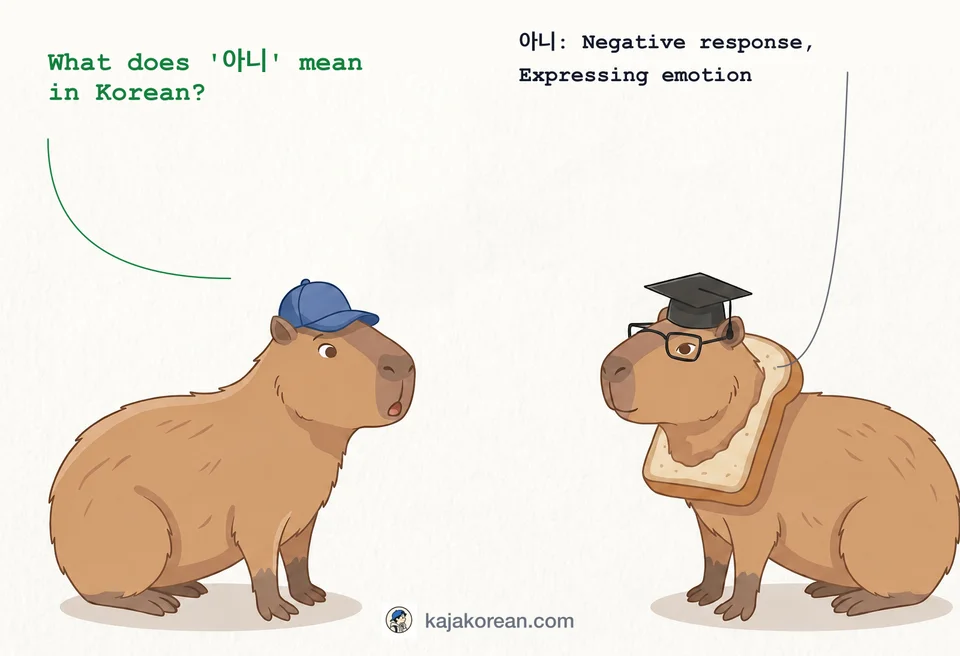
What does 아니 mean?

아니 (a-ni, ani)

'아니' is a fundamental Korean negation word used in many contexts, changing meaning depending on sentence structure.

Korean word 아니 meaning no or negation

Definition & nuance

Core meaning and shades learners miss.

아니(a-ni, ani)

'아니' is a shortened form of '아니다' used to negate facts or states. Alone, it functions as a negative response like 'no,' and within sentences, it conveys negation.

Nuances

  • Used alone as a simple negative answer.
  • Within sentences, it emphasizes negation.
  • '아니요' is more appropriate in formal contexts.
  • Can express surprise or contradiction sometimes.

When to use

Everyday conversation, Negative response, Expressing emotion

In context

'아니' is mainly used independently as a negative response or as an adverb expressing negation within a sentence. In formal situations, '아니요' is preferred, while '아니' sounds natural in casual conversation. It often appears at sentence endings to negate.

Real-world examples

  • 아니, 그게 아니야.

    a-ni, geu-ge a-ni-ya., a ni, geu ge a ni ya.

    '아니' is correctly used as a negative response.

  • 나는 아니 좋아해.

    na-neun a-ni joh-a-hae., na neun a ni joh a hae.

    '아니' is not used before verbs like this.

  • 아니요, 감사합니다.

    a-ni-yo, gam-sa-hap-ni-da., a ni yo, gam sa hap ni da.

    '아니요' is a polite negative response.

  • 아니, 그럴 리가 없어.

    a-ni, geu-reol ri-ga eop-eo., a ni, geu reol ri ga eop eo.

    Expresses negation and surprise simultaneously.

  • 아니, 너는 왜 그래?

    a-ni, neo-neun wae geu-rae?, a ni, neo neun wae geu rae?

    Natural usage expressing negation and contradiction.

Quick quiz

  1. What does '아니' mean?

    '아니'는 어떤 뜻인가요?('a-ni'neuneo-tteontteus-in-ga-yo?, 'ani'neuneotteontteusingayo?)
  2. When do you use '아니요'?

    '아니요'는 언제 쓰나요?('a-ni-yo'neuneon-jesseu-na-yo?, 'aniyo'neuneonjesseunayo?)
  3. Which sentence is correct?

    다음 중 올바른 문장은?(da-eumjungol-ba-reunmun-jang-eun?, daeumjungolbareunmunjangeun?)

More meaning guides

View all meaning guides →