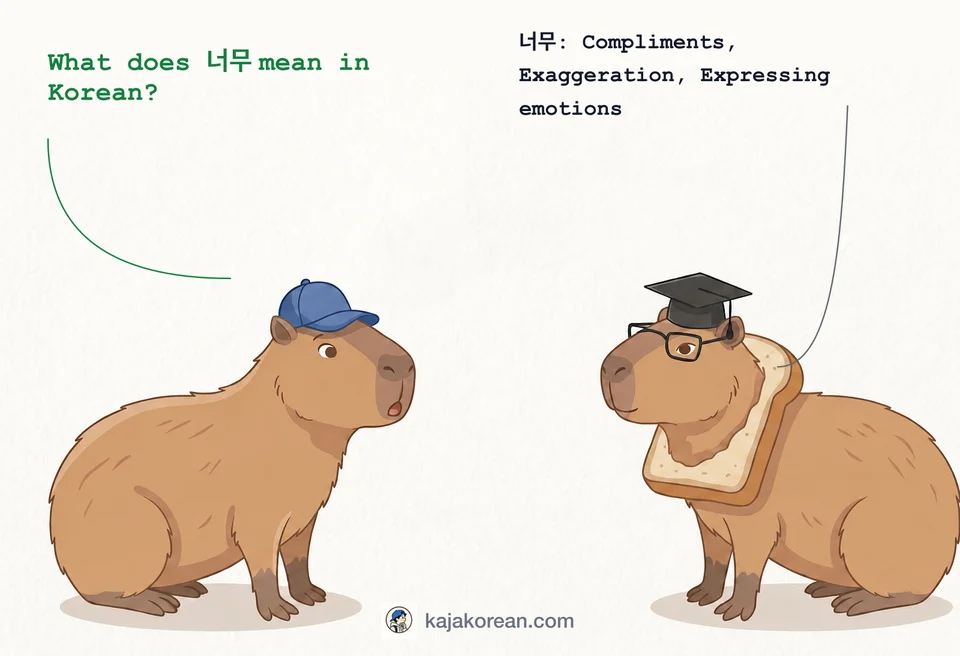
What does 너무 mean?

너무 (neo-mu, neomu)

'너무' in Korean expresses excessiveness or a high degree. It's common in everyday speech and writing.

Korean word 너무 meaning very or too much

Definition & nuance

Core meaning and shades learners miss.

너무(neo-mu, neomu)

'너무' is an adverb indicating that a state or degree is excessively strong or high. It can be used for both positive and negative contexts, and sometimes simply means 'very'.

Nuances

  • Emphasizes excessiveness in negative contexts
  • Simply means 'very' in positive contexts
  • Can be used for exaggeration
  • Used familiarly in spoken language

When to use

Everyday conversation, Expressing emotions, Exaggeration, Compliments

In context

'너무' precedes adjectives or verbs to emphasize degree. It is very common in spoken Korean; in formal contexts, '매우' or '아주' are more appropriate.

Real-world examples

  • 이 음식이 너무 맛있어요.

    i eum-sik-i neo-mu mas-iss-eo-yo., i eum sik i neo mu mas iss eo yo.

    '너무' precedes adjective '맛있다' to emphasize degree.

  • 너무 많이 먹었어요.

    neo-mu man-i meok-eoss-eo-yo., neo mu man i meok eoss eo yo.

    '너무' adverbially exaggerates the verb 'eat'.

  • 그 영화는 너무 재미있었어요.

    geu yeong-hwa-neun neo-mu jae-mi-iss-eoss-eo-yo., geu yeong hwa neun neo mu jae mi iss eoss eo yo.

    '너무' used as 'very' in positive meaning.

  • 너무 춥다!

    neo-mu chup-da!, neo mu chup da!

    '너무' indicates excessive degree in negative context.

  • 너무 좋아요!

    neo-mu joh-a-yo!, neo mu joh a yo!

    '너무' used to strongly express emotion.

  • 너무 빨리 달렸어요.

    neo-mu ppal-ri dal-ryeoss-eo-yo., neo mu ppal ri dal ryeoss eo yo.

    '너무' exaggerates speed before verb.

  • 너무 예뻐서 말을 잃었어요.

    neo-mu ye-ppeo-seo mal-eul il-eoss-eo-yo., neo mu ye ppeo seo mal eul il eoss eo yo.

    '너무' used for positive exaggeration.

  • 너무 힘들지 마세요.

    neo-mu him-deul-ji ma-se-yo., neo mu him deul ji ma se yo.

    '너무' used to soften negative state in advice.

Quick quiz

  1. What meaning does '너무' have?

    '너무'는 어떤 의미로 쓰이나요?('neo-mu'neuneo-tteonui-mi-rosseu-i-na-yo?, 'neomu'neuneotteonuimirosseuinayo?)
  2. Which sentence is correct?

    다음 중 올바른 문장은?(da-eumjungol-ba-reunmun-jang-eun?, daeumjungolbareunmunjangeun?)
  3. Where does '너무' appear in a sentence?

    '너무'는 어디에 위치하나요?('neo-mu'neuneo-di-ewi-chi-ha-na-yo?, 'neomu'neuneodiewichihanayo?)

More meaning guides

View all meaning guides →