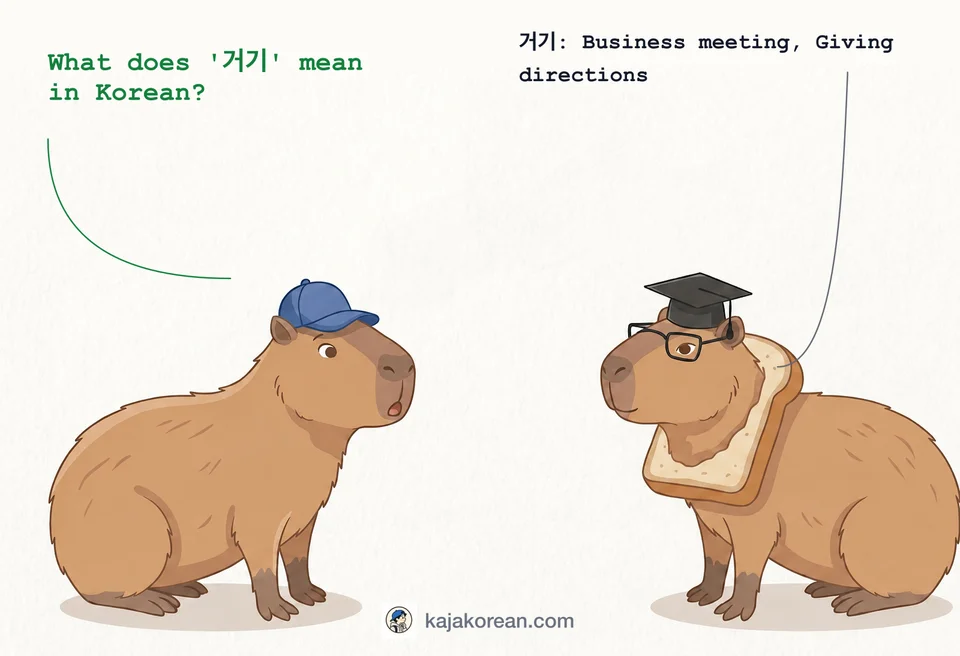
What does 거기 mean?

거기 (geo-gi, geogi)

'거기' is commonly used to refer to a place known to both speaker and listener. Learn its exact meaning and usage.

Illustration showing a person pointing to a place and saying '거기'

Definition & nuance

Core meaning and shades learners miss.

거기(geo-gi, geogi)

'거기' is a demonstrative pronoun indicating a specific place already known or mentioned between speaker and listener.

Nuances

  • Refers to a place known to both speaker and listener.
  • Often indicates a place closer to the listener than '저기'.
  • Can sometimes refer to abstract places or situations.

When to use

Casual conversation, Business meeting, Giving directions

In context

'거기' functions as a demonstrative pronoun for places mutually recognized by speaker and listener. It is natural in spoken Korean and common in everyday or business conversations, less so in formal writing.

Real-world examples

  • 거기 어디예요?

    geo-gi eo-di-ye-yo?, geo gi eo di ye yo?

    '거기' correctly points to a place known by the listener.

  • 나는 거기에서 일해요.

    na-neun geo-gi-e-seo il-hae-yo., na neun geo gi e seo il hae yo.

    Naturally refers to a place known to both speaker and listener.

  • 거기 가고 싶어요.

    geo-gi ga-go sip-eo-yo., geo gi ga go sip eo yo.

    '거기' appropriately indicates a specific place.

  • 거기 책을 읽었어요.

    geo-gi chaek-eul ik-eoss-eo-yo., geo gi chaek eul ik eoss eo yo.

    '거기' correctly functions as a place adverb.

  • 저기 거기 가요.

    jeo-gi geo-gi ga-yo., jeo gi geo gi ga yo.

    Using '저기' and '거기' together is redundant and unnatural.

  • 거기 맛있어요.

    geo-gi mas-iss-eo-yo., geo gi mas iss eo yo.

    '거기' refers to place, but 'delicious' cannot directly describe a place.

Quick quiz

  1. Which sentence uses '거기' correctly?

    다음 중 '거기'를 올바르게 사용한 문장은?(da-eumjung'geo-gi'reulol-ba-reu-gesa-yong-hanmun-jang-eun?, daeumjung'geogi'reulolbareugesayonghanmunjangeun?)
  2. What does '거기' refer to?

    '거기'가 가리키는 것은?('geo-gi'gaga-ri-ki-neungeos-eun?, 'geogi'gagarikineungeoseun?)

More meaning guides

View all meaning guides →