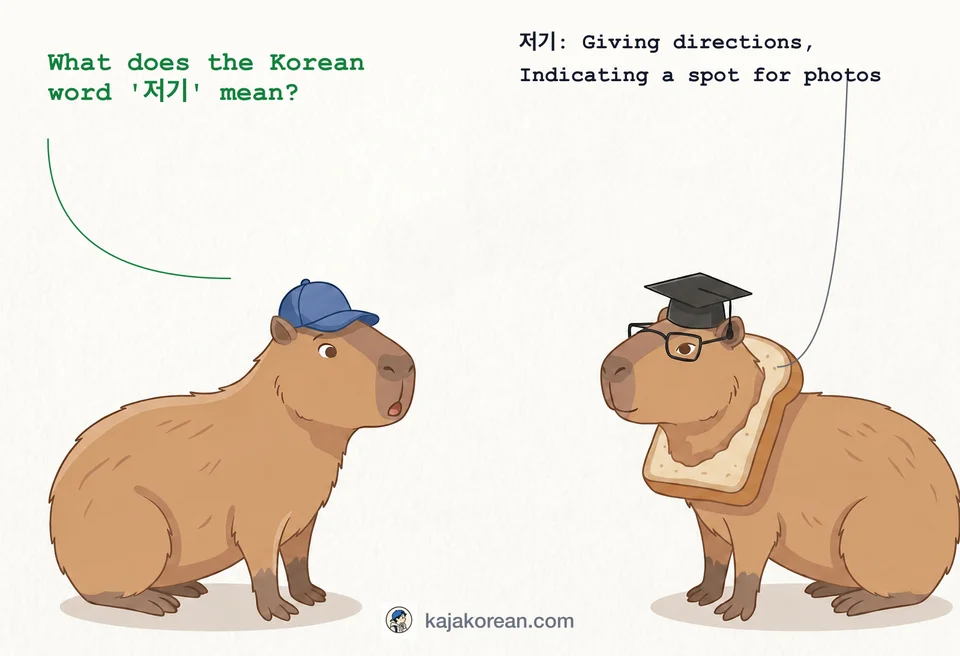
What does 저기 mean?

저기 (jeo-gi, jeogi)

'저기' is used in Korean to point out a place or person far from both speaker and listener. It's common in everyday conversation.

Pointing to a distant place

Definition & nuance

Core meaning and shades learners miss.

저기(jeo-gi, jeogi)

'저기' is an adverb used to indicate a place or object far from both the speaker and the listener.

Nuances

  • Points to a place far from both speaker and listener.
  • Used when the speaker knows or can see the place.
  • Casual and friendly expression.

When to use

Giving directions, Finding a seat at a restaurant, Indicating a spot for photos

In context

'저기' is mainly used as an adverb pointing to a location in sentences and fits naturally in casual conversations. In formal contexts, alternatives like '저쪽' or '저기 쪽' are more appropriate.

Real-world examples

  • 저기 있는 가게가 맛집이에요.

    jeo-gi iss-neun ga-ge-ga mas-jip-i-e-yo., jeo gi iss neun ga ge ga mas jip i e yo.

    '저기' correctly points to a distant place, making the sentence natural.

  • 저기 책상에 앉으세요.

    jeo-gi chaek-sang-e an-eu-se-yo., jeo gi chaek sang e an eu se yo.

    Using '저기' to indicate a distant desk is natural.

  • 저기에서 만나요.

    jeo-gi-e-seo man-na-yo., jeo gi e seo man na yo.

    Appropriate for specifying a meeting place far away.

  • 저기요, 여기요!

    jeo-gi-yo, yeo-gi-yo!, jeo gi yo, yeo gi yo!

    Commonly used to get someone's attention.

  • 여기 저기 다 가봤어요.

    yeo-gi jeo-gi da ga-bwass-eo-yo., yeo gi jeo gi da ga bwass eo yo.

    Natural contrast between 'here' and 'there'.

  • 저기 책이 내 거야.

    jeo-gi chaek-i nae geo-ya., jeo gi chaek i nae geo ya.

    Suitable for pointing out a distant object.

  • 저기 앉지 마세요.

    jeo-gi an-ji ma-se-yo., jeo gi an ji ma se yo.

    Natural when indicating a distant seat.

  • 저기 말고 여기로 와요.

    jeo-gi mal-go yeo-gi-ro wa-yo., jeo gi mal go yeo gi ro wa yo.

    Clear sentence contrasting 'there' and 'here'.

Quick quiz

  1. What kind of place does '저기' indicate?

    '저기'는 어떤 장소를 가리키나요?('jeo-gi'neuneo-tteonjang-so-reulga-ri-ki-na-yo?, 'jeogi'neuneotteonjangsoreulgarikinayo?)
  2. When is '저기요' used?

    '저기요'는 어떤 상황에서 쓰이나요?('jeo-gi-yo'neuneo-tteonsang-hwang-e-seosseu-i-na-yo?, 'jeogiyo'neuneotteonsanghwangeseosseuinayo?)
  3. Which sentence uses '저기' correctly?

    다음 중 '저기'를 올바르게 사용한 문장은?(da-eumjung'jeo-gi'reulol-ba-reu-gesa-yong-hanmun-jang-eun?, daeumjung'jeogi'reulolbareugesayonghanmunjangeun?)

More meaning guides

View all meaning guides →