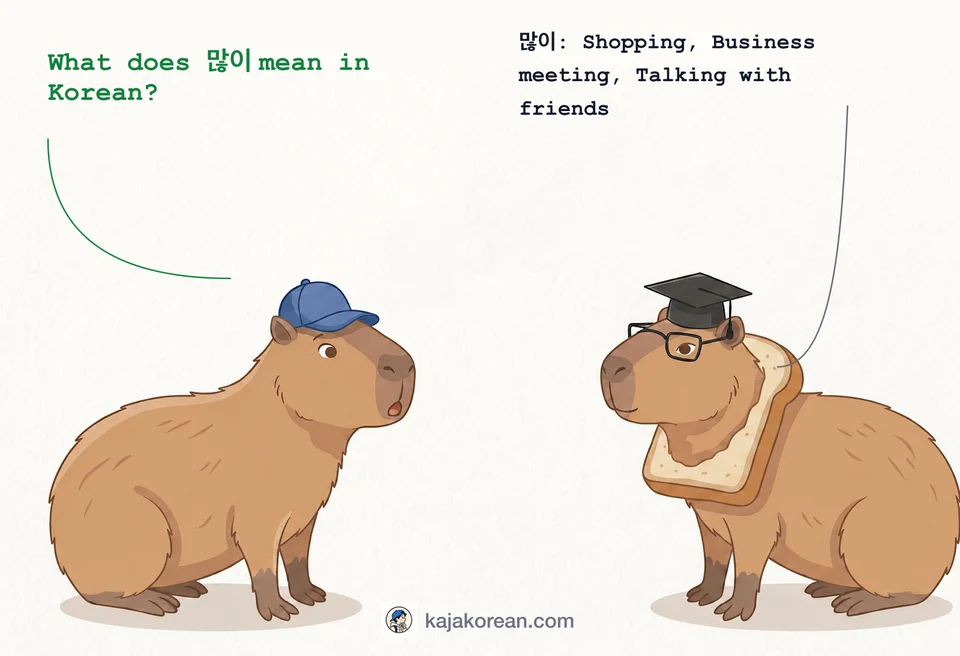
What does 많이 mean?

많이 (man-i, mani)

많이 (manhi) is an adverb meaning 'a lot' or 'much' in Korean, used to express large quantity or degree in various contexts.

Korean word 많이 meaning a lot or much

Definition & nuance

Core meaning and shades learners miss.

많이(man-i, mani)

많이 is an adverb meaning 'a lot' or 'much,' indicating a large amount or high degree of an action or state.

Nuances

  • Expresses not just quantity but also intensity or degree
  • Can convey 'a lot' without comparative forms
  • Emphasizes frequency or intensity when combined with verbs

When to use

Everyday conversation, Business meeting, Talking with friends, Shopping

In context

많이 typically modifies verbs or adjectives to emphasize quantity or degree. It is natural in both formal and informal speech.

Real-world examples

  • 저는 커피를 많이 마셔요.

    jeo-neun keo-pi-reul man-i ma-syeo-yo., jeo neun keo pi reul man i ma syeo yo.

    많이 correctly modifies the verb 'drink' to indicate drinking a large amount of coffee.

  • 그는 많이 행복해요.

    geu-neun man-i haeng-bok-hae-yo., geu neun man i haeng bok hae yo.

    많이 modifies the adjective 'happy' to clearly express a high degree of happiness.

  • 많이 책을 읽었어요.

    man-i chaek-eul ik-eoss-eo-yo., man i chaek eul ik eoss eo yo.

    많이 modifies the verb 'read' to indicate reading a large quantity of books.

  • 저는 많이 사과를 좋아해요.

    jeo-neun man-i sa-gwa-reul joh-a-hae-yo., jeo neun man i sa gwa reul joh a hae yo.

    많이 modifies the verb 'like' to naturally express liking apples very much.

  • 많이 공부하지 마세요.

    man-i gong-bu-ha-ji ma-se-yo., man i gong bu ha ji ma se yo.

    In a negative command, 많이 warns about studying too much.

  • 많이 먹었어요?

    man-i meok-eoss-eo-yo?, man i meok eoss eo yo?

    In a question, 많이 appropriately asks if the amount eaten was large.

  • 많이 예뻐요.

    man-i ye-ppeo-yo., man i ye ppeo yo.

    많이 modifies the adjective 'pretty' to emphasize the degree of prettiness.

  • 많이 달려.

    man-i dal-ryeo., man i dal ryeo.

    In an imperative, 많이 naturally emphasizes the amount or frequency of running.

Quick quiz

  1. What part of speech does 많이 usually modify?

    많이는 주로 어떤 품사를 수식하나요?(man-i-neunju-roeo-tteonpum-sa-reulsu-sik-ha-na-yo?, manineunjuroeotteonpumsareulsusikhanayo?)
  2. Which sentence uses 많이 correctly?

    다음 문장 중 많이가 올바르게 쓰인 문장은?(da-eummun-jangjungman-i-gaol-ba-reu-gesseu-inmun-jang-eun?, daeummunjangjungmanigaolbareugesseuinmunjangeun?)
  3. What is the best meaning of 많이?

    많이의 의미로 가장 적절한 것은?(man-i-uiui-mi-roga-jangjeok-jeol-hangeos-eun?, maniuiuimirogajangjeokjeolhangeoseun?)

More meaning guides

View all meaning guides →