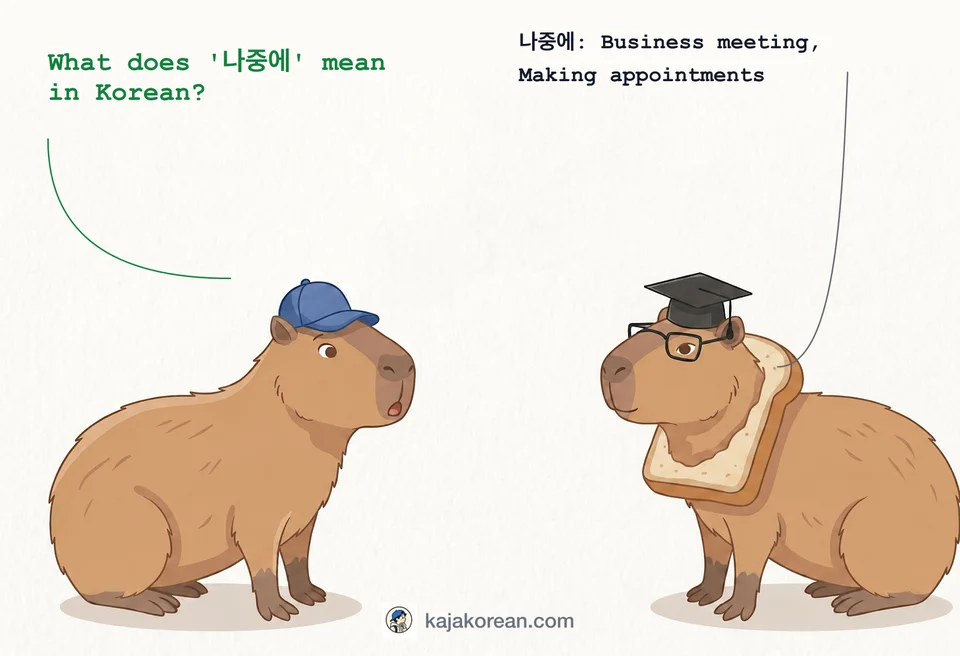
What does 나중에 mean?

나중에 (na-jung-e, najunge)

'나중에' (najunge) is an adverb indicating time, meaning 'later' or 'afterwards.' It's commonly used in everyday and business conversations.

Clock showing later time representing '나중에' meaning later

Definition & nuance

Core meaning and shades learners miss.

나중에(na-jung-e, najunge)

'나중에' is an adverb used when something happens not now but after some time. It refers to a future point, not the present.

Nuances

  • Refers vaguely to some future time
  • Means after some time, not immediately
  • Used to express flexible timing in plans or promises

When to use

Everyday conversation, Business meeting, Making appointments

In context

'나중에' typically appears at the beginning or middle of a sentence, used with verbs or adjectives to indicate time. It fits naturally in both formal and informal speech.

Real-world examples

  • 나중에 다시 연락할게요.

    na-jung-e da-si yeon-rak-hal-ge-yo., na jung e da si yeon rak hal ge yo.

    '나중에' clearly indicates a future time, making the sentence natural.

  • 나중에 밥 먹었어요.

    na-jung-e bap meok-eoss-eo-yo., na jung e bap meok eoss eo yo.

    '나중에' implies future, but 'ate' is past tense, so time reference conflicts.

  • 회의는 나중에 시작합니다.

    hoe-ui-neun na-jung-e si-jak-hap-ni-da., hoe ui neun na jung e si jak hap ni da.

    This sentence correctly uses '나중에' to indicate a future time in a formal context.

  • 나중에 지금 갑니다.

    na-jung-e ji-geum gap-ni-da., na jung e ji geum gap ni da.

    '나중에' and 'now' contradict each other, making the sentence awkward.

  • 나중에 만나서 이야기해요.

    na-jung-e man-na-seo i-ya-gi-hae-yo., na jung e man na seo i ya gi hae yo.

    A natural everyday phrase indicating a future meeting.

Quick quiz

  1. What is the best meaning of '나중에'?

    '나중에'의 뜻으로 가장 알맞은 것은?('na-jung-e'uitteus-eu-roga-jangal-maj-eungeos-eun?, 'najunge'uitteuseurogajangalmajeungeoseun?)
  2. Which sentence is correct?

    다음 문장 중 올바른 예는?(da-eummun-jangjungol-ba-reunye-neun?, daeummunjangjungolbareunyeneun?)
  3. What part of speech is '나중에'?

    '나중에'는 주로 어떤 품사인가요?('na-jung-e'neunju-roeo-tteonpum-sa-in-ga-yo?, 'najunge'neunjuroeotteonpumsaingayo?)

More meaning guides

View all meaning guides →