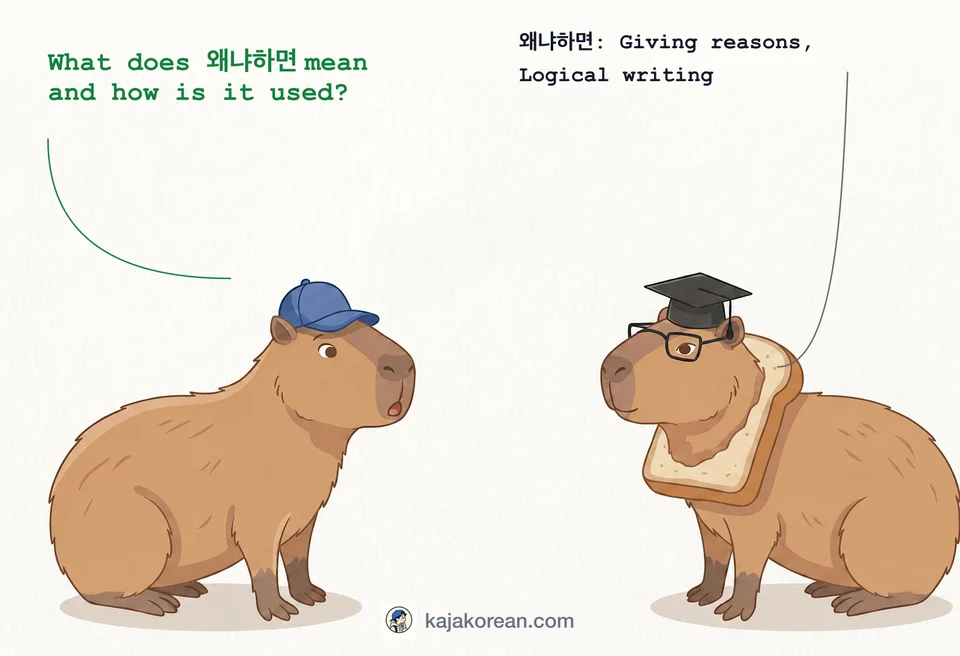
What does 왜냐하면 mean?

왜냐하면 (wae-nya-ha-myeon, waenyahamyeon)

왜냐하면 (waenya-hamyeon) is a conjunction used to explain reasons clearly in sentences.

Korean conjunction 왜냐하면 meaning because

Definition & nuance

Core meaning and shades learners miss.

왜냐하면(wae-nya-ha-myeon, waenyahamyeon)

왜냐하면 is a conjunction used to explain reasons, connecting a sentence that states a cause or reason.

Nuances

  • Used to clearly state reasons at sentence start or middle.
  • More suitable for written/formal contexts than spoken.
  • Must be followed by a clause containing the reason.
  • Often followed by a comma after 왜냐하면.

When to use

Formal explanation, Giving reasons, Logical writing

In context

왜냐하면 usually appears at the beginning or middle of a sentence, leading a clause that explains a reason. It is not combined with sentence endings like ‘-기 때문이다’ or ‘-서’ and must be followed by a clause stating the cause. It is more common in written or formal language than in casual speech.

Real-world examples

  • 나는 오늘 못 갔어. 왜냐하면 몸이 안 좋았거든.

    na-neun o-neul mos gass-eo. wae-nya-ha-myeon mom-i an joh-ass-geo-deun., na neun o neul mos gass eo. wae nya ha myeon mom i an joh ass geo deun.

    The clause after 왜냐하면 contains the reason, making it grammatically correct.

  • 왜냐하면 그는 바쁘다.

    wae-nya-ha-myeon geu-neun ba-ppeu-da., wae nya ha myeon geu neun ba ppeu da.

    왜냐하면 is correctly placed at the beginning to clearly state a reason.

  • 나는 왜냐하면 피곤하다.

    na-neun wae-nya-ha-myeon pi-gon-ha-da., na neun wae nya ha myeon pi gon ha da.

    왜냐하면 is a conjunction and cannot directly follow the subject without leading a reason clause.

  • 그는 집에 갔어 왜냐하면.

    geu-neun jip-e gass-eo wae-nya-ha-myeon., geu neun jip e gass eo wae nya ha myeon.

    왜냐하면 must be followed by a reason clause; sentence ending after 왜냐하면 is incorrect.

Quick quiz

  1. What role does 왜냐하면 play?

    왜냐하면은 어떤 역할을 하나요?(wae-nya-ha-myeon-euneo-tteonyeok-hal-eulha-na-yo?, waenyahamyeoneuneotteonyeokhaleulhanayo?)
  2. Which sentence is correct?

    다음 문장 중 올바른 문장은?(da-eummun-jangjungol-ba-reunmun-jang-eun?, daeummunjangjungolbareunmunjangeun?)
  3. Where is 왜냐하면 mainly used?

    왜냐하면은 주로 어디에서 사용되나요?(wae-nya-ha-myeon-eunju-roeo-di-e-seosa-yong-doe-na-yo?, waenyahamyeoneunjuroeodieseosayongdoenayo?)

More meaning guides

View all meaning guides →