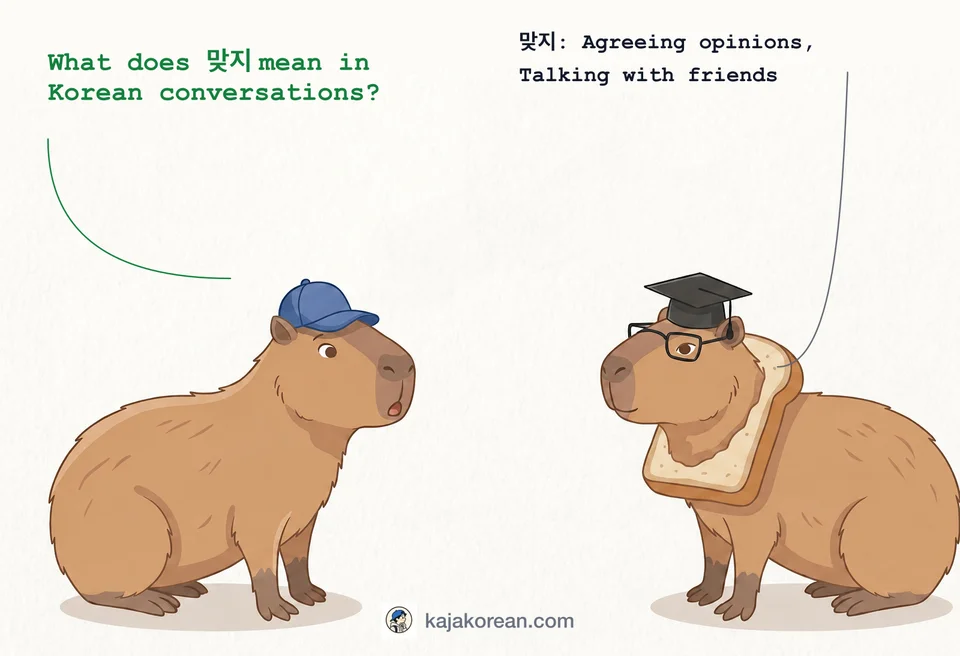
What does 맞지 mean?

맞지 (maj-ji, majji)

맞지 is used to agree or confirm what someone said. It's common in everyday Korean conversations.

Korean word 맞지 meaning agreement or confirmation

Definition & nuance

Core meaning and shades learners miss.

맞지(maj-ji, majji)

맞지 is a conjugated form of '맞다' used to agree with or confirm someone's statement or opinion.

Nuances

  • Expresses confident agreement
  • Informal, friendly ending
  • Softly confirms listener’s opinion

When to use

Talking with friends, Agreeing opinions, Seeking confirmation

In context

맞지 usually appears at the end of a sentence to agree with or seek confirmation from the listener. It's mainly used in informal or friendly contexts and is inappropriate in formal settings.

Real-world examples

  • 오늘 날씨 정말 좋지?

    o-neul nal-ssi jeong-mal joh-ji?, o neul nal ssi jeong mal joh ji?

    맞지 naturally asks for agreement from the listener.

  • 네 말이 맞지.

    ne mal-i maj-ji., ne mal i maj ji.

    맞지 can be used to agree with someone's opinion.

  • 이거 맞지?

    i-geo maj-ji?, i geo maj ji?

    맞지 is natural when attached to a question seeking confirmation.

  • 맞지, 너도 그렇게 생각해?

    maj-ji, neo-do geu-reoh-ge saeng-gak-hae?, maj ji, neo do geu reoh ge saeng gak hae?

    Appropriate for seeking agreement during conversation.

  • 맞지? 그거 틀렸어.

    maj-ji? geu-geo teul-ryeoss-eo., maj ji? geu geo teul ryeoss eo.

    Contradicting immediately after asking for agreement is contradictory.

  • 맞지요?

    maj-ji-yo?, maj ji yo?

    맞지 is informal; 맞지요 mixes honorifics awkwardly.

Quick quiz

  1. In what situation is 맞지 mainly used?

    맞지는 어떤 상황에서 주로 쓰이나요?(maj-ji-neuneo-tteonsang-hwang-e-seoju-rosseu-i-na-yo?, majjineuneotteonsanghwangeseojurosseuinayo?)
  2. Which sentence correctly uses 맞지?

    다음 문장 중 맞지 사용이 올바른 문장은?(da-eummun-jangjungmaj-jisa-yong-iol-ba-reunmun-jang-eun?, daeummunjangjungmajjisayongiolbareunmunjangeun?)
  3. What does '네 말이 맞지.' mean?

    '네 말이 맞지.' 문장의 의미는?('nemal-imaj-ji.'mun-jang-uiui-mi-neun?, 'nemalimajji.'munjanguiuimineun?)

More meaning guides

View all meaning guides →