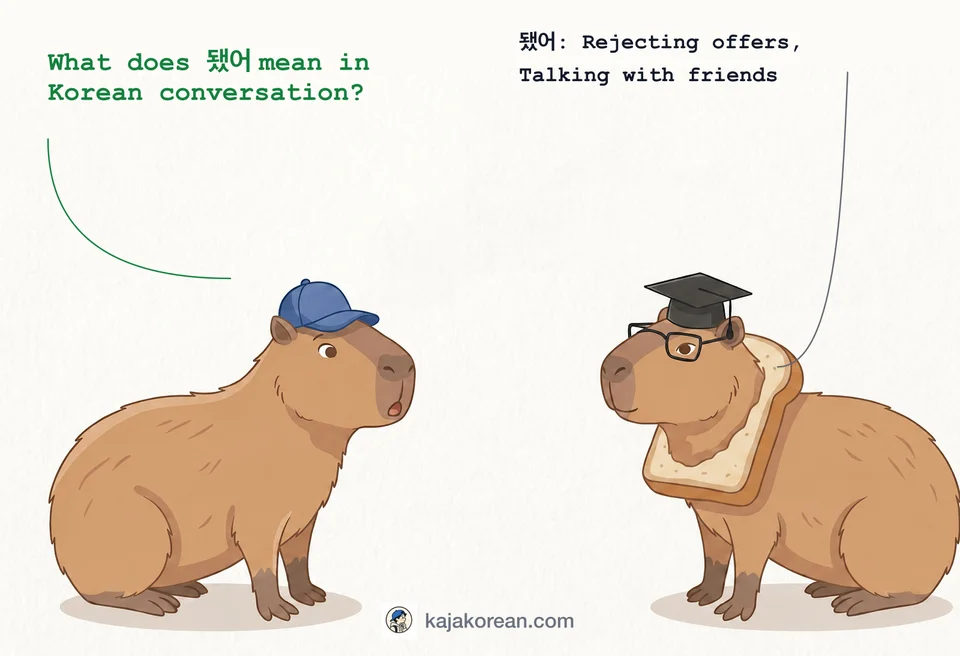
What does 됐어 mean?

됐어 (dwaess-eo, dwaesseo)

‘됐어’ is a common Korean expression meaning ‘it's okay’, ‘no need’, or ‘stop’ depending on context.

Korean word 됐어 meaning explained

Definition & nuance

Core meaning and shades learners miss.

됐어(dwaess-eo, dwaesseo)

‘됐어’ is the past form of ‘되다’ plus informal ending ‘-어’, used to reject offers or indicate completion.

Nuances

  • Can sound negative or dismissive
  • Friendly or blunt tone depending on context
  • Means ‘okay’ or ‘no need’ depending on situation

When to use

Talking with friends, Rejecting offers, Indicating completion

In context

‘됐어’ is used in informal speech to tell someone to stop or to indicate something is enough. It often stands alone or as a short reply.

Real-world examples

  • 이거 더 먹을래? 됐어.

    i-geo deo meok-eul-rae? dwaess-eo., i geo deo meok eul rae? dwaess eo.

    ‘됐어’ naturally means ‘no need’ here.

  • 도와줄까? 됐어.

    do-wa-jul-kka? dwaess-eo., do wa jul kka? dwaess eo.

    Appropriate to reject an offer of help.

  • 오늘은 여기까지 하자. 됐어.

    o-neul-eun yeo-gi-kka-ji ha-ja. dwaess-eo., o neul eun yeo gi kka ji ha ja. dwaess eo.

    Used naturally to indicate completion.

  • 됐어, 더 말하지 마.

    dwaess-eo, deo mal-ha-ji ma., dwaess eo, deo mal ha ji ma.

    Means ‘stop it’ in this context.

  • 됐어, 내가 할게.

    dwaess-eo, nae-ga hal-ge., dwaess eo, nae ga hal ge.

    Used to say ‘it's okay’ or ‘I'll handle it’.

  • 됐어, 그거 안 할래.

    dwaess-eo, geu-geo an hal-rae., dwaess eo, geu geo an hal rae.

    Natural sentence expressing refusal.

  • 됐어, 더 이상 필요 없어.

    dwaess-eo, deo i-sang pil-yo eop-eo., dwaess eo, deo i sang pil yo eop eo.

    Clearly expresses no need.

  • 됐어, 계속해도 돼.

    dwaess-eo, gye-sok-hae-do dwae., dwaess eo, gye sok hae do dwae.

    ‘됐어’ is not used to give positive permission.

Quick quiz

  1. When is ‘됐어’ most naturally used?

    ‘됐어’가 가장 자연스러운 상황은?(‘dwaess-eo’gaga-jangja-yeon-seu-reo-unsang-hwang-eun?, ‘dwaesseo’gagajangjayeonseureounsanghwangeun?)
  2. Which is NOT a meaning of ‘됐어’?

    ‘됐어’의 의미가 아닌 것은?(‘dwaess-eo’uiui-mi-gaa-ningeos-eun?, ‘dwaesseo’uiuimigaaningeoseun?)
  3. Who is appropriate to use ‘됐어’ with in informal speech?

    ‘됐어’를 반말로 사용할 때 적절한 대상은?(‘dwaess-eo’reulban-mal-rosa-yong-halttaejeok-jeol-handae-sang-eun?, ‘dwaesseo’reulbanmalrosayonghalttaejeokjeolhandaesangeun?)

More meaning guides

View all meaning guides →