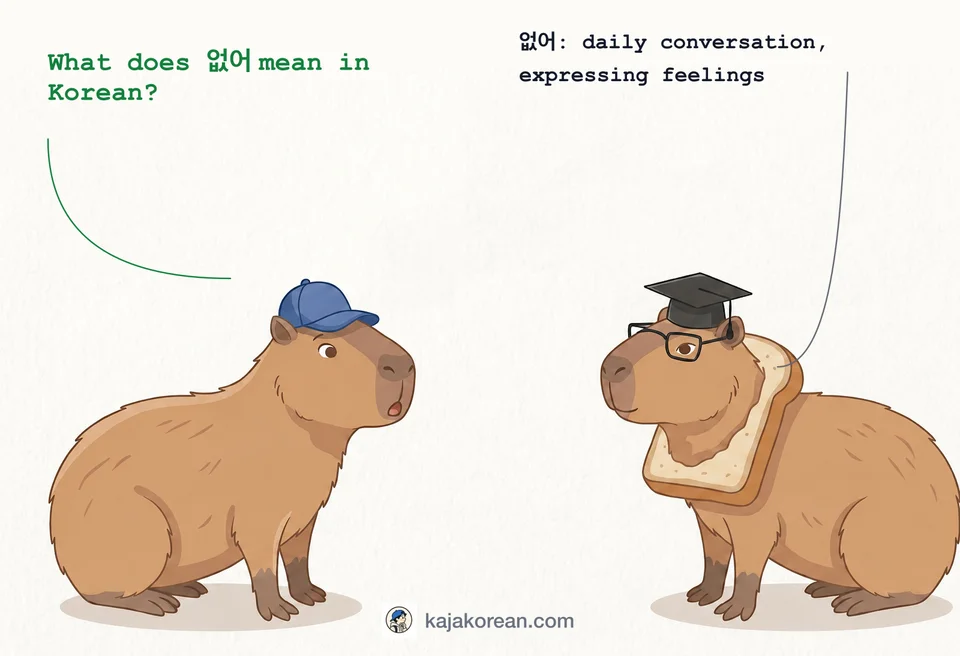
What does 없어 mean?

없어 (eop-eo, eopeo)

'없어' is the informal form of '없다' in Korean, meaning something does not exist or is not possessed.

Korean word 없어 meaning absence or lack

Definition & nuance

Core meaning and shades learners miss.

없어(eop-eo, eopeo)

'없어' is the informal (반말) form of '없다', used to express non-existence or lack of something.

Nuances

  • Expresses both absence and emotional lack
  • Informal, not suitable for formal situations
  • Covers both non-existence and lack of possession

When to use

daily conversation, talking with friends, expressing feelings

In context

'없어' is used in informal speech (반말), typically among close friends or family. It follows the subject and describes a state of non-existence or lack, e.g., '돈이 없어' (I have no money).

Real-world examples

  • 돈이 없어.

    don-i eop-eo., don i eop eo.

    '돈이 없어' is a natural and correct informal sentence.

  • 시간이 없어.

    si-gan-i eop-eo., si gan i eop eo.

    '시간이 없어' is also a correct informal expression.

  • 사과가 없어.

    sa-gwa-ga eop-eo., sa gwa ga eop eo.

    A proper sentence indicating the state with a subject.

  • 없어 돈이.

    eop-eo don-i., eop eo don i.

    The word order is unnatural, making the sentence incorrect.

  • 없어 나 친구.

    eop-eo na chin-gu., eop eo na chin gu.

    The subject and verb positions are awkward and incorrect.

  • 책이 없어.

    chaek-i eop-eo., chaek i eop eo.

    A correct informal sentence.

  • 없어 집이.

    eop-eo jip-i., eop eo jip i.

    The subject-verb order is unnatural.

Quick quiz

  1. What does '없어' mean?

    '없어'는 어떤 의미인가요?('eop-eo'neuneo-tteonui-mi-in-ga-yo?, 'eopeo'neuneotteonuimiingayo?)
  2. Which sentence is correct?

    다음 중 올바른 문장은?(da-eumjungol-ba-reunmun-jang-eun?, daeumjungolbareunmunjangeun?)
  3. In what situation is '없어' used?

    '없어'는 어떤 상황에서 사용하나요?('eop-eo'neuneo-tteonsang-hwang-e-seosa-yong-ha-na-yo?, 'eopeo'neuneotteonsanghwangeseosayonghanayo?)

More meaning guides

View all meaning guides →