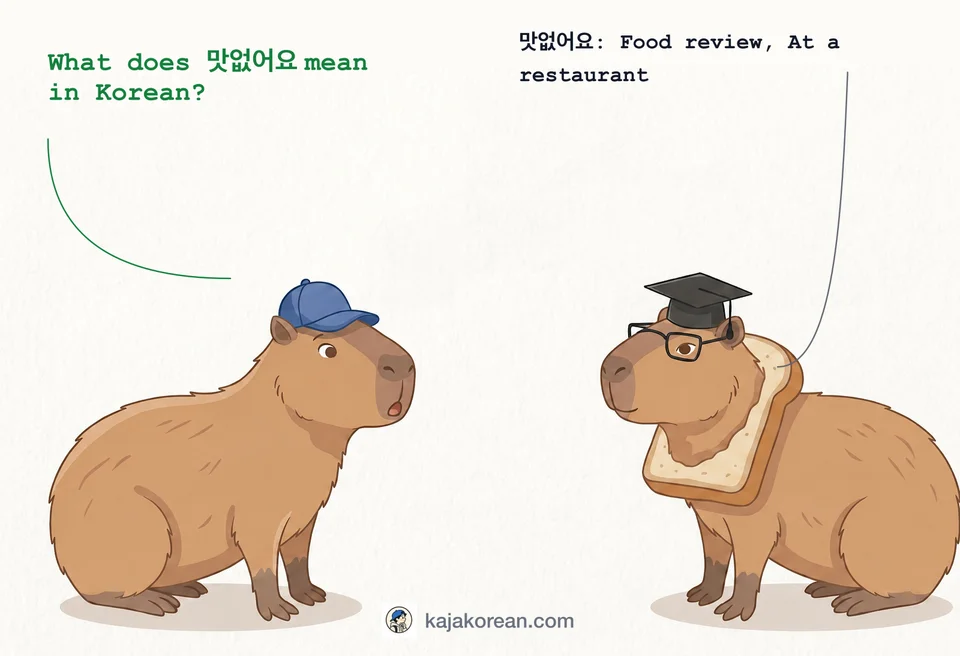
What does 맛없어요 mean?

맛없어요 (mas-eop-eo-yo, maseopeoyo)

맛없어요 means the food tastes bad. It's a common phrase in everyday conversation.

Korean phrase 맛없어요 meaning 'tastes bad'

Definition & nuance

Core meaning and shades learners miss.

맛없어요(mas-eop-eo-yo, maseopeoyo)

맛없어요 is the polite form of ‘맛이 없다’, meaning the food or drink tastes bad or unpleasant.

Nuances

  • Simply a negative taste evaluation
  • Direct but polite expression
  • Use carefully to avoid offending

When to use

At a restaurant, Talking with friends, Food review

In context

‘맛없어요’ is used to evaluate the taste of food or drink politely. The subject is often omitted but can be included, e.g., ‘이 음식은 맛없어요’ (This food tastes bad).

Real-world examples

  • 이 김치는 정말 맛없어요.

    i gim-chi-neun jeong-mal mas-eop-eo-yo., i gim chi neun jeong mal mas eop eo yo.

    ‘맛없어요’ correctly expresses that the food tastes bad.

  • 이 음식은 맛없어요.

    i eum-sik-eun mas-eop-eo-yo., i eum sik eun mas eop eo yo.

    Including the subject ‘this food’ is natural.

  • 그 영화는 맛없어요.

    geu yeong-hwa-neun mas-eop-eo-yo., geu yeong hwa neun mas eop eo yo.

    ‘맛없어요’ is only for food, not movies.

  • 이 커피는 맛없어요.

    i keo-pi-neun mas-eop-eo-yo., i keo pi neun mas eop eo yo.

    ‘맛없어요’ can be used to evaluate coffee taste.

  • 맛없어요, 더 주세요.

    mas-eop-eo-yo, deo ju-se-yo., mas eop eo yo, deo ju se yo.

    ‘맛없어요’ and ‘give me more’ contradict each other.

  • 이 음식은 맛없어요, 미안해요.

    i eum-sik-eun mas-eop-eo-yo, mi-an-hae-yo., i eum sik eun mas eop eo yo, mi an hae yo.

    Polite apology softens direct negative comment.

Quick quiz

  1. In which situation is ‘맛없어요’ mainly used?

    ‘맛없어요’는 어떤 상황에서 주로 쓰이나요?(‘mas-eop-eo-yo’neuneo-tteonsang-hwang-e-seoju-rosseu-i-na-yo?, ‘maseopeoyo’neuneotteonsanghwangeseojurosseuinayo?)
  2. Is ‘맛없어요’ a polite form?

    ‘맛없어요’의 존댓말 형태인가요?(‘mas-eop-eo-yo’uijon-daes-malhyeong-tae-in-ga-yo?, ‘maseopeoyo’uijondaesmalhyeongtaeingayo?)
  3. Which sentence correctly uses ‘맛없어요’?

    다음 중 ‘맛없어요’가 올바르게 사용된 문장은?(da-eumjung‘mas-eop-eo-yo’gaol-ba-reu-gesa-yong-doenmun-jang-eun?, daeumjung‘maseopeoyo’gaolbareugesayongdoenmunjangeun?)

More meaning guides

View all meaning guides →