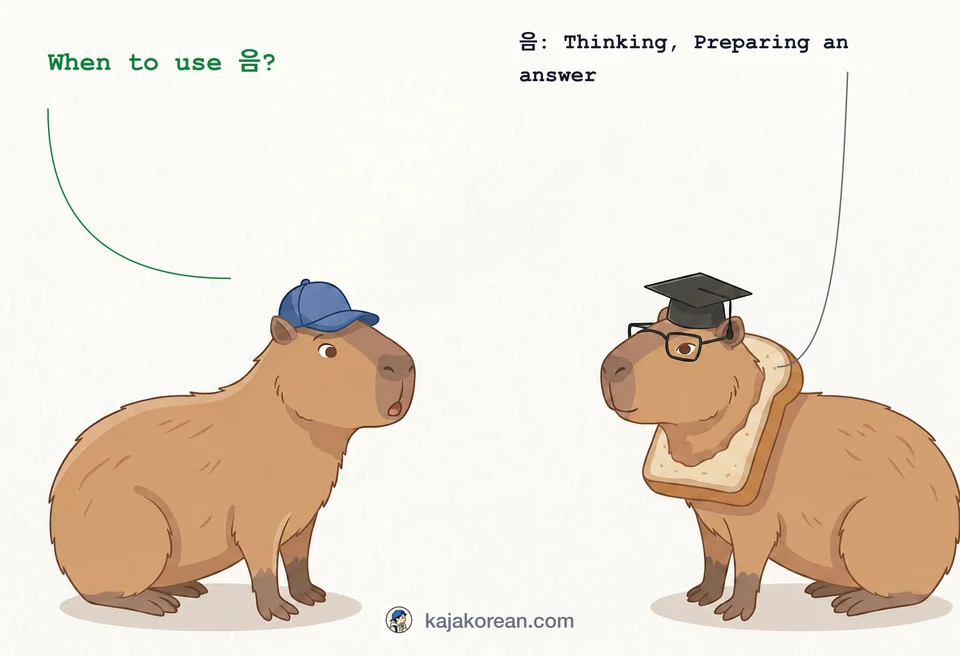
What does 음 mean?

음 (eum)

'음' in Korean shows hesitation or thinking during speech. It works as a natural filler in conversations.

Korean word 음 meaning hesitation or thinking sound

Definition & nuance

Core meaning and shades learners miss.

(eum)

'음' is a sound made when pausing to think or hesitate while speaking. It is mainly used in conversations to organize thoughts or prepare an answer.

Nuances

  • Signals attention beyond hesitation
  • Used more in casual than formal settings
  • Creates a friendly, natural atmosphere

When to use

Thinking, Preparing an answer, Pausing in conversation

In context

'음' is mainly used in spoken Korean, inserted mid-sentence or before answers. It has no grammatical function but serves as an interjection to aid meaning delivery.

Real-world examples

  • 음, 그건 좀 어려울 것 같아요.

    eum, geu-geon jom eo-ryeo-ul geos gat-a-yo., eum, geu geon jom eo ryeo ul geos gat a yo.

    '음' is naturally used as a thinking sound.

  • 음, 오늘 날씨가 좋아요.

    eum, o-neul nal-ssi-ga joh-a-yo., eum, o neul nal ssi ga joh a yo.

    Appropriate use when speaking while thinking.

  • 음, 네가 좋아해요.

    eum, ne-ga joh-a-hae-yo., eum, ne ga joh a hae yo.

    Shows hesitation before expressing feelings.

  • 음, 갑자기 왜 그래?

    eum, gap-ja-gi wae geu-rae?, eum, gap ja gi wae geu rae?

    Thinking sound reacting to the other person.

  • 음, 밥 먹었어요?

    eum, bap meok-eoss-eo-yo?, eum, bap meok eoss eo yo?

    Appropriate as a brief thinking sound before conversation.

  • 음, 내일 회의는 몇 시예요?

    eum, nae-il hoe-ui-neun myeoch si-ye-yo?, eum, nae il hoe ui neun myeoch si ye yo?

    Shows hesitation before asking a question.

  • 음, 그거 내가 할게.

    eum, geu-geo nae-ga hal-ge., eum, geu geo nae ga hal ge.

    Natural as a brief thinking sound before deciding.

  • 음, 지금 바빠요.

    eum, ji-geum ba-ppa-yo., eum, ji geum ba ppa yo.

    Appropriate as a thinking sound before answering.

Quick quiz

  1. In what situation is '음' mainly used?

    '음'은 주로 어떤 상황에서 사용되나요?('eum'eunju-roeo-tteonsang-hwang-e-seosa-yong-doe-na-yo?, 'eum'eunjuroeotteonsanghwangeseosayongdoenayo?)
  2. What is the correct role of '음'?

    '음'의 역할로 옳은 것은?('eum'uiyeok-hal-rool-eungeos-eun?, 'eum'uiyeokhalrooleungeoseun?)
  3. Which sentence uses '음' naturally?

    다음 중 '음'을 자연스럽게 사용한 문장은?(da-eumjung'eum'eulja-yeon-seu-reop-gesa-yong-hanmun-jang-eun?, daeumjung'eum'euljayeonseureopgesayonghanmunjangeun?)

More meaning guides

View all meaning guides →