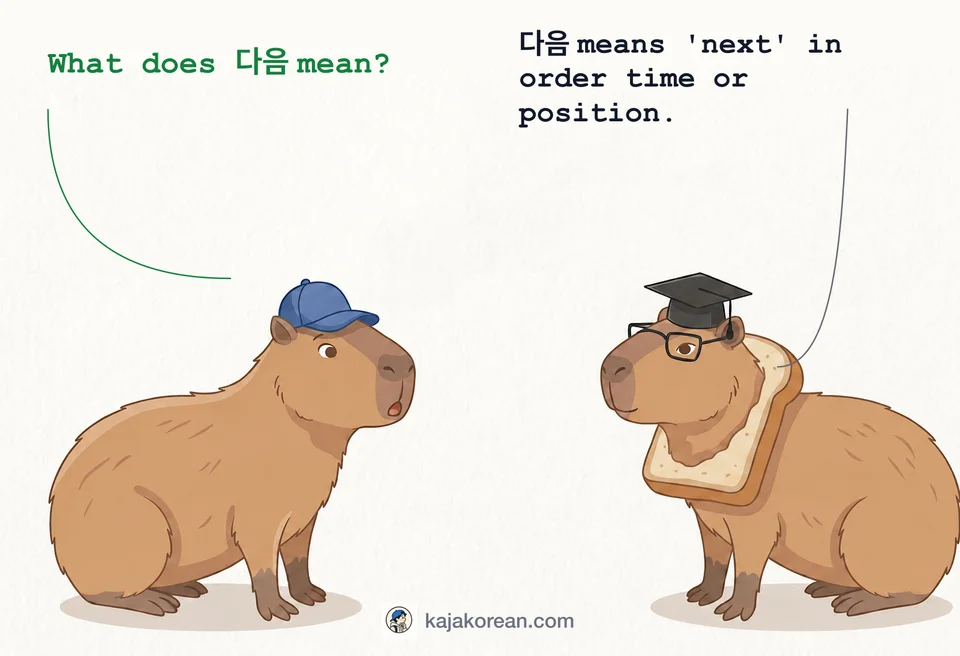
What does 다음 mean?

다음 (da-eum, daeum)

다음 (da-eum) means 'next' in time, order, or position. It's common in daily and formal contexts.

Meaning of Korean word 다음

Definition & nuance

Core meaning and shades learners miss.

다음(da-eum, daeum)

다음 means the one immediately following in order or time, like 'the next day' after today.

Nuances

  • emphasizes temporal order
  • can indicate spatial position
  • used for abstract sequences too

When to use

daily conversation, work instructions, time expressions

In context

다음 is mainly a noun used in '다음 + noun' form, but also functions as an adverb like '다음에'. It's suitable for both formal and informal contexts.

Real-world examples

  • 다음 주에 회의가 있습니다.

    da-eum ju-e hoe-ui-ga iss-seup-ni-da., da eum ju e hoe ui ga iss seup ni da.

    '다음 주' means the week immediately after this week, a natural phrase.

  • 다음 사람은 누구인가요?

    da-eum sa-ram-eun nu-gu-in-ga-yo?, da eum sa ram eun nu gu in ga yo?

    '다음 사람' correctly indicates the next person in order.

  • 다음에 봐요.

    da-eum-e bwa-yo., da eum e bwa yo.

    '다음에' is an adverb meaning 'next time'.

  • 다음 달에 여행 갈 거예요.

    da-eum dal-e yeo-haeng gal geo-ye-yo., da eum dal e yeo haeng gal geo ye yo.

    '다음 달' is a natural and accurate time expression.

  • 다음이 너무 어렵다.

    da-eum-i neo-mu eo-ryeop-da., da eum i neo mu eo ryeop da.

    Without a noun after '다음', the sentence is awkward; a noun is required.

  • 다음으로 이동하세요.

    da-eum-eu-ro i-dong-ha-se-yo., da eum eu ro i dong ha se yo.

    '다음으로' means 'to the next position' and is appropriate in commands.

  • 다음 음식은 맛있어요.

    da-eum eum-sik-eun mas-iss-eo-yo., da eum eum sik eun mas iss eo yo.

    Referring to the next food in order or list is natural.

Quick quiz

  1. What is the best meaning of 다음?

    다음의 뜻으로 가장 적절한 것은?(da-eum-uitteus-eu-roga-jangjeok-jeol-hangeos-eun?, daeumuitteuseurogajangjeokjeolhangeoseun?)
  2. What does '다음' mean in '다음 주에 만나요'?

    '다음 주에 만나요'에서 '다음'은 어떤 의미인가요?('da-eumju-eman-na-yo'e-seo'da-eum'euneo-tteonui-mi-in-ga-yo?, 'daeumjuemannayo'eseo'daeum'euneotteonuimiingayo?)
  3. What part of speech is '다음에' in '다음에 전화할게요'?

    '다음에 전화할게요' 문장에서 '다음에'의 품사는?('da-eum-ejeon-hwa-hal-ge-yo'mun-jang-e-seo'da-eum-e'uipum-sa-neun?, 'daeumejeonhwahalgeyo'munjangeseo'daeume'uipumsaneun?)

More meaning guides

View all meaning guides →