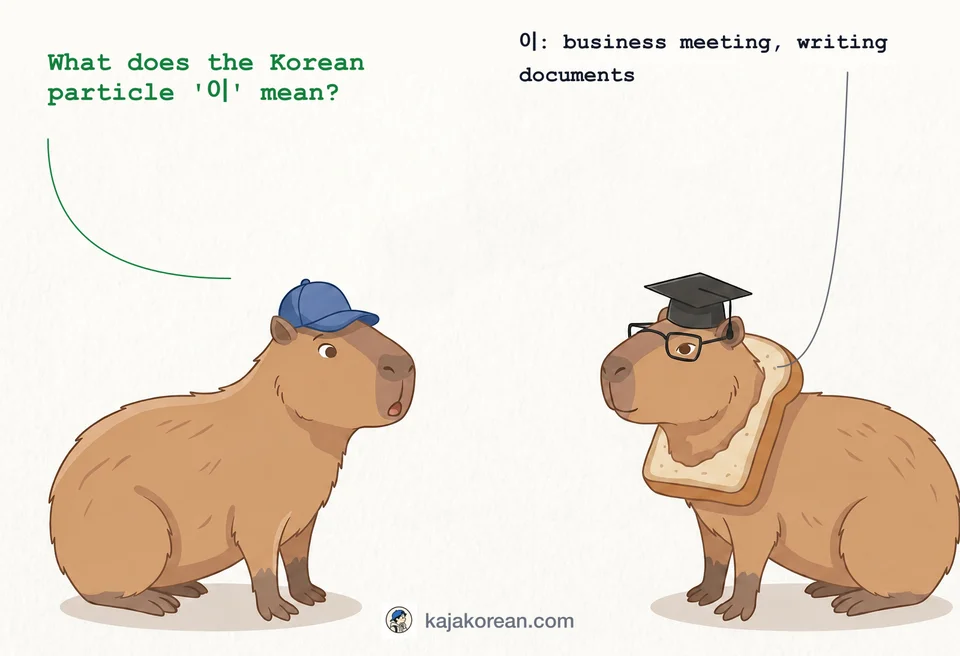
What does 이 mean?

이 (i)

'이' is a very common Korean word with multiple roles. This guide explains its core meanings and grammar use clearly.

Korean particle 이 explained with examples

Definition & nuance

Core meaning and shades learners miss.

(i)

'이' is mainly a subject particle attached to nouns, marking the subject in a sentence, similar to 'the' or 'this' in English.

Nuances

  • Subject particle for nouns with final consonant
  • Clearly marks the subject
  • Sometimes adds emphasis

When to use

daily conversation, business meeting, writing documents

In context

'이' is a subject particle attached to nouns ending with a consonant (batchim). It marks the subject of the sentence and functions as a case particle. For example, '책이' (the book) uses '이' because '책' ends with a consonant.

Real-world examples

  • 책이 재미있어요.

    chaek-i jae-mi-iss-eo-yo., chaek i jae mi iss eo yo.

    Correctly attaches subject particle '이' to noun '책' ending with a consonant.

  • 사과가 맛있어요.

    sa-gwa-ga mas-iss-eo-yo., sa gwa ga mas iss eo yo.

    '사과' has no final consonant, so subject particle '가' must be used.

  • 의자가 고장 났어요.

    ui-ja-ga go-jang nass-eo-yo., ui ja ga go jang nass eo yo.

    '의자' ends with a consonant, so '이' is correct.

  • 나무가 크다.

    na-mu-ga keu-da., na mu ga keu da.

    '나무' has no final consonant, so '가' must be used.

  • 이 사람이 선생님이에요.

    i sa-ram-i seon-saeng-nim-i-e-yo., i sa ram i seon saeng nim i e yo.

    '이' used as demonstrative meaning 'this'.

  • 이 책이 내 거야.

    i chaek-i nae geo-ya., i chaek i nae geo ya.

    Sentence uses demonstrative '이' and subject particle '이' together.

Quick quiz

  1. When is '이' used as a subject particle?

    '이'는 어떤 경우에 주격 조사로 쓰이나요?('i'neuneo-tteongyeong-u-eju-gyeokjo-sa-rosseu-i-na-yo?, 'i'neuneotteongyeonguejugyeokjosarosseuinayo?)
  2. What does '이' mean when used as a demonstrative?

    '이'가 지시사로 쓰일 때 의미는?('i'gaji-si-sa-rosseu-ilttaeui-mi-neun?, 'i'gajisisarosseuilttaeuimineun?)

More meaning guides

View all meaning guides →