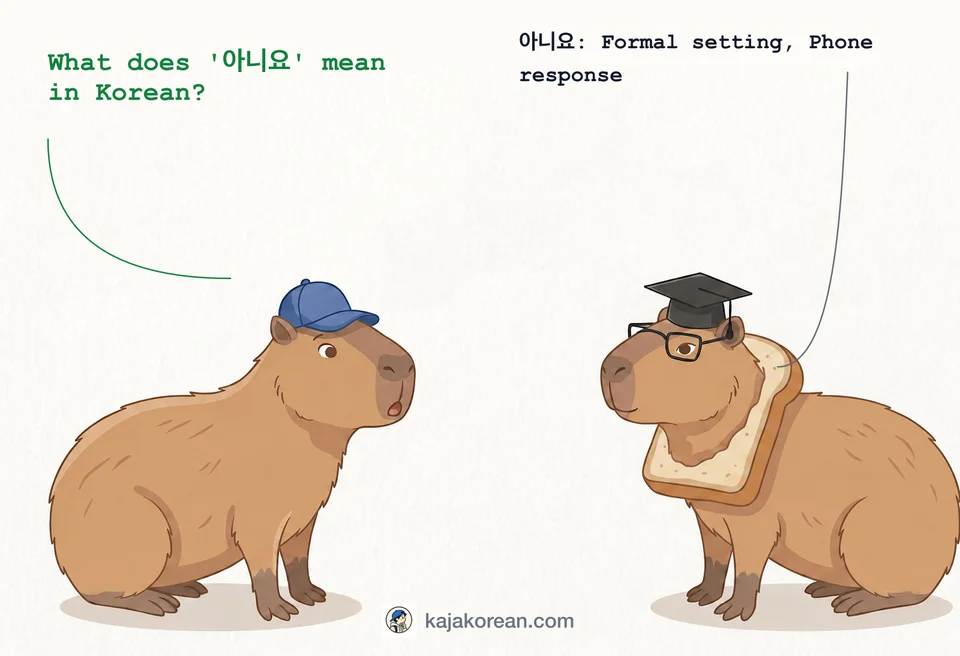
What does 아니요 mean?

아니요 (a-ni-yo, aniyo)

'아니요' is a polite Korean negation used to say 'no'. Common in daily and formal conversations.

Polite Korean word 아니요 meaning no

Definition & nuance

Core meaning and shades learners miss.

아니요(a-ni-yo, aniyo)

'아니요' is a polite expression used to negate or refuse someone's question or proposal.

Nuances

  • Polite and courteous negation
  • Can sound stiff among close friends
  • More natural and common than '아니오'

When to use

Everyday conversation, Formal setting, Phone response

In context

'아니요' functions as a standalone negation, mainly as an answer to questions. It is used in formal and polite contexts without needing a subject or verb in the sentence.

Real-world examples

  • 아니요, 저는 학생이 아니에요.

    a-ni-yo, jeo-neun hak-saeng-i a-ni-e-yo., a ni yo, jeo neun hak saeng i a ni e yo.

    '아니요' is correctly used as a polite negation in response to a question.

  • 아니요, 감사합니다.

    a-ni-yo, gam-sa-hap-ni-da., a ni yo, gam sa hap ni da.

    Appropriate polite refusal expression.

  • 아니요, 좋아요.

    a-ni-yo, joh-a-yo., a ni yo, joh a yo.

    '아니요' contradicts the positive phrase '좋아요', making it incorrect.

  • 아니요, 오늘은 못 가요.

    a-ni-yo, o-neul-eun mos ga-yo., a ni yo, o neul eun mos ga yo.

    Polite negation combined with an apology is correct.

  • 아니요, 먹었어요.

    a-ni-yo, meok-eoss-eo-yo., a ni yo, meok eoss eo yo.

    Natural response negating a question politely.

Quick quiz

  1. In which situation is '아니요' mainly used?

    '아니요'는 어떤 상황에서 주로 쓰이나요?('a-ni-yo'neuneo-tteonsang-hwang-e-seoju-rosseu-i-na-yo?, 'aniyo'neuneotteonsanghwangeseojurosseuinayo?)
  2. What is the most appropriate English meaning of '아니요'?

    '아니요'의 가장 적절한 영어 의미는?('a-ni-yo'uiga-jangjeok-jeol-hanyeong-eoui-mi-neun?, 'aniyo'uigajangjeokjeolhanyeongeouimineun?)
  3. Which sentence correctly uses '아니요'?

    다음 중 '아니요'를 올바르게 사용한 문장은?(da-eumjung'a-ni-yo'reulol-ba-reu-gesa-yong-hanmun-jang-eun?, daeumjung'aniyo'reulolbareugesayonghanmunjangeun?)

More meaning guides

View all meaning guides →