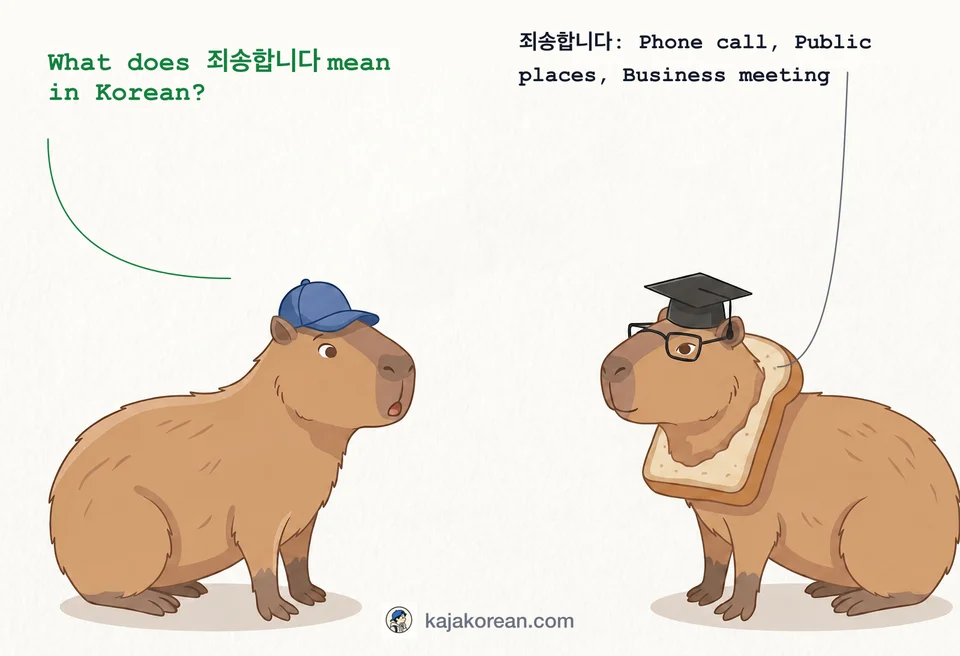
What does 죄송합니다 mean?

죄송합니다 (joe-song-hap-ni-da, joesonghapnida)

'죄송합니다' is a polite Korean expression to apologize, used in daily life and business.

Polite Korean apology phrase 죄송합니다

Definition & nuance

Core meaning and shades learners miss.

죄송합니다(joe-song-hap-ni-da, joesonghapnida)

'죄송합니다' is a polite phrase to apologize when you have caused inconvenience or made a mistake.

Nuances

  • More polite than '미안합니다'
  • Suitable for formal, respectful situations
  • Expresses sincere acknowledgment of fault
  • Used for minor to serious mistakes

When to use

Everyday conversation, Business meeting, Public places, Phone call

In context

'죄송합니다' is used to apologize directly to someone, placed at the end of a sentence in honorific form. It is used mainly in formal and polite contexts.

Real-world examples

  • 늦어서 죄송합니다.

    neuj-eo-seo joe-song-hap-ni-da., neuj eo seo joe song hap ni da.

    It is a polite apology for being late.

  • 죄송합니다, 다시 한번 말씀해 주세요.

    joe-song-hap-ni-da, da-si han-beon mal-sseum-hae ju-se-yo., joe song hap ni da, da si han beon mal sseum hae ju se yo.

    Appropriate polite expression when asking someone to repeat.

  • 죄송합니다만, 그건 불가능합니다.

    joe-song-hap-ni-da-man, geu-geon bul-ga-neung-hap-ni-da., joe song hap ni da man, geu geon bul ga neung hap ni da.

    Used politely to reject or deny.

  • 죄송합니다, 내일은 바쁩니다.

    joe-song-hap-ni-da, nae-il-eun ba-ppeup-ni-da., joe song hap ni da, nae il eun ba ppeup ni da.

    Polite apology while explaining a situation.

  • 죄송합니다, 이거 얼마예요?

    joe-song-hap-ni-da, i-geo eol-ma-ye-yo?, joe song hap ni da, i geo eol ma ye yo?

    Apologizing when asking price is unnatural and unnecessary.

  • 죄송합니다, 나중에 전화할게요.

    joe-song-hap-ni-da, na-jung-e jeon-hwa-hal-ge-yo., joe song hap ni da, na jung e jeon hwa hal ge yo.

    Polite apology when postponing a call.

  • 죄송합니다, 밥 먹었어요?

    joe-song-hap-ni-da, bap meok-eoss-eo-yo?, joe song hap ni da, bap meok eoss eo yo?

    Apologizing in casual greetings is inappropriate.

Quick quiz

  1. In which situation is '죄송합니다' mainly used?

    '죄송합니다'는 어떤 상황에서 주로 사용되나요?('joe-song-hap-ni-da'neuneo-tteonsang-hwang-e-seoju-rosa-yong-doe-na-yo?, 'joesonghapnida'neuneotteonsanghwangeseojurosayongdoenayo?)
  2. Which expression has the closest meaning to '죄송합니다'?

    '죄송합니다'와 가장 비슷한 의미를 가진 표현은?('joe-song-hap-ni-da'waga-jangbi-seus-hanui-mi-reulga-jinpyo-hyeon-eun?, 'joesonghapnida'wagajangbiseushanuimireulgajinpyohyeoneun?)
  3. Which sentence uses '죄송합니다' incorrectly?

    다음 중 '죄송합니다'를 잘못 사용한 문장은?(da-eumjung'joe-song-hap-ni-da'reuljal-mossa-yong-hanmun-jang-eun?, daeumjung'joesonghapnida'reuljalmossayonghanmunjangeun?)

More meaning guides

View all meaning guides →