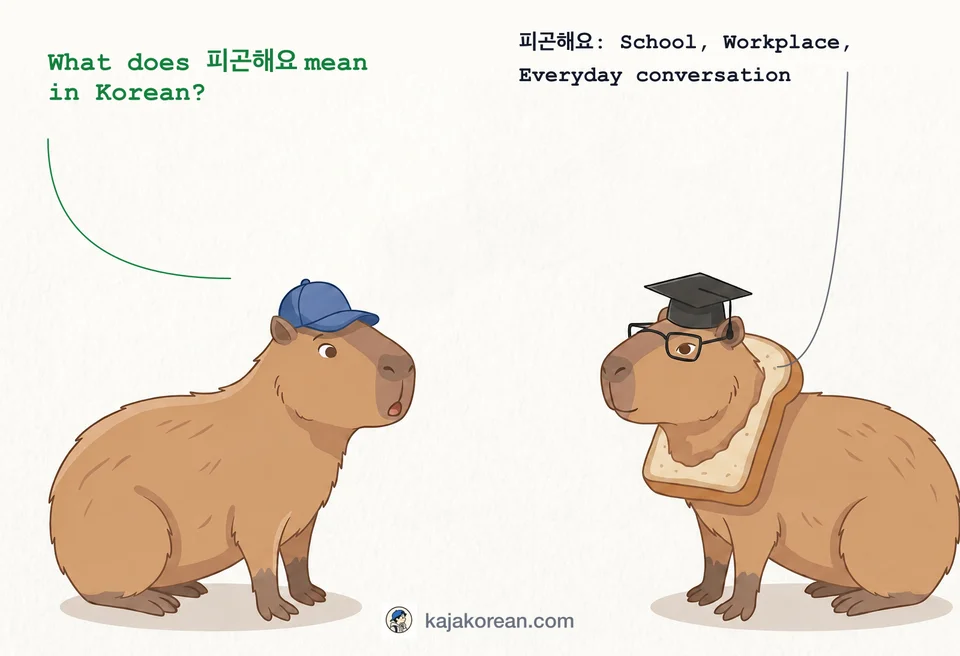
What does 피곤해요 mean?

피곤해요 (pi-gon-hae-yo, pigonhaeyo)

피곤해요 (pigonhaeyo) is a common expression used in daily conversation to express tiredness or fatigue.

Person looking tired and saying 피곤해요

Definition & nuance

Core meaning and shades learners miss.

피곤해요(pi-gon-hae-yo, pigonhaeyo)

피곤해요 is the polite form of '피곤하다,' meaning to be physically or mentally tired or exhausted.

Nuances

  • Includes both physical tiredness and mental stress
  • Used politely to inform others about your fatigue
  • Can be replaced with more casual forms among close friends

When to use

Everyday conversation, Workplace, School

In context

피곤해요 is the polite present tense form of the adjective '피곤하다' used to describe one's own or someone else's tiredness. It is commonly used in everyday conversation and is appropriate when speaking politely to others.

Real-world examples

  • 오늘 너무 피곤해요.

    o-neul neo-mu pi-gon-hae-yo., o neul neo mu pi gon hae yo.

    Correct sentence using polite form to express personal tiredness.

  • 피곤해요 친구.

    pi-gon-hae-yo chin-gu., pi gon hae yo chin gu.

    Subject and predicate are not properly connected, making the sentence grammatically incorrect.

  • 저는 지금 피곤해요.

    jeo-neun ji-geum pi-gon-hae-yo., jeo neun ji geum pi gon hae yo.

    Clear subject and time adverb with polite expression, making it correct.

  • 너 피곤해요?

    neo pi-gon-hae-yo?, neo pi gon hae yo?

    '너' is informal, so it does not match the polite '피곤해요' form.

  • 선생님, 피곤해요?

    seon-saeng-nim, pi-gon-hae-yo?, seon saeng nim, pi gon hae yo?

    Polite and respectful question properly combining honorifics and polite speech.

Quick quiz

  1. What does '피곤해요' mean?

    '피곤해요'는 어떤 뜻인가요?('pi-gon-hae-yo'neuneo-tteontteus-in-ga-yo?, 'pigonhaeyo'neuneotteontteusingayo?)
  2. Which sentence is correct?

    다음 중 올바른 문장은?(da-eumjungol-ba-reunmun-jang-eun?, daeumjungolbareunmunjangeun?)

More meaning guides

View all meaning guides →