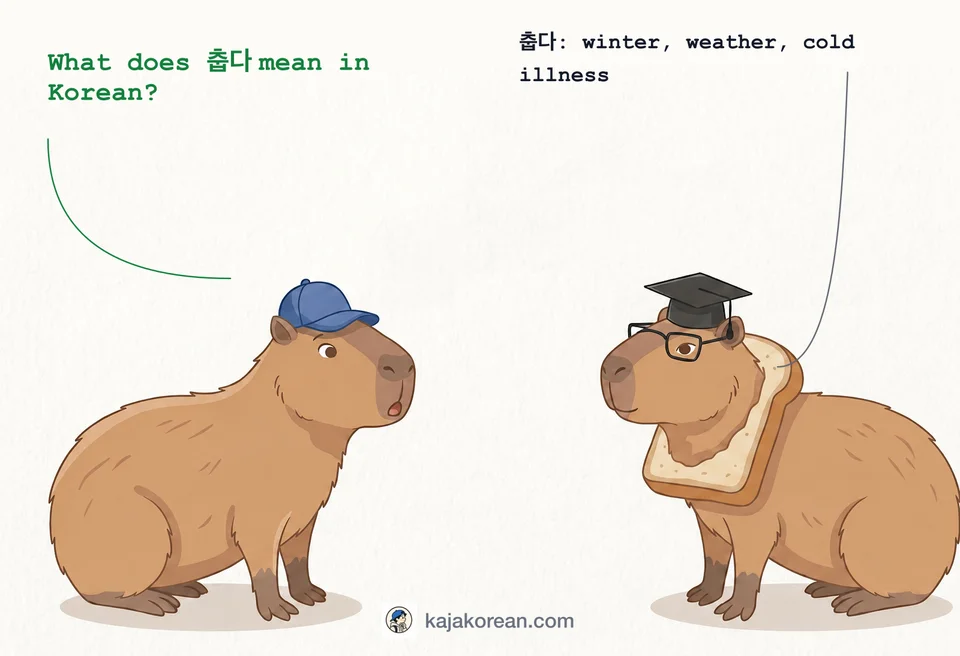
What does 춥다 mean?

춥다 (chup-da, chupda)

춥다 (chup-da) describes feeling cold due to low temperature or environment.

Korean word 춥다 meaning cold

Definition & nuance

Core meaning and shades learners miss.

춥다(chup-da, chupda)

춥다 means 'to be cold' describing a low temperature causing discomfort.

Nuances

  • Used mainly when the temperature is low.
  • May differ from actual temperature to personal feeling.
  • Basic and common word to express coldness.
  • Can be used metaphorically to describe cold feelings or atmosphere.

When to use

weather, indoor temperature, cold illness, winter

In context

춥다 is an adjective used mainly for weather, temperature, or environment. The subject is usually a person or place. It functions as a predicate to describe a state. It is natural in both spoken and written Korean.

Real-world examples

  • 밖이 너무 추워서 코트가 필요해.

    bakk-i neo-mu chu-wo-seo ko-teu-ga pil-yo-hae., bakk i neo mu chu wo seo ko teu ga pil yo hae.

    춥다 naturally describes cold weather outside.

  • 나는 오늘 기분이 춥다.

    na-neun o-neul gi-bun-i chup-da., na neun o neul gi bun i chup da.

    춥다 does not describe moods directly.

  • 방 안이 춥다.

    bang an-i chup-da., bang an i chup da.

    Using 춥다 for indoor temperature is correct.

  • 나는 추워서 창문을 열었어.

    na-neun chu-wo-seo chang-mun-eul yeol-eoss-eo., na neun chu wo seo chang mun eul yeol eoss eo.

    Opening a window when cold is contradictory.

  • 겨울에는 항상 춥다.

    gyeo-ul-e-neun hang-sang chup-da., gyeo ul e neun hang sang chup da.

    Winter is cold, so using 춥다 is appropriate.

  • 그 사람은 춥다.

    geu sa-ram-eun chup-da., geu sa ram eun chup da.

    춥다 does not describe personality.

Quick quiz

  1. What is the exact meaning of ‘춥다’?

    ‘춥다’의 정확한 뜻은 무엇인가요?(‘chup-da’uijeong-hwak-hantteus-eunmu-eos-in-ga-yo?, ‘chupda’uijeonghwakhantteuseunmueosingayo?)
  2. Which sentence uses ‘춥다’ correctly?

    다음 중 ‘춥다’를 올바르게 사용한 문장은?(da-eumjung‘chup-da’reulol-ba-reu-gesa-yong-hanmun-jang-eun?, daeumjung‘chupda’reulolbareugesayonghanmunjangeun?)

More meaning guides

View all meaning guides →