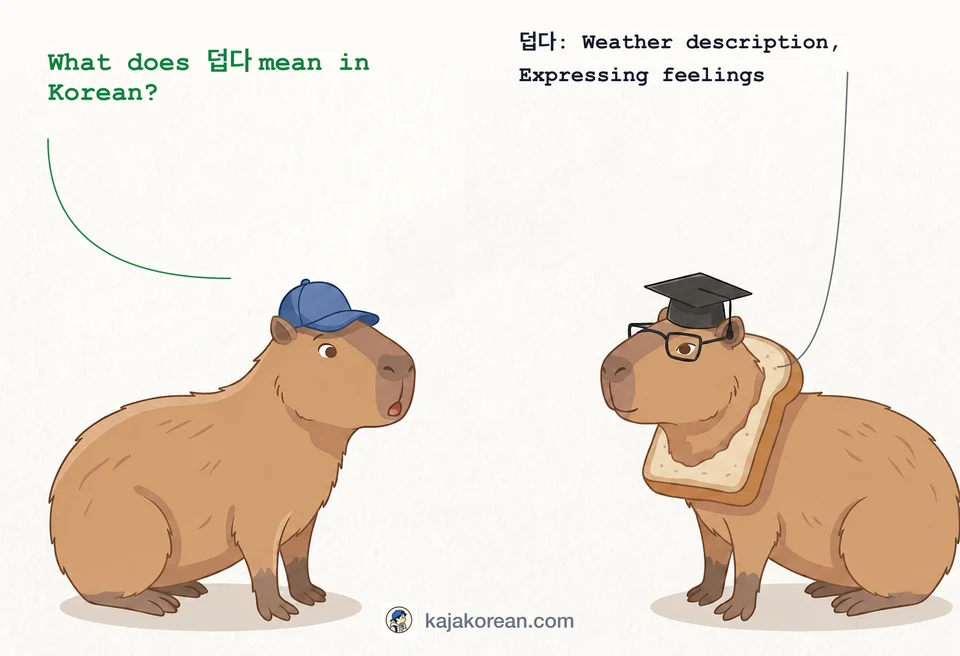
What does 덥다 mean?

덥다 (deop-da, deopda)

'덥다' in Korean mainly describes a high temperature causing discomfort or hardship.

Korean word 덥다 meaning hot or warm

Definition & nuance

Core meaning and shades learners miss.

덥다(deop-da, deopda)

'덥다' is an adjective that describes a state of being hot due to high temperature.

Nuances

  • Conveys not just high temperature but also discomfort or stuffiness
  • Can describe people, places, or situations
  • Similar to '더위' (heat), but '덥다' is an adjective

When to use

Weather description, Expressing feelings, Everyday conversation

In context

'덥다' is an adjective used when the subject (person, place, weather) is hot or uncomfortably warm. It typically appears as subject + 가/이 + 덥다. It suits casual and spoken Korean.

Real-world examples

  • 오늘 날씨가 정말 덥다.

    o-neul nal-ssi-ga jeong-mal deop-da., o neul nal ssi ga jeong mal deop da.

    Subject (weather) correctly described as hot.

  • 나는 덥다.

    na-neun deop-da., na neun deop da.

    Natural sentence expressing a person feeling hot.

  • 이 방은 너무 덥다.

    i bang-eun neo-mu deop-da., i bang eun neo mu deop da.

    Uses place as subject to express high temperature.

  • 덥다 오늘 날씨.

    deop-da o-neul nal-ssi., deop da o neul nal ssi.

    Word order is unnatural and grammatically incorrect.

  • 덥다 사람이.

    deop-da sa-ram-i., deop da sa ram i.

    Subject and predicate order reversed causing grammar error.

  • 밖이 너무 덥다.

    bakk-i neo-mu deop-da., bakk i neo mu deop da.

    Naturally connects place (outside) with 덥다.

  • 덥다 느낌이 들어요.

    deop-da neu-kkim-i deul-eo-yo., deop da neu kkim i deul eo yo.

    '덥다' is an adjective and doesn't fit well with '느낌이 들어요'.

Quick quiz

  1. What does '덥다' mean?

    '덥다'는 어떤 뜻인가요?('deop-da'neuneo-tteontteus-in-ga-yo?, 'deopda'neuneotteontteusingayo?)
  2. Which sentence is correct?

    다음 문장 중 올바른 문장은?(da-eummun-jangjungol-ba-reunmun-jang-eun?, daeummunjangjungolbareunmunjangeun?)
  3. When is it incorrect to use '덥다'?

    '덥다'를 사용할 수 없는 경우는?('deop-da'reulsa-yong-halsueop-neungyeong-u-neun?, 'deopda'reulsayonghalsueopneungyeonguneun?)

More meaning guides

View all meaning guides →