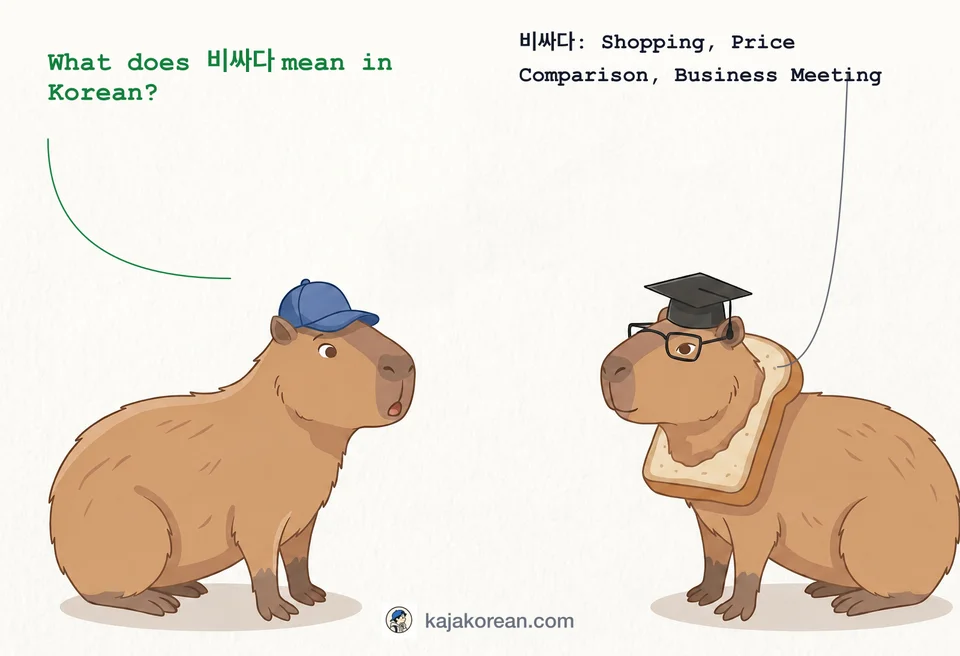
What does 비싸다 mean?

비싸다 (bi-ssa-da, bissada)

비싸다 (bissada) means 'to be expensive' and is commonly used in everyday and business Korean.

Price tag showing expensive price

Definition & nuance

Core meaning and shades learners miss.

비싸다(bi-ssa-da, bissada)

비싸다 means that the price of an item or service is high compared to normal or expected.

Nuances

  • Implies price is high relative to value, not just absolute.
  • Includes subjective judgment about cost.
  • Used comparatively against other items or expectations.

When to use

Shopping, Price Comparison, Business Meeting

In context

비싸다 is an adjective used to describe a noun with a high price. It commonly appears as ‘~이/가 비싸다’. It can be modified by adverbs like ‘너무’ (too) or ‘조금’ (a little) to express degree.

Real-world examples

  • 이 가방은 너무 비싸요.

    i ga-bang-eun neo-mu bi-ssa-yo., i ga bang eun neo mu bi ssa yo.

    ‘가방’ is the subject and ‘비싸다’ is correctly used as an adjective.

  • 이 음식은 비싸다.

    i eum-sik-eun bi-ssa-da., i eum sik eun bi ssa da.

    ‘음식’ is the subject and ‘비싸다’ is appropriately used.

  • 비싸다 이 신발.

    bi-ssa-da i sin-bal., bi ssa da i sin bal.

    Incorrect word order and missing subject make it unnatural.

  • 그 차는 비싸요.

    geu cha-neun bi-ssa-yo., geu cha neun bi ssa yo.

    ‘That car’ is the subject and ‘비싸다’ is properly used.

  • 비싸다 너무 그 집.

    bi-ssa-da neo-mu geu jip., bi ssa da neo mu geu jip.

    Adverb ‘너무’ must precede adjective; word order is wrong.

Quick quiz

  1. What does ‘비싸다’ mean?

    ‘비싸다’의 뜻은 무엇인가요?(‘bi-ssa-da’uitteus-eunmu-eos-in-ga-yo?, ‘bissada’uitteuseunmueosingayo?)
  2. Which sentence uses ‘비싸다’ correctly?

    다음 문장에서 ‘비싸다’가 올바르게 쓰인 문장은?(da-eummun-jang-e-seo‘bi-ssa-da’gaol-ba-reu-gesseu-inmun-jang-eun?, daeummunjangeseo‘bissada’gaolbareugesseuinmunjangeun?)

More meaning guides

View all meaning guides →