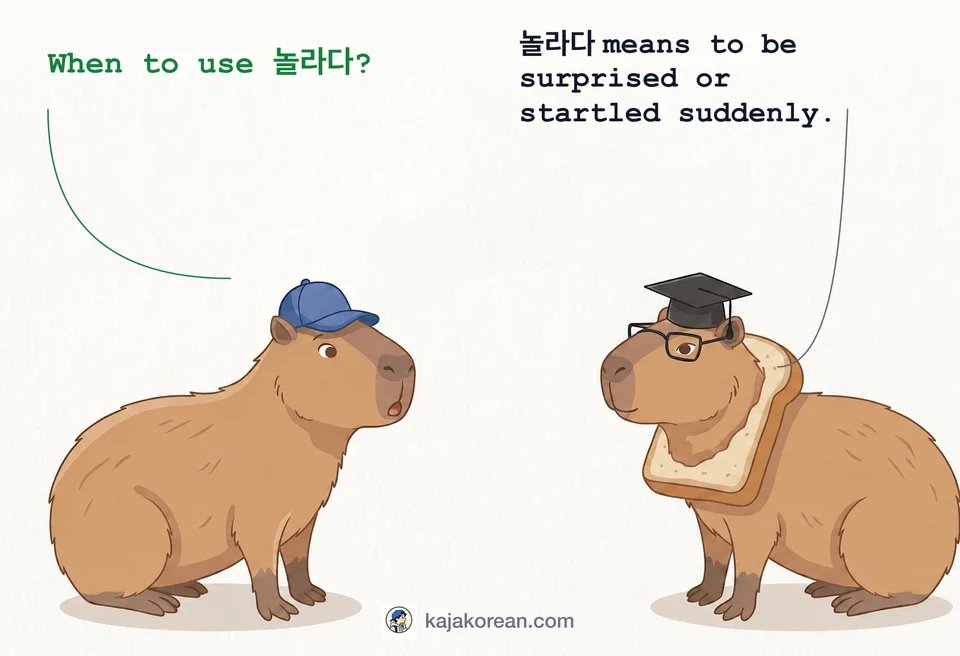
What does 놀라다 mean?

놀라다 (nol-ra-da, nolrada)

놀라다 (nollada) means to be surprised or startled by something sudden. It's common in daily conversation.

Definition of 놀라다 in Korean

Definition & nuance

Core meaning and shades learners miss.

놀라다(nol-ra-da, nolrada)

놀라다 means to be suddenly surprised or startled due to an unexpected event or situation.

Nuances

  • Immediate reaction to sudden situations
  • Can express both positive and negative surprise
  • Used mainly with human subjects

When to use

daily conversation, expressing emotions, news reaction

In context

놀라다 is an intransitive verb mainly used with a person as the subject to express emotion. It commonly appears as ‘~에 놀라다’ to indicate the cause or reason of surprise.

Real-world examples

  • 갑자기 큰 소리에 놀랐어요.

    gap-ja-gi keun so-ri-e nol-rass-eo-yo., gap ja gi keun so ri e nol rass eo yo.

    ‘놀랐다’ naturally expresses a reaction to a sudden noise.

  • 그 소식에 모두가 놀랐다.

    geu so-sik-e mo-du-ga nol-rass-da., geu so sik e mo du ga nol rass da.

    The cause is clearly indicated with ‘~에 놀랐다’.

  • 나는 놀라다 그를 만났다.

    na-neun nol-ra-da geu-reul man-nass-da., na neun nol ra da geu reul man nass da.

    ‘놀라다’ is intransitive and cannot take a direct object.

  • 그녀는 그의 행동에 놀랐어요.

    geu-nyeo-neun geu-ui haeng-dong-e nol-rass-eo-yo., geu nyeo neun geu ui haeng dong e nol rass eo yo.

    Cause expression with ‘~에 놀랐다’ is correct.

  • 나는 놀라서 말을 잇지 못했다.

    na-neun nol-ra-seo mal-eul is-ji mos-haess-da., na neun nol ra seo mal eul is ji mos haess da.

    ‘놀라서’ naturally connects cause and effect.

Quick quiz

  1. What does '놀라다' mean?

    ‘놀라다’의 뜻은 무엇인가요?(‘nol-ra-da’uitteus-eunmu-eos-in-ga-yo?, ‘nolrada’uitteuseunmueosingayo?)
  2. Fill in the blank: ‘그는 갑자기 큰 소리에 ___.’

    ‘그는 갑자기 큰 소리에 ___.’ 빈칸에 들어갈 올바른 단어는?(‘geu-neungap-ja-gikeunso-ri-e___.’bin-kan-edeul-eo-galol-ba-reundan-eo-neun?, ‘geuneungapjagikeunsorie___.’binkanedeuleogalolbareundaneoneun?)
  3. What type of verb is ‘놀라다’?

    ‘놀라다’는 어떤 동사인가요?(‘nol-ra-da’neuneo-tteondong-sa-in-ga-yo?, ‘nolrada’neuneotteondongsaingayo?)

More meaning guides

View all meaning guides →