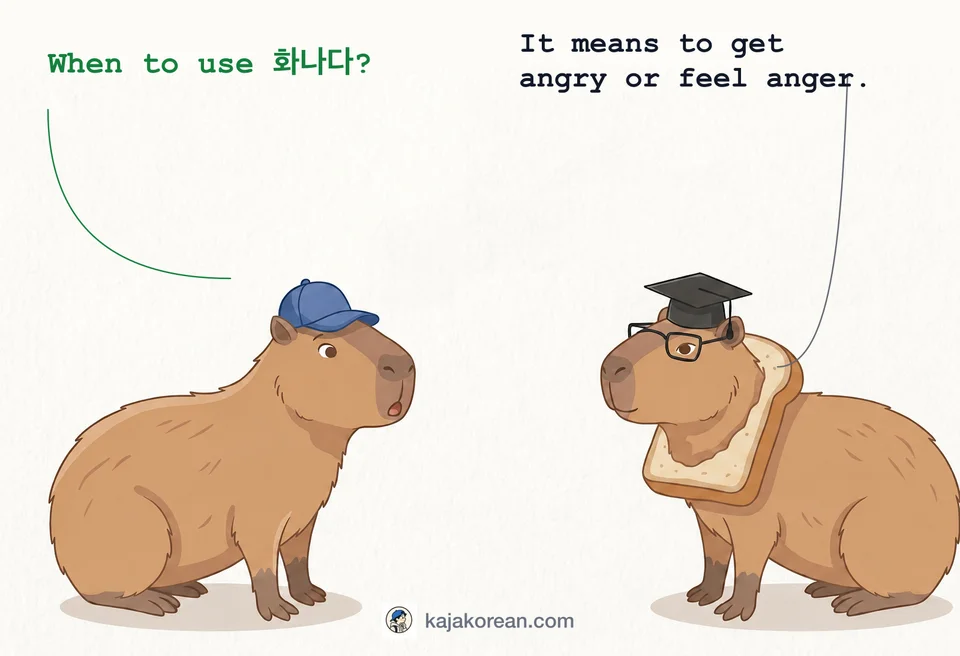
What does 화나다 mean?

화나다 (hwa-na-da, hwanada)

화나다 (hwanada) means 'to get angry'; used when feeling irritation or anger toward someone or something.

Expression of anger in Korean

Definition & nuance

Core meaning and shades learners miss.

화나다(hwa-na-da, hwanada)

화나다 is an emotion verb that expresses the state of becoming angry or feeling anger.

Nuances

  • 화나다 can describe both brief and lasting anger.
  • It specifically expresses negative emotions, not happiness or sadness.
  • It means the same as '화가 나다' but is a more concise form.

When to use

daily conversation, expressing emotions, workplace, family

In context

화나다 is an intransitive verb used with a subject expressing anger. It commonly appears in the pattern '누구에게 화나다' (to be angry at someone). It is natural in both spoken and written Korean.

Real-world examples

  • 나는 그 사람의 말에 화났다.

    na-neun geu sa-ram-ui mal-e hwa-nass-da., na neun geu sa ram ui mal e hwa nass da.

    The subject and 화나다 are naturally connected to express emotion.

  • 화나서 소리를 질렀다.

    hwa-na-seo so-ri-reul jil-reoss-da., hwa na seo so ri reul jil reoss da.

    화나다 expresses the emotional state leading to an action.

  • 나는 화나다 그 영화가 재미없어서.

    na-neun hwa-na-da geu yeong-hwa-ga jae-mi-eop-eo-seo., na neun hwa na da geu yeong hwa ga jae mi eop eo seo.

    '나는 화나다' is grammatically incorrect; '나는 화났다' or '화가 났다' is correct.

  • 그녀는 친구에게 화났다.

    geu-nyeo-neun chin-gu-e-ge hwa-nass-da., geu nyeo neun chin gu e ge hwa nass da.

    Natural sentence with 화나다 used with '누구에게'.

  • 나는 화나서 울었다.

    na-neun hwa-na-seo ul-eoss-da., na neun hwa na seo ul eoss da.

    화나다 is used to indicate cause or emotional state.

Quick quiz

  1. What does '화나다' mean?

    '화나다'의 뜻은 무엇인가요?('hwa-na-da'uitteus-eunmu-eos-in-ga-yo?, 'hwanada'uitteuseunmueosingayo?)
  2. Which sentence is correct?

    다음 중 올바른 문장은?(da-eumjungol-ba-reunmun-jang-eun?, daeumjungolbareunmunjangeun?)
  3. What does '누구에게 화나다' mean?

    '누구에게 화나다'는 어떤 뜻인가요?('nu-gu-e-gehwa-na-da'neuneo-tteontteus-in-ga-yo?, 'nuguegehwanada'neuneotteontteusingayo?)

More meaning guides

View all meaning guides →