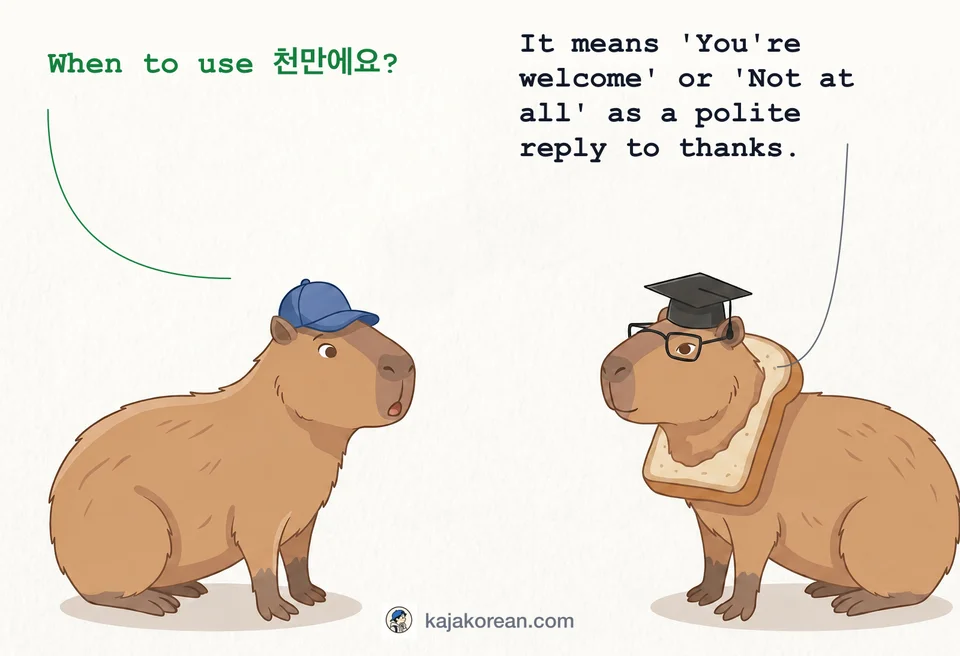
What does 천만에요 mean?

천만에요 (cheon-man-e-yo, cheonmaneyo)

천만에요 (cheonmaneyo) is a humble Korean response to thanks, meaning 'not at all' or 'you're welcome.'

Korean phrase 천만에요 meaning you're welcome

Definition & nuance

Core meaning and shades learners miss.

천만에요(cheon-man-e-yo, cheonmaneyo)

천만에요 is a humble expression used to respond to thanks, meaning 'not at all' or 'you're welcome.'

Nuances

  • Humble response that minimizes the burden of thanks
  • Abbreviation of '천만의 말씀', sounding polite and respectful
  • Used mainly as a spoken reply to verbal thanks

When to use

Thanking, Everyday conversation, Formal occasions

In context

천만에요 is used mainly as a polite and humble reply to thanks. It fits both casual and formal contexts but is more natural in everyday polite conversations rather than very stiff formal settings.

Real-world examples

  • 감사합니다!

    gam-sa-hap-ni-da!, gam sa hap ni da!

    Natural reply to a thank you.

  • 천만에요, 별말씀을요.

    cheon-man-e-yo, byeol-mal-sseum-eul-yo., cheon man e yo, byeol mal sseum eul yo.

    천만에요 is an appropriate humble reply.

  • 천만에요, 제가 잘했어요.

    cheon-man-e-yo, je-ga jal-haess-eo-yo., cheon man e yo, je ga jal haess eo yo.

    천만에요 is not used with self-praise.

  • 도와줘서 고마워요. 천만에요.

    do-wa-jwo-seo go-ma-wo-yo. cheon-man-e-yo., do wa jwo seo go ma wo yo. cheon man e yo.

    Natural reply to thanks.

  • 천만에요, 신경 쓰지 마세요.

    cheon-man-e-yo, sin-gyeong sseu-ji ma-se-yo., cheon man e yo, sin gyeong sseu ji ma se yo.

    Appropriate humble response to thanks.

Quick quiz

  1. In which situation is '천만에요' mainly used?

    '천만에요'는 어떤 상황에서 주로 쓰이나요?('cheon-man-e-yo'neuneo-tteonsang-hwang-e-seoju-rosseu-i-na-yo?, 'cheonmaneyo'neuneotteonsanghwangeseojurosseuinayo?)
  2. What is the most appropriate English meaning of '천만에요'?

    '천만에요'의 가장 적절한 영어 뜻은?('cheon-man-e-yo'uiga-jangjeok-jeol-hanyeong-eotteus-eun?, 'cheonmaneyo'uigajangjeokjeolhanyeongeotteuseun?)
  3. What nuance does '천만에요' carry?

    '천만에요'는 어떤 뉘앙스를 가지고 있나요?('cheon-man-e-yo'neuneo-tteonnwi-ang-seu-reulga-ji-goiss-na-yo?, 'cheonmaneyo'neuneotteonnwiangseureulgajigoissnayo?)

More meaning guides

View all meaning guides →