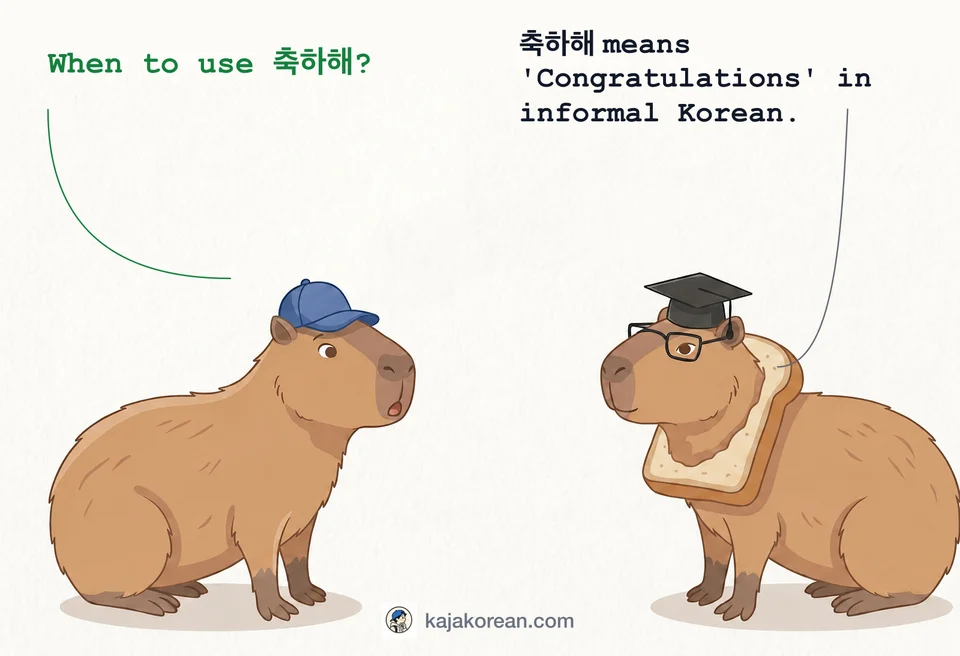
What does 축하해 mean?

축하해 (chuk-ha-hae, chukhahae)

축하해 (chukhahae) is a casual way to congratulate someone on their good news or achievement, often used among friends and family.

Korean word 축하해 meaning congratulations

Definition & nuance

Core meaning and shades learners miss.

축하해(chuk-ha-hae, chukhahae)

축하해 is an informal way to express congratulations for someone's good event or achievement, used mainly among close friends or family.

Nuances

  • Used naturally only among close people
  • Informal congratulatory phrase
  • Can express warmth and friendliness
  • Inappropriate in formal situations

When to use

Friend's birthday, Graduation celebration, Promotion congrats, Wedding

In context

축하해 is the informal present tense form of the verb 축하하다 (to congratulate), used directly to the listener in casual speech. The polite forms are 축하합니다 or 축하해요.

Real-world examples

  • 시험에 합격했어! 축하해!

    si-heom-e hap-gyeok-haess-eo! chuk-ha-hae!, si heom e hap gyeok haess eo! chuk ha hae!

    Natural informal congratulation to a friend.

  • 축하해, 선생님!

    chuk-ha-hae, seon-saeng-nim!, chuk ha hae, seon saeng nim!

    Using informal speech to a teacher is inappropriate.

  • 결혼 축하해!

    gyeol-hon chuk-ha-hae!, gyeol hon chuk ha hae!

    Friendly congratulation suitable for friends or colleagues.

  • 축하해요, 사장님!

    chuk-ha-hae-yo, sa-jang-nim!, chuk ha hae yo, sa jang nim!

    Polite form appropriate for a superior.

  • 졸업 축하해!

    jol-eop chuk-ha-hae!, jol eop chuk ha hae!

    Natural phrase to a close friend.

  • 축하해, 아버지!

    chuk-ha-hae, a-beo-ji!, chuk ha hae, a beo ji!

    Appropriate informal congratulation within family.

Quick quiz

  1. Which is the natural way to congratulate a friend who got a job?

    친구가 취직했을 때 어떤 표현이 자연스러운가요?(chin-gu-gachwi-jik-haess-eulttaeeo-tteonpyo-hyeon-ija-yeon-seu-reo-un-ga-yo?, chingugachwijikhaesseulttaeeotteonpyohyeonijayeonseureoungayo?)
  2. What is the appropriate congratulatory phrase to a boss?

    상사에게 축하 인사를 할 때 적절한 표현은?(sang-sa-e-gechuk-hain-sa-reulhalttaejeok-jeol-hanpyo-hyeon-eun?, sangsaegechukhainsareulhalttaejeokjeolhanpyohyeoneun?)
  3. Which is NOT an informal congratulatory expression?

    다음 중 반말 축하 표현이 아닌 것은?(da-eumjungban-malchuk-hapyo-hyeon-ia-ningeos-eun?, daeumjungbanmalchukhapyohyeonianingeoseun?)

More meaning guides

View all meaning guides →