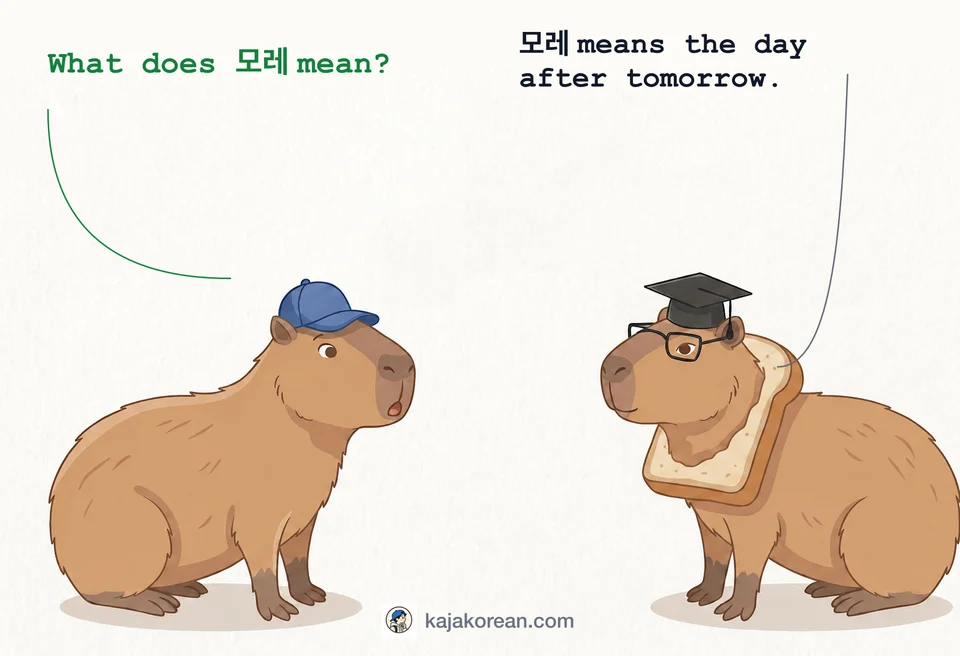
What does 모레 mean?

모레 (mo-re, more)

모레 means the day after tomorrow, counting two days from today.

Calendar showing the day after tomorrow highlighted

Definition & nuance

Core meaning and shades learners miss.

모레(mo-re, more)

모레 refers to the day after tomorrow, two days from today.

Nuances

  • Specifically means the day after tomorrow, not just near future.
  • Used to clearly specify a future date two days ahead.
  • Distinguishes clearly from today and tomorrow in time expressions.

When to use

daily conversation, making appointments, time expression

In context

모레 is used as an adverb of time to indicate the day after tomorrow. It appears in sentences to specify dates or times, e.g., 'Let's meet 모레.' It is common in both formal and informal speech.

Real-world examples

  • 모레 친구하고 영화 보러 갈 거예요.

    mo-re chin-gu-ha-go yeong-hwa bo-reo gal geo-ye-yo., mo re chin gu ha go yeong hwa bo reo gal geo ye yo.

    모레 correctly indicates two days from today, making the sentence clear.

  • 모레는 비가 올 거예요.

    mo-re-neun bi-ga ol geo-ye-yo., mo re neun bi ga ol geo ye yo.

    Using 모레 specifies the forecast for the day after tomorrow.

  • 모레 어제 만나자.

    mo-re eo-je man-na-ja., mo re eo je man na ja.

    모레 refers to future, so it cannot be combined with past 'yesterday'.

  • 모레 학교에 갈 거야.

    mo-re hak-gyo-e gal geo-ya., mo re hak gyo e gal geo ya.

    모레 correctly indicates a future day two days from today.

  • 모레가 내일이다.

    mo-re-ga nae-il-i-da., mo re ga nae il i da.

    모레 cannot be the same as tomorrow.

Quick quiz

  1. What day does 모레 refer to?

    모레가 의미하는 날은 언제인가요?(mo-re-gaui-mi-ha-neunnal-euneon-je-in-ga-yo?, moregauimihaneunnaleuneonjeingayo?)
  2. Which sentence uses 모레 correctly?

    다음 중 모레를 올바르게 사용한 문장은?(da-eumjungmo-re-reulol-ba-reu-gesa-yong-hanmun-jang-eun?, daeumjungmorereulolbareugesayonghanmunjangeun?)
  3. What kind of time expression is 모레?

    모레는 어떤 시간 표현인가요?(mo-re-neuneo-tteonsi-ganpyo-hyeon-in-ga-yo?, moreneuneotteonsiganpyohyeoningayo?)

More meaning guides

View all meaning guides →