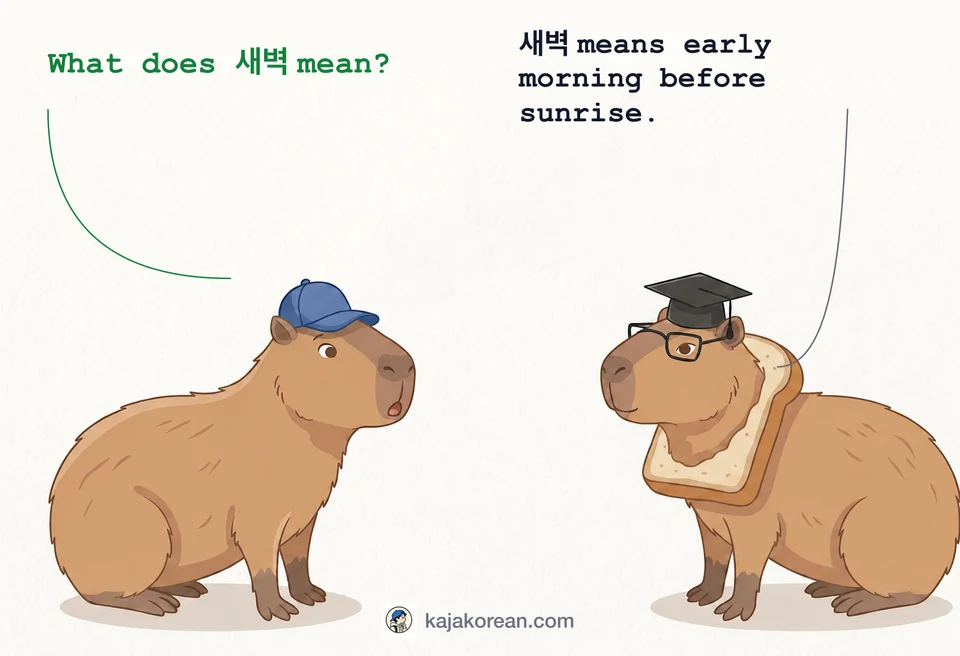
What does 새벽 mean?

새벽 (sae-byeok, saebyeok)

새벽 (saebyeok) refers to the time between night and morning, usually early morning before sunrise.

Korean word 새벽 meaning early morning

Definition & nuance

Core meaning and shades learners miss.

새벽(sae-byeok, saebyeok)

새벽 means the time between night and morning, roughly from 1 AM to 5 or 6 AM.

Nuances

  • 새벽 marks the boundary between night and morning, very early morning.
  • Usually refers to the quiet time before sunrise.
  • Saying 'wake up at 새벽' means starting activities very early.

When to use

daily conversation, time expression, literary usage

In context

새벽 is a noun used to indicate a time period. It commonly appears with particles like ‘~에’ (at), ‘~부터’ (from), or ‘~까지’ (until). It is natural in both spoken and written Korean.

Real-world examples

  • 새벽에 일어나서 운동을 해요.

    sae-byeok-e il-eo-na-seo un-dong-eul hae-yo., sae byeok e il eo na seo un dong eul hae yo.

    ‘새벽에’ correctly indicates the time 'at dawn'.

  • 나는 새벽부터 공부를 시작했어.

    na-neun sae-byeok-bu-teo gong-bu-reul si-jak-haess-eo., na neun sae byeok bu teo gong bu reul si jak haess eo.

    ‘새벽부터’ naturally means 'starting from dawn'.

  • 새벽까지 파티했어요.

    sae-byeok-kka-ji pa-ti-haess-eo-yo., sae byeok kka ji pa ti haess eo yo.

    ‘새벽까지’ appropriately means 'until dawn'.

  • 새벽에 잠을 잤어요.

    sae-byeok-e jam-eul jass-eo-yo., sae byeok e jam eul jass eo yo.

    ‘Sleeping at dawn’ is unnatural; usually people say ‘wake up at dawn’.

  • 새벽은 밤과 아침 사이의 시간이에요.

    sae-byeok-eun bam-gwa a-chim sa-i-ui si-gan-i-e-yo., sae byeok eun bam gwa a chim sa i ui si gan i e yo.

    This sentence accurately defines 새벽.

Quick quiz

  1. What time does '새벽' refer to?

    '새벽'은 어떤 시간을 의미하나요?('sae-byeok'euneo-tteonsi-gan-eului-mi-ha-na-yo?, 'saebyeok'euneotteonsiganeuluimihanayo?)
  2. Which sentence is correct?

    다음 중 올바른 문장은?(da-eumjungol-ba-reunmun-jang-eun?, daeumjungolbareunmunjangeun?)
  3. What does ‘새벽부터’ mean?

    ‘새벽부터’의 의미는?(‘sae-byeok-bu-teo’uiui-mi-neun?, ‘saebyeokbuteo’uiuimineun?)

More meaning guides

View all meaning guides →