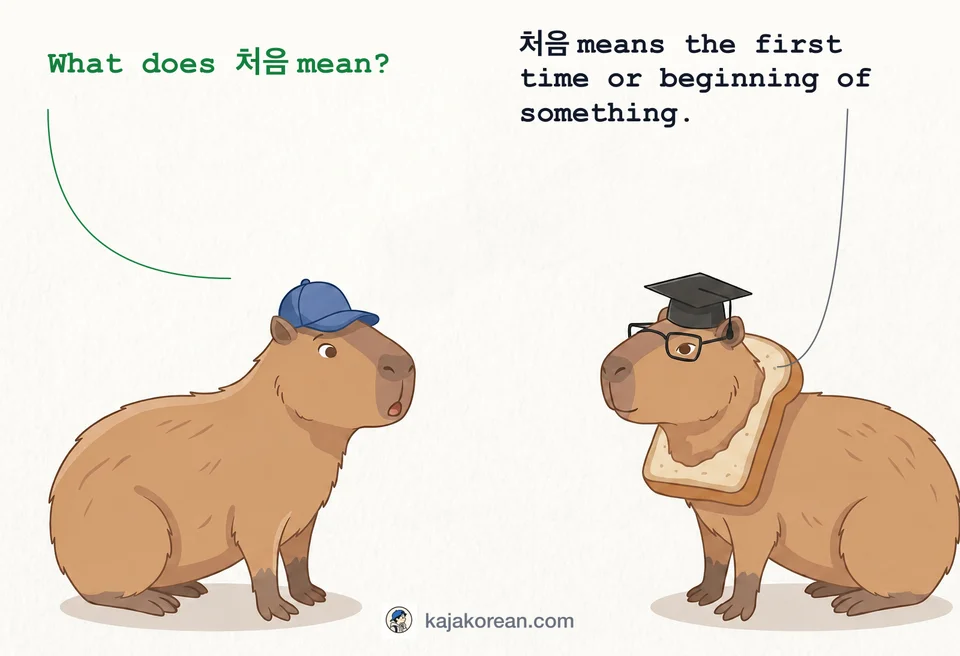
What does 처음 mean?

처음 (cheo-eum, cheoeum)

'처음' means the starting point or the very first time something happens. It is commonly used in both casual and formal contexts.

Meaning of the Korean word 처음

Definition & nuance

Core meaning and shades learners miss.

처음(cheo-eum, cheoeum)

'처음' means the starting point in time or the very first occurrence of something. It refers to the earliest point in a sequence or the first time an experience or action happens.

Nuances

  • Emphasizes the starting point in time
  • Indicates the first experience or occurrence
  • Refers to the initial stage of a process

When to use

Daily conversation, Workplace, School life

In context

‘처음’ functions as a noun meaning 'the first time' or 'beginning', and often as an adverb in phrases like ‘처음에’ (at first) or ‘처음부터’ (from the beginning). It is widely used in both everyday conversation and formal writing.

Real-world examples

  • 처음 만났을 때 정말 떨렸어요.

    cheo-eum man-nass-eul ttae jeong-mal tteol-ryeoss-eo-yo., cheo eum man nass eul ttae jeong mal tteol ryeoss eo yo.

    ‘처음’ correctly used to mean ‘the first time’.

  • 이 일은 처음부터 끝까지 신중해야 해요.

    i il-eun cheo-eum-bu-teo kkeut-kka-ji sin-jung-hae-ya hae-yo., i il eun cheo eum bu teo kkeut kka ji sin jung hae ya hae yo.

    ‘처음부터’ naturally used as an adverbial phrase meaning ‘from the beginning’.

  • 처음에 그 사람을 봤어요.

    cheo-eum-e geu sa-ram-eul bwass-eo-yo., cheo eum e geu sa ram eul bwass eo yo.

    ‘처음에’ properly used as an adverb meaning ‘at first’.

  • 처음으로 시험을 봤어요.

    cheo-eum-eu-ro si-heom-eul bwass-eo-yo., cheo eum eu ro si heom eul bwass eo yo.

    ‘처음으로’ emphasizes ‘처음’ by adding the particle ‘으로’.

  • 처음부터 끝까지 모두 이해했어요.

    cheo-eum-bu-teo kkeut-kka-ji mo-du i-hae-haess-eo-yo., cheo eum bu teo kkeut kka ji mo du i hae haess eo yo.

    ‘처음부터 끝까지’ clearly defines the time range starting at ‘처음’.

  • 처음에 도착했을 때 비가 왔어요.

    cheo-eum-e do-chak-haess-eul ttae bi-ga wass-eo-yo., cheo eum e do chak haess eul ttae bi ga wass eo yo.

    ‘처음에’ naturally used as a temporal adverb.

  • 처음으로 한국에 갔을 때 문화 충격을 받았어요.

    cheo-eum-eu-ro han-guk-e gass-eul ttae mun-hwa chung-gyeok-eul bat-ass-eo-yo., cheo eum eu ro han guk e gass eul ttae mun hwa chung gyeok eul bat ass eo yo.

    ‘처음으로’ correctly emphasizes ‘처음’.

  • 처음부터 그 계획은 잘못됐어요.

    cheo-eum-bu-teo geu gye-hoek-eun jal-mos-dwaess-eo-yo., cheo eum bu teo geu gye hoek eun jal mos dwaess eo yo.

    ‘처음부터’ accurately indicates the starting point.

Quick quiz

  1. What is the correct meaning of ‘처음’?

    ‘처음’의 의미로 옳은 것은?(‘cheo-eum’uiui-mi-rool-eungeos-eun?, ‘cheoeum’uiuimirooleungeoseun?)
  2. What role does ‘처음에’ play?

    ‘처음에’는 어떤 역할을 하나요?(‘cheo-eum-e’neuneo-tteonyeok-hal-eulha-na-yo?, ‘cheoeume’neuneotteonyeokhaleulhanayo?)
  3. Which sentence uses ‘처음’ correctly?

    다음 문장에서 ‘처음’이 올바르게 사용된 문장은?(da-eummun-jang-e-seo‘cheo-eum’iol-ba-reu-gesa-yong-doenmun-jang-eun?, daeummunjangeseo‘cheoeum’iolbareugesayongdoenmunjangeun?)

More meaning guides

View all meaning guides →