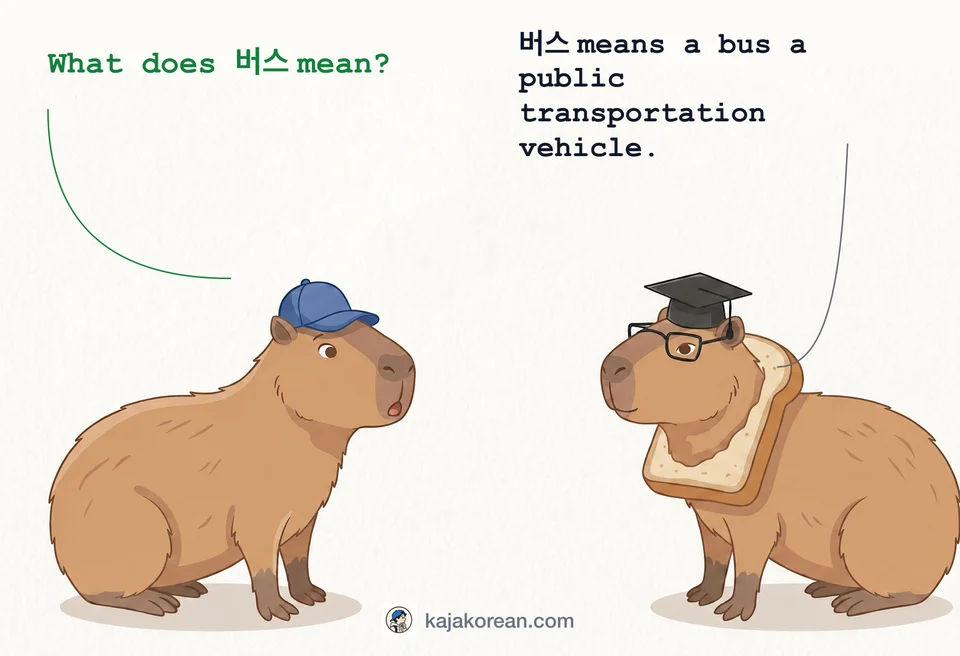
What does 버스 mean?

버스 (beo-seu, beoseu)

버스 (beoseu) means a bus, a common public transport in Korean, used daily and in travel.

Illustration of a bus

Definition & nuance

Core meaning and shades learners miss.

버스(beo-seu, beoseu)

버스 means a public transportation vehicle that carries people along fixed routes.

Nuances

  • Recognized as a typical public transport mode
  • Used in both urban and rural areas
  • Bus routes and schedules are important

When to use

daily conversation, travel, public transport info

In context

버스 is a noun used as subject, object, or part of adverbial phrases. It fits naturally in both casual and formal contexts.

Real-world examples

  • 버스를 타고 학교에 갑니다.

    beo-seu-reul ta-go hak-gyo-e gap-ni-da., beo seu reul ta go hak gyo e gap ni da.

    버스 is the subject and the sentence is natural.

  • 버스가 길을 달립니다.

    beo-seu-ga gil-eul dal-rip-ni-da., beo seu ga gil eul dal rip ni da.

    버스 is appropriately used as subject.

  • 나는 버스를 좋아해요.

    na-neun beo-seu-reul joh-a-hae-yo., na neun beo seu reul joh a hae yo.

    버스 is naturally used as object.

  • 버스에 사람이 많아요.

    beo-seu-e sa-ram-i man-a-yo., beo seu e sa ram i man a yo.

    버스 is part of a locative phrase.

  • 버스가 달려요.

    beo-seu-ga dal-ryeo-yo., beo seu ga dal ryeo yo.

    Short, clear sentence with 버스 as subject.

  • 버스를 먹어요.

    beo-seu-reul meok-eo-yo., beo seu reul meok eo yo.

    버스 cannot be eaten, so sentence is incorrect.

  • 버스에서 내립니다.

    beo-seu-e-seo nae-rip-ni-da., beo seu e seo nae rip ni da.

    버스 is combined with '에서' to indicate place.

Quick quiz

  1. What does 버스 mean?

    버스가 무슨 뜻인가요?(beo-seu-gamu-seuntteus-in-ga-yo?, beoseugamuseuntteusingayo?)
  2. Which sentence is correct?

    다음 중 올바른 문장은?(da-eumjungol-ba-reunmun-jang-eun?, daeumjungolbareunmunjangeun?)
  3. What is the role of '버스' in '버스에서 내립니다.'?

    '버스에서 내립니다.' 문장에서 '버스'의 역할은?('beo-seu-e-seonae-rip-ni-da.'mun-jang-e-seo'beo-seu'uiyeok-hal-eun?, 'beoseueseonaeripnida.'munjangeseo'beoseu'uiyeokhaleun?)

More meaning guides

View all meaning guides →