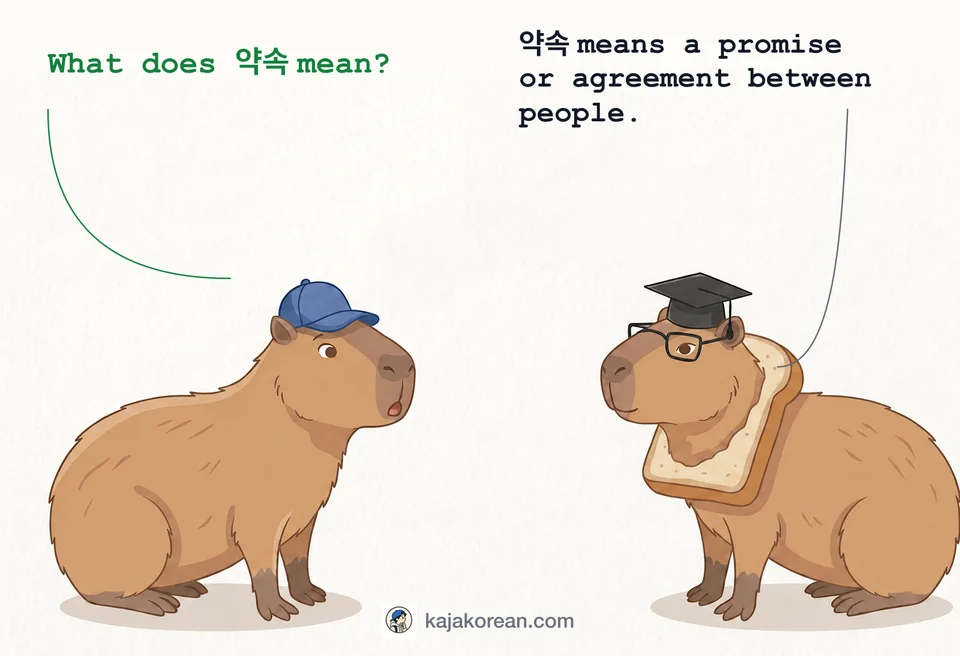
What does 약속 mean?

약속 (yak-sok, yaksok)

약속 (yaksok) is a key Korean word meaning a promise or agreement between people.

Korean word 약속 meaning promise

Definition & nuance

Core meaning and shades learners miss.

약속(yak-sok, yaksok)

약속 refers to an agreement or commitment between two or more people to do or meet in the future.

Nuances

  • Ranges from casual promises to formal agreements
  • Often involves setting time and place
  • Implies trust and responsibility
  • Breaking 약속 damages trust

When to use

meeting friends, business meeting, date, family event

In context

약속 is a noun commonly combined with the verb 하다 to form 약속하다, meaning 'to make a promise.' It is used in both casual and formal contexts.

Real-world examples

  • 내일 3시에 만나기로 약속했어요.

    nae-il 3si-e man-na-gi-ro yak-sok-haess-eo-yo., nae il 3si e man na gi ro yak sok haess eo yo.

    ‘약속하다’ naturally expresses a future plan with ‘만나기로.’

  • 그는 나에게 약속을 지켰다.

    geu-neun na-e-ge yak-sok-eul ji-kyeoss-da., geu neun na e ge yak sok eul ji kyeoss da.

    ‘약속을 지키다’ correctly means to fulfill a promise.

  • 약속을 어기면 안 돼요.

    yak-sok-eul eo-gi-myeon an dwae-yo., yak sok eul eo gi myeon an dwae yo.

    ‘약속을 어기다’ means breaking a promise correctly.

  • 나는 약속을 만들었어요.

    na-neun yak-sok-eul man-deul-eoss-eo-yo., na neun yak sok eul man deul eoss eo yo.

    ‘약속을 만들다’ is unnatural; use ‘약속하다’ instead.

  • 우리는 약속할 거예요.

    u-ri-neun yak-sok-hal geo-ye-yo., u ri neun yak sok hal geo ye yo.

    ‘약속하다’ usually requires specifics; standalone future tense is awkward.

  • 약속 시간에 늦지 마세요.

    yak-sok si-gan-e neuj-ji ma-se-yo., yak sok si gan e neuj ji ma se yo.

    ‘약속 시간’ naturally means the agreed meeting time.

Quick quiz

  1. What does ‘약속하다’ mean?

    ‘약속하다’의 뜻은?(‘yak-sok-ha-da’uitteus-eun?, ‘yaksokhada’uitteuseun?)
  2. What does ‘약속을 어기다’ mean?

    ‘약속을 어기다’는 무슨 뜻인가요?(‘yak-sok-euleo-gi-da’neunmu-seuntteus-in-ga-yo?, ‘yaksokeuleogida’neunmuseuntteusingayo?)
  3. Which sentence is correct?

    다음 중 올바른 문장은?(da-eumjungol-ba-reunmun-jang-eun?, daeumjungolbareunmunjangeun?)

More meaning guides

View all meaning guides →