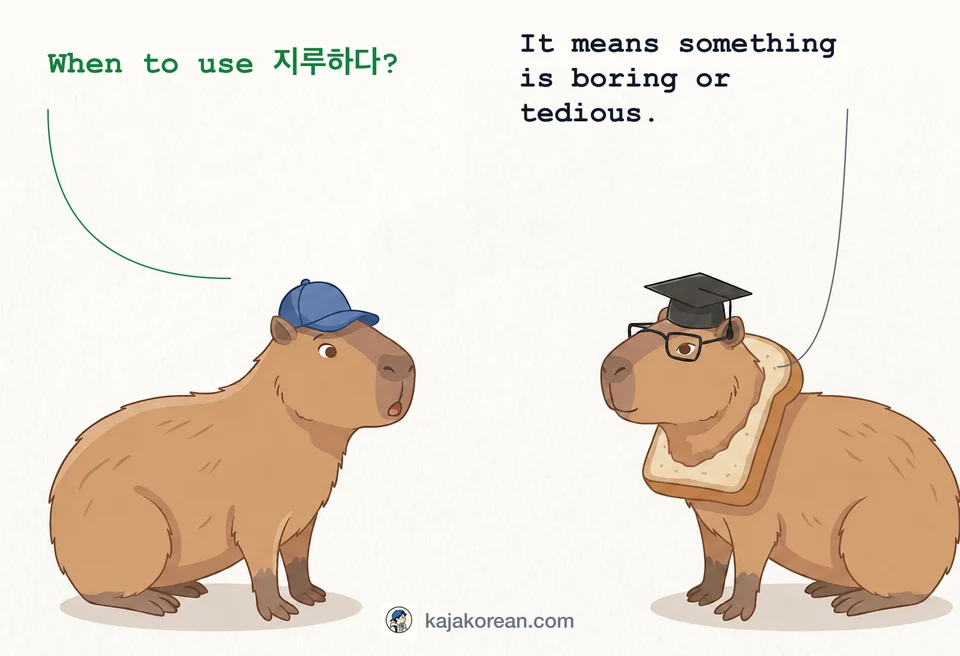
What does 지루하다 mean?

지루하다 (ji-ru-ha-da, jiruhada)

지루하다 (jiruhada) means 'boring or tedious' in Korean. It's commonly used in daily conversations and various situations.

Meaning of Korean word 지루하다

Definition & nuance

Core meaning and shades learners miss.

지루하다(ji-ru-ha-da, jiruhada)

‘지루하다’ is an adjective used when something feels boring or tedious, making time seem to pass slowly.

Nuances

  • Used not only for lack of fun but also when something is long or repetitive causing fatigue
  • Can describe people or places as boring
  • Emphasizes state rather than emotion, unlike ‘심심하다’

When to use

daily conversation, class, watching a movie, meeting

In context

‘지루하다’ is an adjective that describes a state, used with a subject to express that a situation or experience is boring or uninteresting. It conjugates like ‘지루해요’ (present) or ‘지루했어요’ (past).

Real-world examples

  • 수업이 너무 지루해서 졸렸어요.

    su-eop-i neo-mu ji-ru-hae-seo jol-ryeoss-eo-yo., su eop i neo mu ji ru hae seo jol ryeoss eo yo.

    ‘지루하다’ appropriately describes boring situations like a class.

  • 이 영화는 지루해요.

    i yeong-hwa-neun ji-ru-hae-yo., i yeong hwa neun ji ru hae yo.

    Use ‘지루하다’ to express a movie is uninteresting.

  • 나는 지루하다.

    na-neun ji-ru-ha-da., na neun ji ru ha da.

    ‘지루하다’ describes a state, so ‘나는 지루하다’ implies ‘I am boring someone,’ which is awkward. Use ‘나는 지루해요’ to say ‘I feel bored.’

  • 그 사람은 지루해요.

    geu sa-ram-eun ji-ru-hae-yo., geu sa ram eun ji ru hae yo.

    ‘지루하다’ can describe a person or thing as boring.

  • 회의가 지루했어요.

    hoe-ui-ga ji-ru-haess-eo-yo., hoe ui ga ji ru haess eo yo.

    Use ‘지루하다’ for boring situations like meetings.

Quick quiz

  1. What does ‘지루하다’ mean?

    ‘지루하다’의 뜻은 무엇인가요?(‘ji-ru-ha-da’uitteus-eunmu-eos-in-ga-yo?, ‘jiruhada’uitteuseunmueosingayo?)
  2. Which sentence is correct?

    다음 중 올바른 문장은?(da-eumjungol-ba-reunmun-jang-eun?, daeumjungolbareunmunjangeun?)
  3. Choose the closest meaning to ‘지루하다’.

    ‘지루하다’와 가장 가까운 뜻을 고르세요.(‘ji-ru-ha-da’waga-jangga-kka-untteus-eulgo-reu-se-yo., ‘jiruhada’wagajanggakkauntteuseulgoreuseyo.)

More meaning guides

View all meaning guides →