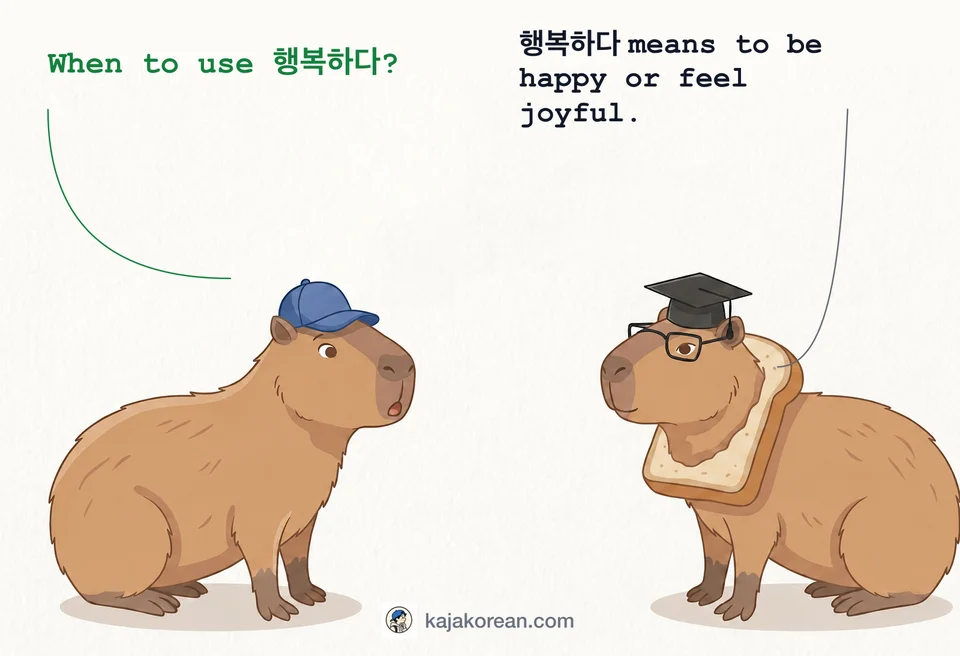
What does 행복하다 mean?

행복하다 (haeng-bok-ha-da, haengbokhada)

행복하다 (haengbokhada) is a basic adjective expressing feelings or states of happiness. It is used commonly in both everyday and formal contexts.

Korean word 행복하다 meaning happiness

Definition & nuance

Core meaning and shades learners miss.

행복하다(haeng-bok-ha-da, haengbokhada)

행복하다 means to be happy or to feel a state of joy and satisfaction.

Nuances

  • Emphasizes inner satisfaction and joy
  • Indicates a lasting state rather than a momentary feeling
  • Strongly subjective feeling

When to use

daily conversation, expressing emotions, formal speech

In context

행복하다 is an adjective describing the subject's state. It is typically used in the dictionary form '-다' and can combine with various grammatical endings like '-아/어/여서 행복하다' or '-게 행복하다'.

Real-world examples

  • 저는 지금 정말 행복해요.

    jeo-neun ji-geum jeong-mal haeng-bok-hae-yo., jeo neun ji geum jeong mal haeng bok hae yo.

    Correct sentence expressing the subject 'I' being happy currently.

  • 행복하다 느껴요.

    haeng-bok-ha-da neu-kkyeo-yo., haeng bok ha da neu kkyeo yo.

    Incorrect because '행복하다' as adjective needs a noun form before '느껴요'.

  • 그녀는 행복한 사람이다.

    geu-nyeo-neun haeng-bok-han sa-ram-i-da., geu nyeo neun haeng bok han sa ram i da.

    Correct use of the adjective's modifier form to describe a noun.

  • 행복하다가 오늘은 기분이 좋아요.

    haeng-bok-ha-da-ga o-neul-eun gi-bun-i joh-a-yo., haeng bok ha da ga o neul eun gi bun i joh a yo.

    '행복하다가' is not a natural grammatical form.

  • 행복하게 살고 싶어요.

    haeng-bok-ha-ge sal-go sip-eo-yo., haeng bok ha ge sal go sip eo yo.

    Correct adverbial form modifying the verb.

  • 행복하다면 저도 기쁠 거예요.

    haeng-bok-ha-da-myeon jeo-do gi-ppeul geo-ye-yo., haeng bok ha da myeon jeo do gi ppeul geo ye yo.

    Correct conditional form with clear meaning.

Quick quiz

  1. What does '행복하다' mean?

    '행복하다'의 뜻은 무엇인가요?('haeng-bok-ha-da'uitteus-eunmu-eos-in-ga-yo?, 'haengbokhada'uitteuseunmueosingayo?)
  2. Which sentence is correct?

    다음 중 올바른 문장은?(da-eumjungol-ba-reunmun-jang-eun?, daeumjungolbareunmunjangeun?)

More meaning guides

View all meaning guides →