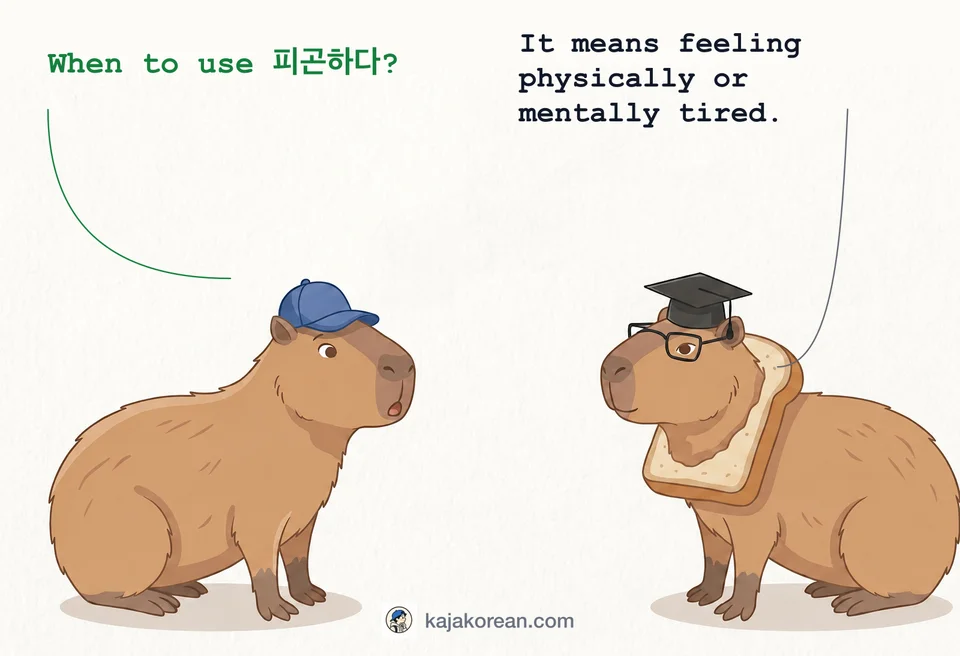
What does 피곤하다 mean?

피곤하다 (pi-gon-ha-da, pigonhada)

피곤하다 (pigonhada) is a common Korean adjective meaning to feel tired or exhausted, physically or mentally.

Person looking tired and exhausted

Definition & nuance

Core meaning and shades learners miss.

피곤하다(pi-gon-ha-da, pigonhada)

피곤하다 means feeling physically or mentally tired and lacking energy.

Nuances

  • Includes both physical and mental tiredness.
  • Expresses a subjective feeling of exhaustion.
  • Different from ‘졸리다’ (sleepy); 피곤하다 is about tiredness, not sleepiness.

When to use

daily conversation, work life, health condition

In context

피곤하다 is mainly used as an adjective describing the subject's tired state. It often appears with cause connectors like ‘~아서/어서 피곤하다’ or ‘피곤해서’ to explain reasons. It is very common in everyday conversation.

Real-world examples

  • 오늘 너무 많이 걸어서 정말 피곤해요.

    o-neul neo-mu man-i geol-eo-seo jeong-mal pi-gon-hae-yo., o neul neo mu man i geol eo seo jeong mal pi gon hae yo.

    ‘피곤하다’ correctly describes the subject's tired state here.

  • 저는 피곤하다 공부했어요.

    jeo-neun pi-gon-ha-da gong-bu-haess-eo-yo., jeo neun pi gon ha da gong bu haess eo yo.

    ‘피곤하다’ is an adjective and cannot directly modify verbs without proper form.

  • 피곤해서 일찍 잤어요.

    pi-gon-hae-seo il-jjik jass-eo-yo., pi gon hae seo il jjik jass eo yo.

    ‘피곤해서’ correctly connects cause and result.

  • 그는 피곤하다 보인다.

    geu-neun pi-gon-ha-da bo-in-da., geu neun pi gon ha da bo in da.

    ‘피곤하다 보인다’ is grammatically incorrect; needs ‘-해’ form.

  • 어제 늦게 자서 피곤해요.

    eo-je neuj-ge ja-seo pi-gon-hae-yo., eo je neuj ge ja seo pi gon hae yo.

    ‘피곤해요’ properly describes the subject's tiredness.

Quick quiz

  1. What does ‘피곤하다’ mean?

    ‘피곤하다’의 뜻은 무엇인가요?(‘pi-gon-ha-da’uitteus-eunmu-eos-in-ga-yo?, ‘pigonhada’uitteuseunmueosingayo?)
  2. Which sentence is correct?

    다음 중 올바른 문장은?(da-eumjungol-ba-reunmun-jang-eun?, daeumjungolbareunmunjangeun?)
  3. Which word is closest in meaning to ‘피곤하다’?

    ‘피곤하다’와 가장 가까운 단어는?(‘pi-gon-ha-da’waga-jangga-kka-undan-eo-neun?, ‘pigonhada’wagajanggakkaundaneoneun?)

More meaning guides

View all meaning guides →