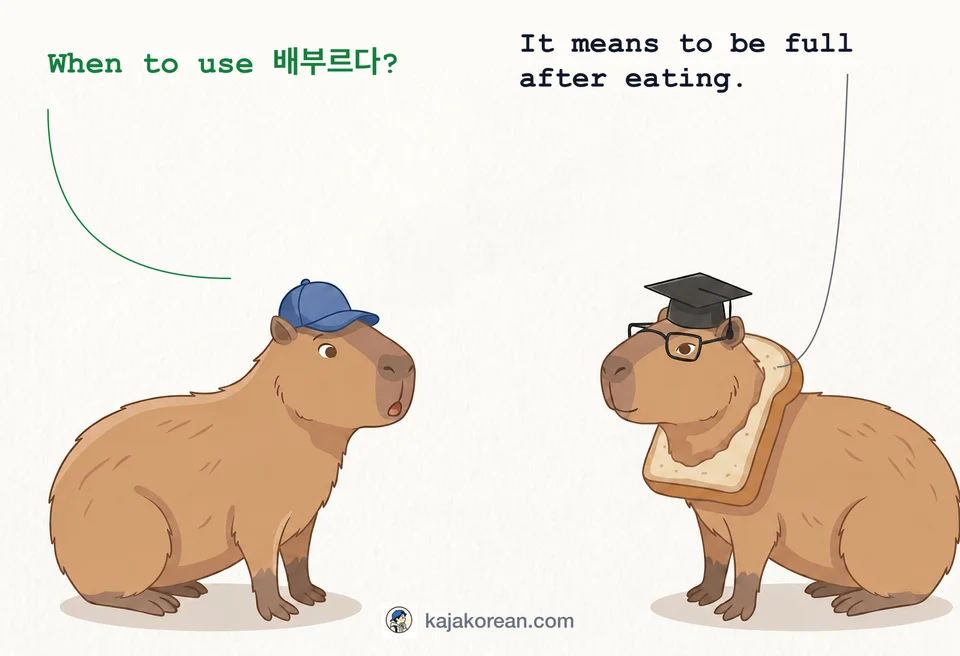
What does 배부르다 mean?

배부르다 (bae-bu-reu-da, baebureuda)

배부르다 (baebureuda) means 'to be full after eating' in Korean, commonly used in everyday conversation.

Illustration of a person feeling full after eating

Definition & nuance

Core meaning and shades learners miss.

배부르다(bae-bu-reu-da, baebureuda)

‘배부르다’ is an adjective meaning to be full after eating enough food.

Nuances

  • Implies not just fullness but also satisfaction or satiety.
  • Can be used metaphorically beyond just food (e.g., 마음이 배부르다).
  • Basic and intuitive antonym of ‘배고프다’ (hungry).

When to use

daily conversation, after meals, expressing physical state

In context

‘배부르다’ is an adjective describing the subject’s state, often used as ‘배가 부르다.’ It naturally appears in affirmative, interrogative, and negative sentences and fits both formal and informal contexts.

Real-world examples

  • 점심을 많이 먹어서 배가 부르다.

    jeom-sim-eul man-i meok-eo-seo bae-ga bu-reu-da., jeom sim eul man i meok eo seo bae ga bu reu da.

    ‘배가 부르다’ naturally describes the subject’s state of fullness.

  • 나는 배부르다.

    na-neun bae-bu-reu-da., na neun bae bu reu da.

    ‘배부르다’ is naturally used with ‘I’ as the subject.

  • 배부르지 않아요?

    bae-bu-reu-ji an-a-yo?, bae bu reu ji an a yo?

    Negative question form is natural and common.

  • 배부를 거예요.

    bae-bu-reul geo-ye-yo., bae bu reul geo ye yo.

    Future tense usage is natural.

  • 배부르다 싶다.

    bae-bu-reu-da sip-da., bae bu reu da sip da.

    Attaching ‘싶다’ after ‘배부르다’ is grammatically incorrect.

  • 배부르다 먹었어요.

    bae-bu-reu-da meok-eoss-eo-yo., bae bu reu da meok eoss eo yo.

    ‘배부르다’ is not a verb and cannot precede ‘먹었어요’.

  • 배부르니까 더 이상 안 먹을래요.

    bae-bu-reu-ni-kka deo i-sang an meok-eul-rae-yo., bae bu reu ni kka deo i sang an meok eul rae yo.

    ‘배부르니까’ naturally expresses reason.

Quick quiz

  1. What does ‘배부르다’ mean?

    ‘배부르다’의 뜻은 무엇인가요?(‘bae-bu-reu-da’uitteus-eunmu-eos-in-ga-yo?, ‘baebureuda’uitteuseunmueosingayo?)
  2. Which sentence is correct?

    다음 중 올바른 문장은?(da-eumjungol-ba-reunmun-jang-eun?, daeumjungolbareunmunjangeun?)
  3. How do you use ‘배부르다’ in future tense?

    ‘배부르다’를 미래 시제로 쓰려면?(‘bae-bu-reu-da’reulmi-raesi-je-rosseu-ryeo-myeon?, ‘baebureuda’reulmiraesijerosseuryeomyeon?)

More meaning guides

View all meaning guides →