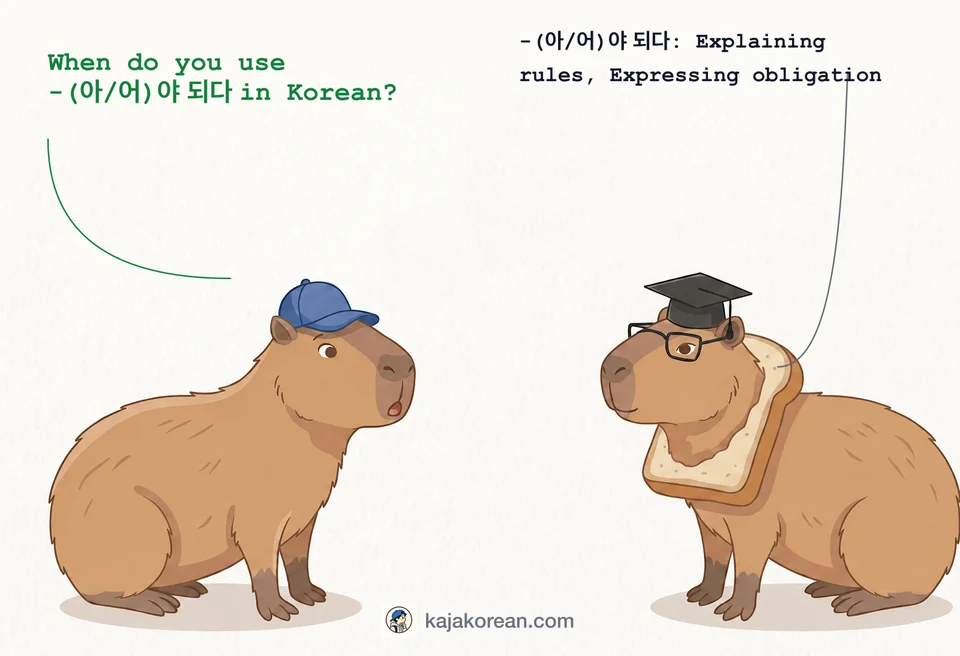
How to use 아야 되다/어야 되다 in Korean

Pattern: -(아/어)야 되다

-(아/어)야 되다 (-(a, (a, eo)yadoe-da, eo)yadoeda)

-(아/어)야 되다 expresses obligation or necessity like 'must' or 'have to' in English.

Korean grammar pattern -(아/어)야 되다 usage

Usage guide

When and how native speakers actually use it.

-(아/어)야 되다(-(a, (a, eo)yadoe-da, eo)yadoeda)

Indicates that an action or state is necessary or obligatory.

When to use

Expressing obligation, Talking about necessity, Explaining rules

The nuance

Attach -(아/어)야 되다 to the verb stem. Use 아야 if the last vowel of the stem is ㅏ or ㅗ; otherwise, use 어야. 되다 remains unchanged. Example: 가다 → 가야 되다, 먹다 → 먹어야 되다.

Real-world examples

  • 내일까지 숙제를 해야 돼.

    nae-il-kka-ji suk-je-reul hae-ya dwae., nae il kka ji suk je reul hae ya dwae.

    ‘해야 돼’ clearly expresses obligation, so it's natural.

  • 여기서 담배 피워야 돼요.

    yeo-gi-seo dam-bae pi-wo-ya dwae-yo., yeo gi seo dam bae pi wo ya dwae yo.

    ‘담배 피워야 돼요’ expresses obligation, but here smoking is prohibited, so it's inappropriate.

  • 약을 꼭 먹어야 돼요.

    yak-eul kkok meok-eo-ya dwae-yo., yak eul kkok meok eo ya dwae yo.

    ‘먹어야 돼요’ naturally expresses a health-related obligation.

  • 이 서류를 제출해야 돼.

    i seo-ryu-reul je-chul-hae-ya dwae., i seo ryu reul je chul hae ya dwae.

    ‘제출해야 돼’ appropriately indicates official obligation.

  • 내일 일찍 일어나야 돼요.

    nae-il il-jjik il-eo-na-ya dwae-yo., nae il il jjik il eo na ya dwae yo.

    ‘일어나야 돼요’ naturally expresses personal obligation.

  • 여기서 사진 찍어야 돼.

    yeo-gi-seo sa-jin jjik-eo-ya dwae., yeo gi seo sa jin jjik eo ya dwae.

    ‘사진 찍어야 돼’ implies obligation, but usually photos are allowed or forbidden, so it's unnatural.

Quick quiz

  1. What does -(아/어)야 되다 mean?

    -(아/어)야 되다의 의미는 무엇인가요?(-(a, (a, eo)yadoe-da-uiui-mi-neunmu-eos-in-ga-yo?, eo)yadoedauiuimineunmueosingayo?)
  2. How do you attach -(아/어)야 되다 to ‘먹다’?

    ‘먹다’에 -(아/어)야 되다를 붙이면?(‘meok-da’e-(a, ‘meokda’e(a, eo)yadoe-da-reulbut-i-myeon?, eo)yadoedareulbutimyeon?)
  3. Which sentence is correct?

    다음 중 올바른 문장은?(da-eumjungol-ba-reunmun-jang-eun?, daeumjungolbareunmunjangeun?)

More usage guides

View all usage guides →