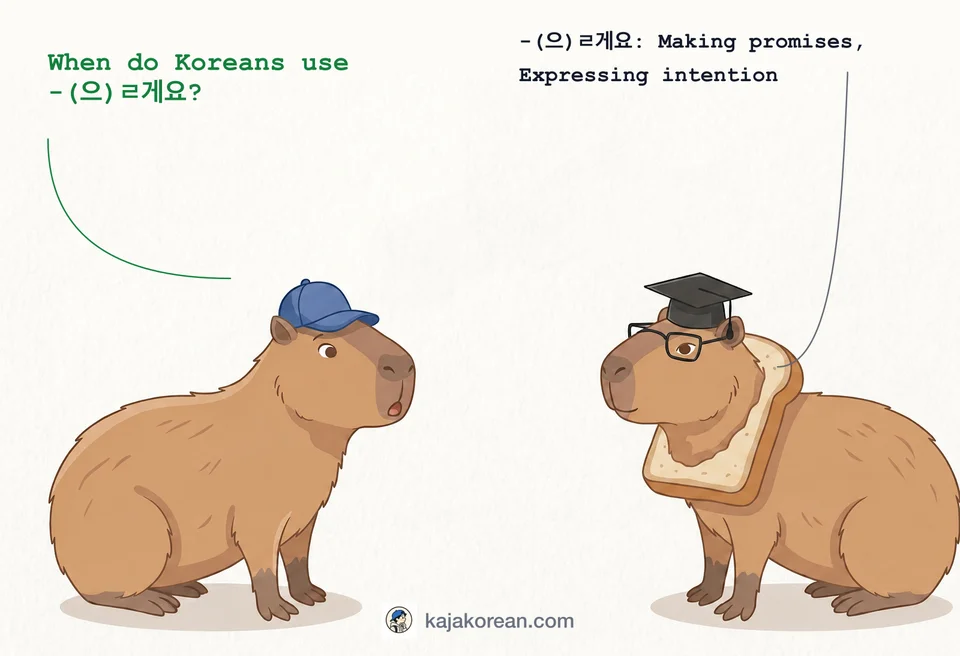
How to use 을/ㄹ게요 in Korean

Pattern: -(으)ㄹ게요

-(으)ㄹ게요 (-(eu)ㄹge-yo, (eu)ㄹgeyo)

-(으)ㄹ게요 is a sentence ending used by the speaker to express intention or promise.

Korean sentence ending -(으)ㄹ게요 usage

Usage guide

When and how native speakers actually use it.

-(으)ㄹ게요(-(eu)ㄹge-yo, (eu)ㄹgeyo)

A sentence ending that expresses the speaker's intention, promise, or commitment.

When to use

Making promises, Expressing intention, Responding to someone's request

The nuance

Attach '-을게요' after verb stems ending with a consonant, and '-ㄹ게요' after stems ending with a vowel. It is mainly used in conversations where the speaker expresses their intention or commitment, often as a response to the listener's situation or request.

Real-world examples

  • 내일 일찍 올게요.

    nae-il il-jjik ol-ge-yo., nae il il jjik ol ge yo.

    Verb stem '오' ends with a vowel, so '-ㄹ게요' is attached to form '올게요'.

  • 밥 먹을게요.

    bap meok-eul-ge-yo., bap meok eul ge yo.

    Verb stem '먹' ends with a consonant, so '-을게요' is attached to form '먹을게요'.

  • 내가 할게요.

    nae-ga hal-ge-yo., nae ga hal ge yo.

    Verb stem '하' ends with a vowel, so '-ㄹ게요' is attached to form '할게요'.

  • 내일 전화할게요.

    nae-il jeon-hwa-hal-ge-yo., nae il jeon hwa hal ge yo.

    Verb stem '전화하' ends with a vowel, so '-ㄹ게요' is attached.

  • 내가 갈게요.

    nae-ga gal-ge-yo., nae ga gal ge yo.

    Verb stem '가' ends with a vowel, so '-ㄹ게요' is attached.

  • 내가 할게요요.

    nae-ga hal-ge-yo-yo., nae ga hal ge yo yo.

    The ending '-요' is duplicated, making it grammatically incorrect.

  • 밥 먹을게.

    bap meok-eul-ge., bap meok eul ge.

    The polite ending '-요' is missing, so it's not polite speech.

  • 내가 할게.

    nae-ga hal-ge., nae ga hal ge.

    Polite ending '-요' is missing, so it's casual speech.

Quick quiz

  1. Which sentence correctly uses -(으)ㄹ게요?

    다음 중 -(으)ㄹ게요를 올바르게 사용한 문장은?(da-eumjung-(eu)ㄹge-yo-reulol-ba-reu-gesa-yong-hanmun-jang-eun?, daeumjung(eu)ㄹgeyoreulolbareugesayonghanmunjangeun?)
  2. What is the correct usage of -(으)ㄹ게요?

    -(으)ㄹ게요의 용법으로 알맞은 것은?(-(eu)ㄹge-yo-uiyong-beop-eu-roal-maj-eungeos-eun?, (eu)ㄹgeyouiyongbeopeuroalmajeungeoseun?)
  3. Which sentence is incorrect?

    다음 문장 중 틀린 것은?(da-eummun-jangjungteul-ringeos-eun?, daeummunjangjungteulringeoseun?)

More usage guides

View all usage guides →