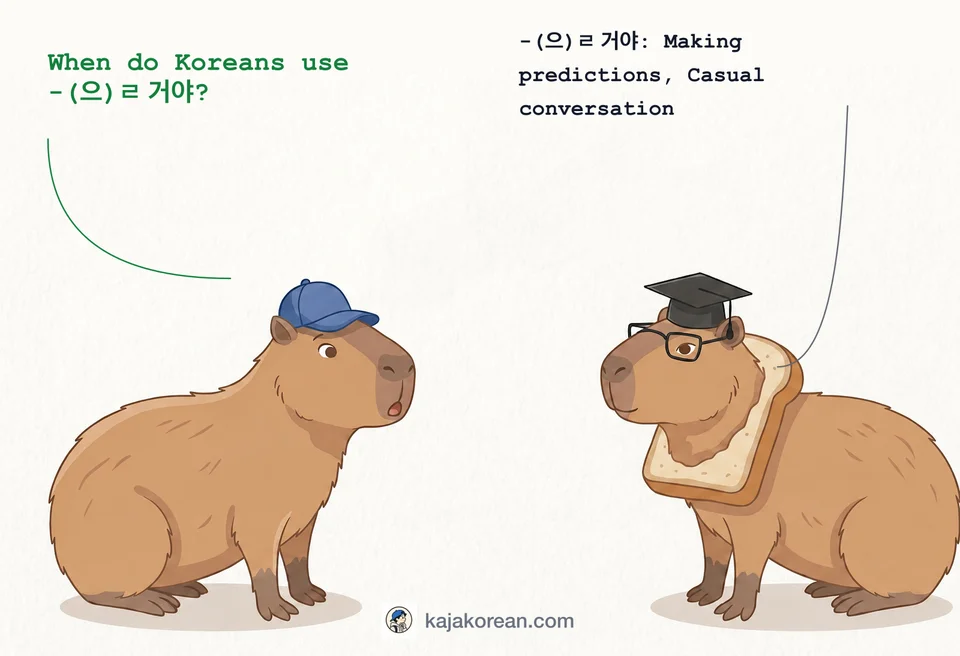
How to use 을/ㄹ 거야 in Korean

Pattern: -(으)ㄹ 거야

-(으)ㄹ 거야 (-(eu)ㄹgeo-ya, (eu)ㄹgeoya)

-(으)ㄹ 거야 expresses future intentions or plans, commonly used in everyday Korean.

Korean future tense grammar -(으)ㄹ 거야

Usage guide

When and how native speakers actually use it.

-(으)ㄹ 거야(-(eu)ㄹgeo-ya, (eu)ㄹgeoya)

An expression indicating future actions or intentions

When to use

Talking about future plans, Making predictions, Casual conversation

The nuance

Attach '-(으)ㄹ 거야' to the verb stem to express future actions. Use '-을 거야' if the stem ends with a consonant, '-ㄹ 거야' if it ends with a vowel. It is mainly used in spoken Korean to indicate confident future plans or intentions.

Real-world examples

  • 내일 친구를 만날 거야.

    nae-il chin-gu-reul man-nal geo-ya., nae il chin gu reul man nal geo ya.

    Verb stem '만나' ends with vowel, so '-ㄹ 거야' is correct to express future.

  • 나는 밥을 먹을 거야.

    na-neun bap-eul meok-eul geo-ya., na neun bap eul meok eul geo ya.

    Verb stem '먹' ends with consonant, so '-을 거야' is correct.

  • 내일 공부할 거야.

    nae-il gong-bu-hal geo-ya., nae il gong bu hal geo ya.

    Verb stem '공부하' ends with vowel, so '-ㄹ 거야' is correct.

  • 나는 갈 거야.

    na-neun gal geo-ya., na neun gal geo ya.

    Verb stem '가' ends with vowel, so '-ㄹ 거야' is correct.

  • 나는 할 거야.

    na-neun hal geo-ya., na neun hal geo ya.

    Verb stem '하' ends with vowel, so '-ㄹ 거야' is correct.

  • 나는 먹ㄹ 거야.

    na-neun meokㄹ geo-ya., na neun meokㄹ geo ya.

    Incorrect form; after consonant-ending stem '먹', use '-을 거야' not '-ㄹ 거야'.

  • 내일 친구를 만날 거야요.

    nae-il chin-gu-reul man-nal geo-ya-yo., nae il chin gu reul man nal geo ya yo.

    '-거야' is informal ending; adding '요' creates awkward form.

Quick quiz

  1. Which sentence is correct?

    다음 중 올바른 문장은?(da-eumjungol-ba-reunmun-jang-eun?, daeumjungolbareunmunjangeun?)
  2. In which situation is '-(으)ㄹ 거야' mainly used?

    '-(으)ㄹ 거야'는 주로 어떤 상황에서 쓰이나요?('-(eu)ㄹgeo-ya'neunju-roeo-tteonsang-hwang-e-seosseu-i-na-yo?, '(eu)ㄹgeoya'neunjuroeotteonsanghwangeseosseuinayo?)

More usage guides

View all usage guides →