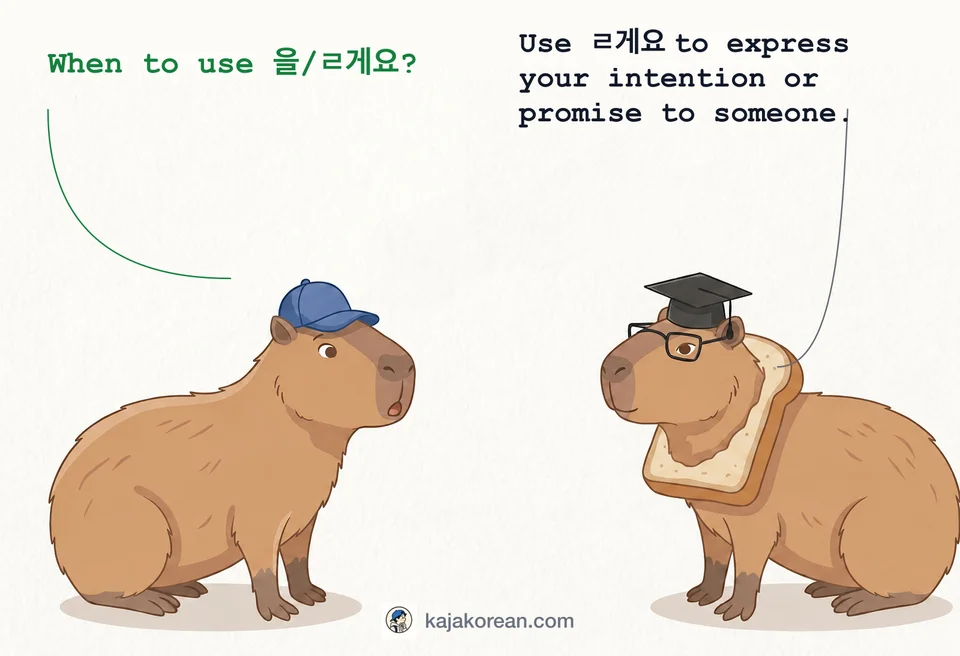
How to use 을/ㄹ게요 in Korean

Pattern: -(으)ㄹ게요

-(으)ㄹ게요 (-(eu)ㄹge-yo, (eu)ㄹgeyo)

-(으)ㄹ게요 is a sentence ending used to express the speaker's intention or promise, often in conversations.

Korean ㄹ게요 usage explanation

Usage guide

When and how native speakers actually use it.

-(으)ㄹ게요(-(eu)ㄹge-yo, (eu)ㄹgeyo)

A sentence ending expressing the speaker's intention or promise

When to use

Making promises, Expressing determination, Showing intention to listener

The nuance

Attach -(으)ㄹ게요 to the verb stem; use '-을게요' if the stem ends with a consonant, '-ㄹ게요' if it ends with a vowel. It expresses the speaker's intention or promise to the listener. Example: 가다 → 갈게요, 먹다 → 먹을게요.

Real-world examples

  • 내일 일찍 올게요.

    nae-il il-jjik ol-ge-yo., nae il il jjik ol ge yo.

    The speaker expresses intention to come early tomorrow.

  • 이거 내가 할게요.

    i-geo nae-ga hal-ge-yo., i geo nae ga hal ge yo.

    The speaker shows determination to do it themselves.

  • 저녁은 내가 살게요.

    jeo-nyeok-eun nae-ga sal-ge-yo., jeo nyeok eun nae ga sal ge yo.

    The speaker promises to pay for dinner to the listener.

  • 내가 할 거예요.

    nae-ga hal geo-ye-yo., nae ga hal geo ye yo.

    -(으)ㄹ 거예요 is simple future, not expressing intention or promise to listener.

  • 내가 할게.

    nae-ga hal-ge., nae ga hal ge.

    Ending '-게' alone is incorrect; correct form is '-ㄹ게요'.

Quick quiz

  1. Which sentence correctly uses '-(으)ㄹ게요'?

    다음 중 '-(으)ㄹ게요'를 올바르게 사용한 문장은?(da-eumjung'-(eu)ㄹge-yo'reulol-ba-reu-gesa-yong-hanmun-jang-eun?, daeumjung'(eu)ㄹgeyo'reulolbareugesayonghanmunjangeun?)
  2. When is it appropriate to use '-ㄹ게요'?

    '-ㄹ게요'를 사용할 때 올바른 상황은?('-ㄹge-yo'reulsa-yong-halttaeol-ba-reunsang-hwang-eun?, 'ㄹgeyo'reulsayonghalttaeolbareunsanghwangeun?)

More usage guides

View all usage guides →