How to use 으려/려고 해요 in Korean

Pattern: -(으)려고 해요

-(으)려고 해요 (-(eu)ryeo-gohae-yo, (eu)ryeogohaeyo)

-(으)려고 해요 expresses intention to do something in the near future. Essential for talking about plans naturally.

Korean grammar -(으)려고 해요 usage guide

Usage guide

When and how native speakers actually use it.

-(으)려고 해요(-(eu)ryeo-gohae-yo, (eu)ryeogohaeyo)

-(으)려고 해요 is the polite form of ‘~하려고 하다’, expressing intention or plan to do something in the future.

When to use

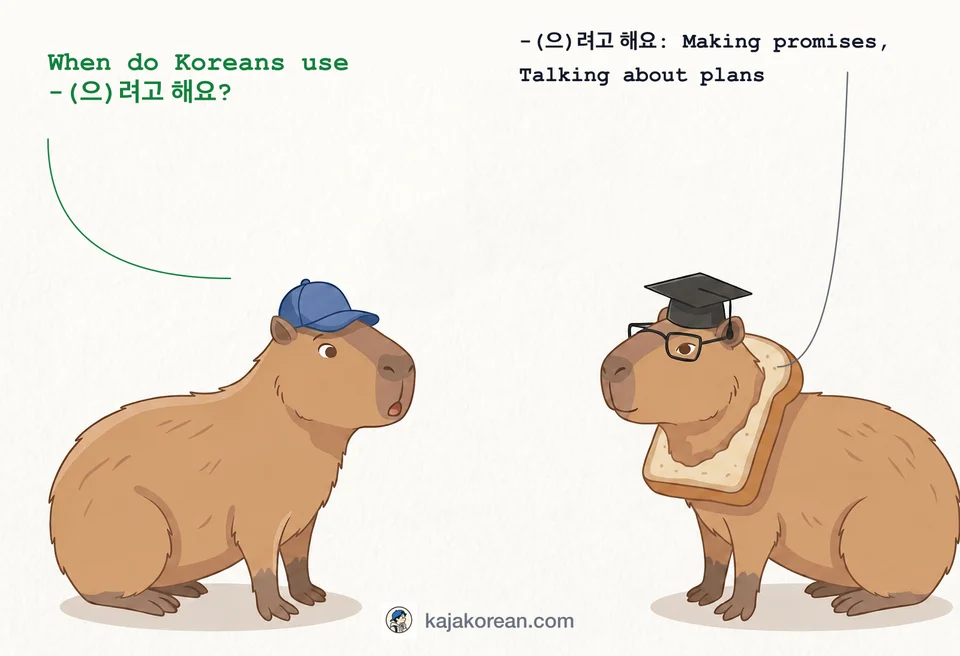
Talking about plans, Expressing intention, Making promises

The nuance

Attach ‘-으려고 해요’ if verb stem ends with a consonant, ‘-려고 해요’ if it ends with a vowel. Used to express future intention or plan.

Real-world examples

  • 내일 영화를 보려고 해요.

    nae-il yeong-hwa-reul bo-ryeo-go hae-yo., nae il yeong hwa reul bo ryeo go hae yo.

    ‘보다’ has no final consonant, so ‘-려고 해요’ is correct.

  • 한국어를 배우려고 해요.

    han-guk-eo-reul bae-u-ryeo-go hae-yo., han guk eo reul bae u ryeo go hae yo.

    ‘배우다’ ends without consonant, so ‘-려고 해요’ is appropriate.

  • 책을 읽으려고 해요.

    chaek-eul ik-eu-ryeo-go hae-yo., chaek eul ik eu ryeo go hae yo.

    ‘읽다’ has a final consonant ‘ㄱ’, so ‘-으려고 해요’ is correct.

  • 밥을 먹으려고 해요.

    bap-eul meok-eu-ryeo-go hae-yo., bap eul meok eu ryeo go hae yo.

    ‘먹다’ ends with consonant ‘ㄱ’, so ‘-으려고 해요’ is used.

  • 운동하려고 해요.

    un-dong-ha-ryeo-go hae-yo., un dong ha ryeo go hae yo.

    ‘운동하다’ is a ‘하다’ verb, so ‘-하려고 해요’ is correct, not ‘-려고 해요’.

  • 공부하려고 해요.

    gong-bu-ha-ryeo-go hae-yo., gong bu ha ryeo go hae yo.

    ‘하다’ verbs use ‘-하려고 해요’.

Quick quiz

  1. Which form fits the verb ‘먹다’?

    ‘먹다’ 동사에 맞는 형태는?(‘meok-da’dong-sa-emaj-neunhyeong-tae-neun?, ‘meokda’dongsaemajneunhyeongtaeneun?)
  2. What is the correct form for ‘가다’?

    ‘가다’에 붙이는 올바른 형태는?(‘ga-da’ebut-i-neunol-ba-reunhyeong-tae-neun?, ‘gada’ebutineunolbareunhyeongtaeneun?)
  3. What is the correct expression for ‘운동하다’?

    ‘운동하다’에 올바른 표현은?(‘un-dong-ha-da’eol-ba-reunpyo-hyeon-eun?, ‘undonghada’eolbareunpyohyeoneun?)

More usage guides

View all usage guides →