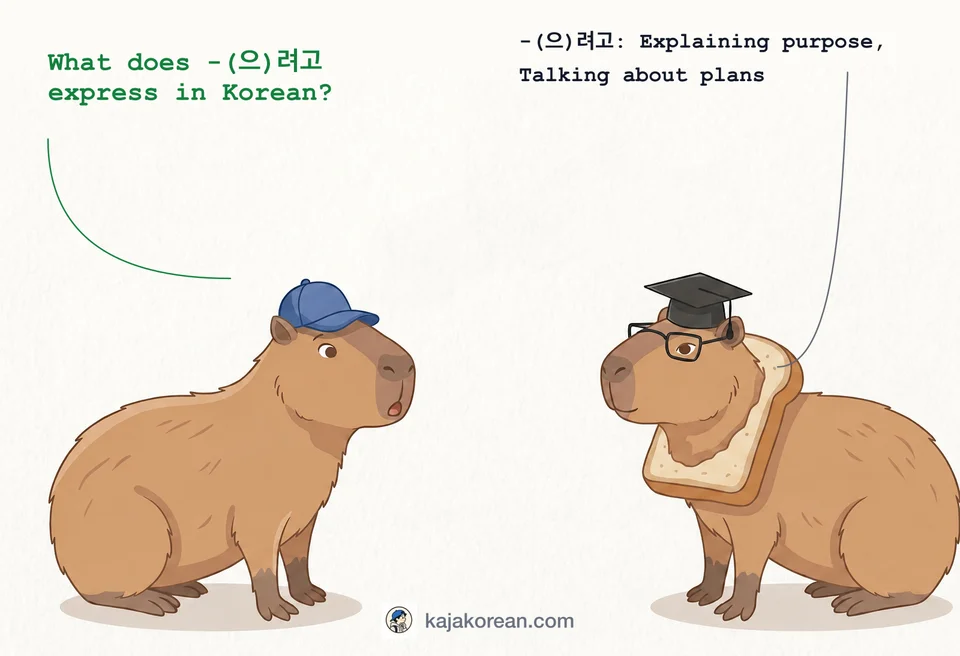
How to use 으려/려고 in Korean

Pattern: -(으)려고

-(으)려고 (-(eu)ryeo-go, (eu)ryeogo)

-(으)려고 expresses intention or purpose when planning to do something. Essential for stating goals.

Korean grammar -(으)려고 usage explanation

Usage guide

When and how native speakers actually use it.

-(으)려고(-(eu)ryeo-go, (eu)ryeogo)

A verb ending expressing intention or purpose to do an action

When to use

Talking about plans, Explaining purpose, Expressing intention

The nuance

Attach '-으려고' to verb stems ending with a consonant, '-려고' if vowel. It expresses intention or purpose for a future action. The following clause usually explains the purpose of the action.

Real-world examples

  • 저는 한국어를 배우려고 학원에 다녀요.

    jeo-neun han-guk-eo-reul bae-u-ryeo-go hak-won-e da-nyeo-yo., jeo neun han guk eo reul bae u ryeo go hak won e da nyeo yo.

    '배우려고' correctly attaches '-려고' to '배우다' to express intention.

  • 내일 친구를 만나려고 영화를 봤어요.

    nae-il chin-gu-reul man-na-ryeo-go yeong-hwa-reul bwass-eo-yo., nae il chin gu reul man na ryeo go yeong hwa reul bwass eo yo.

    Using '-려고' for past actions requires the action to be intended for the purpose; here, watching a movie doesn't logically serve meeting a friend.

  • 운동을 하려고 공원에 갔어요.

    un-dong-eul ha-ryeo-go gong-won-e gass-eo-yo., un dong eul ha ryeo go gong won e gass eo yo.

    '하려고' attaches to verb stem '하' to clearly show purpose.

  • 밥을 먹으려고 일찍 왔어요.

    bap-eul meok-eu-ryeo-go il-jjik wass-eo-yo., bap eul meok eu ryeo go il jjik wass eo yo.

    '먹으려고' correctly uses '-려고' after verb stem without final consonant.

  • 공부하려고 도서관에 가요.

    gong-bu-ha-ryeo-go do-seo-gwan-e ga-yo., gong bu ha ryeo go do seo gwan e ga yo.

    '하려고' attaches to '하다' stem to express intention.

  • 영화를 보려고 친구를 만났어요.

    yeong-hwa-reul bo-ryeo-go chin-gu-reul man-nass-eo-yo., yeong hwa reul bo ryeo go chin gu reul man nass eo yo.

    The purpose of meeting a friend is not logically to watch a movie, so '-려고' usage is incorrect here.

Quick quiz

  1. What does -(으)려고 mean?

    -(으)려고는 어떤 뜻인가요?(-(eu)ryeo-go-neuneo-tteontteus-in-ga-yo?, (eu)ryeogoneuneotteontteusingayo?)
  2. Which sentence is correct?

    다음 문장 중 옳은 문장은?(da-eummun-jangjungol-eunmun-jang-eun?, daeummunjangjungoleunmunjangeun?)
  3. Which sentence is incorrect?

    다음 중 틀린 문장은?(da-eumjungteul-rinmun-jang-eun?, daeumjungteulrinmunjangeun?)

More usage guides

View all usage guides →